
Free Testosterone vs. Total Testosterone: What the Difference Actually Means (And Which One Your Doctor Should Be Checking)
 By Trevor Jaxon
Introduction
You finally got your testosterone levels checked. The results come back, and your doctor says, “Your testosterone looks fine.” But something still feels off — low energy, reduced drive, brain fog, and a body that just doesn’t respond the way it used to. So what gives?
Here is the problem most men never hear about: there are two different testosterone measurements, and your doctor may only be looking at one of them. Total testosterone tells part of the story. Free testosterone tells the rest. And in many cases, it’s the part your doctor missed.
Understanding the difference between free vs total testosterone is not just a matter of medical trivia — it can be the key to finally getting answers about your health, your hormones, and how you actually feel. In this guide, we break down exactly what each measurement means, why both matter, what normal ranges look like, and what steps you should take if something doesn’t add up.
What Is Total Testosterone? A Complete Breakdown
Total testosterone is the most commonly tested form of testosterone. When a standard blood panel is ordered and your doctor asks to “check your testosterone,” this is almost always what they are measuring.
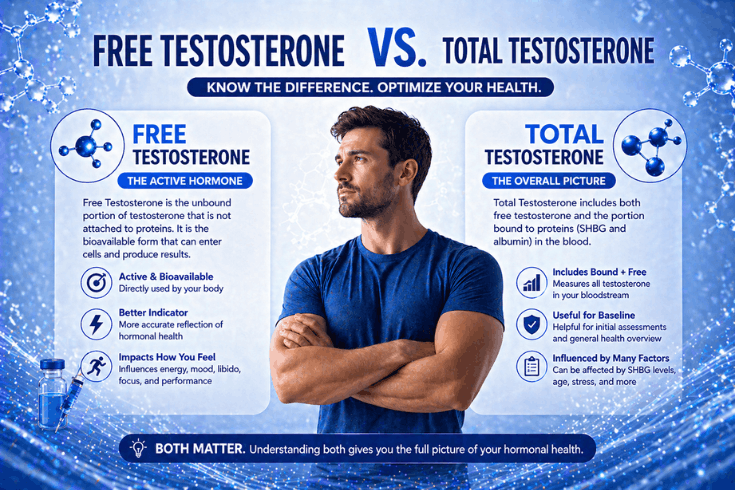
Total testosterone represents the entire amount of testosterone circulating in your bloodstream — regardless of whether that testosterone is actively doing anything or not. This number includes testosterone that is bound to proteins (meaning it is locked up and unavailable to your cells), as well as testosterone that is free and biologically active.
The majority of testosterone in your body roughly 97 to 99 percent — is bound to one of two proteins:
- Sex Hormone-Binding Globulin (SHBG): This is the primary binding protein for testosterone. When testosterone is attached to SHBG, it is tightly bound and essentially inactive. Your cells cannot use it. It is just carried through the bloodstream in a locked state.
- Albumin: This is a more loosely bound form. Testosterone attached to albumin can theoretically become available to tissues, though the degree to which this happens is debated in the literature.
What this means in practice is that your total testosterone number can look completely normal — even optimal while your body is actually functioning with far less usable hormone than the number suggests. A man with a total testosterone of 600 ng/dL might have high SHBG levels, leaving only a tiny fraction of that testosterone available to his tissues. Meanwhile, a man with a total testosterone of 450 ng/dL with low SHBG might have significantly more active hormone available.
This is exactly why total testosterone alone can be misleading — and why relying solely on this number to assess hormonal health is a significant oversimplification.
What Is Free Testosterone? Why It Matters More Than Most Doctors Admit
Free testosterone is the small fraction of testosterone that is not bound to any protein. It floats freely in the bloodstream, which means it can enter cells directly and bind to androgen receptors to produce the effects testosterone is known for muscle growth, libido, mood regulation, cognitive sharpness, bone density, and energy levels.
On average, only about 1 to 3 percent of your total testosterone is free at any given time. That may sound like a small number, but this fraction carries an enormous physiological load. It is the testosterone your body actually uses.
Free testosterone levels are influenced by several factors:
- SHBG levels: Higher SHBG means less free testosterone, regardless of how high total testosterone is
- Age: SHBG tends to increase as men age, which progressively reduces the free fraction
- Obesity: Body fat can increase the conversion of testosterone to estrogen and alter binding dynamics
- Liver function: The liver produces SHBG, so liver health directly impacts how much testosterone remains free
- Thyroid function: Thyroid hormones influence SHBG production and overall hormonal balance
- Insulin sensitivity: Men with insulin resistance often show altered SHBG patterns
When men experience classic symptoms of low testosterone — fatigue, low libido, difficulty gaining muscle, mood changes, reduced motivation — and their total testosterone tests “normal,” free testosterone is frequently the missing link. The total number looks fine on paper, but the biologically active portion is too low to maintain normal function.
This is why free testosterone is considered by many endocrinologists and urologists to be the more clinically relevant measurement when assessing true androgenic status.
Free vs Total Testosterone: Understanding the Key Differences Side by Side
The distinction between free and total testosterone is not just semantic — it reflects a fundamentally different picture of your hormonal health. Here is a direct comparison of the two measurements across the dimensions that matter most clinically.
What is being measured: Total testosterone measures all testosterone in the blood, whether bound or unbound. Free testosterone measures only the unbound, biologically active portion that can interact with cell receptors.
Clinical relevance: Total testosterone provides a baseline snapshot of testosterone production. Free testosterone provides a more accurate picture of how much testosterone your body can actually use.
Normal ranges: For total testosterone, the generally accepted range for adult males is 300 to 1000 ng/dL, though this varies by laboratory. For free testosterone, the reference range is typically 5 to 25 ng/dL (or approximately 50 to 210 pg/mL), though this also varies with age.
Influenced by SHBG: Total testosterone is not adjusted for SHBG binding. Free testosterone is directly reduced when SHBG is elevated, making it the more sensitive marker for men with SHBG abnormalities.
Who benefits from each test: Total testosterone is useful as a first-line screen. Free testosterone becomes essential when symptoms of low testosterone persist despite normal total testosterone, or when SHBG is known to be elevated.
Testing method: Total testosterone is measured by a standard immunoassay. Free testosterone can be measured directly (though this is technically challenging) or calculated using a formula that accounts for total testosterone, SHBG, and albumin levels. Equilibrium dialysis is considered the gold standard for direct measurement.
Understanding these differences puts you in a far stronger position to advocate for the right testing and interpret your results accurately.
Normal Ranges for Free and Total Testosterone: What the Numbers Actually Mean
One of the most confusing aspects of testosterone testing is interpreting what “normal” actually means — because the reference ranges used by labs are broad, age-insensitive in many cases, and often derived from population averages that include men with undiagnosed hormonal dysfunction.
Total Testosterone Normal Ranges by Age (approximate):
- Ages 20–29: 400–1080 ng/dL
- Ages 30–39: 350–950 ng/dL
- Ages 40–49: 300–850 ng/dL
- Ages 50–59: 250–750 ng/dL
- Ages 60+: 200–650 ng/dL
A result in the “normal” range does not automatically mean optimal. A 45-year-old man with a total testosterone of 310 ng/dL technically falls within the reference range, but he may experience significant symptoms because this level is far below what his physiology was accustomed to in his 20s and 30s.
Free Testosterone Normal Ranges by Age (approximate):
- Ages 20–29: 9–30 ng/dL
- Ages 30–39: 8–26 ng/dL
- Ages 40–49: 7–22 ng/dL
- Ages 50–59: 6–20 ng/dL
- Ages 60+: 5–17 ng/dL
Free testosterone declines more steeply with age than total testosterone precisely because SHBG increases with age. This means an older man’s free fraction gets progressively compressed even when total production remains relatively stable.
An important concept here is the difference between “within range” and “optimal.” Symptoms of low testosterone — including fatigue, poor recovery, reduced motivation, sexual dysfunction, and mood changes — can appear even when a man’s levels are technically within the reference range but toward the lower end. This is why experienced hormone specialists often look at the full clinical picture rather than simply checking a box on a lab report.
Why Your Doctor Might Only Be Checking Total Testosterone (And What to Do About It)
The reality of modern primary care is that most physicians order total testosterone as the default testosterone test. There are several reasons for this:
It is the standard protocol: Many clinical guidelines use total testosterone as the first diagnostic step for suspected hypogonadism. This makes sense as a screening tool — but it should not be the final word.
SHBG testing adds cost and complexity: Calculating free testosterone requires measuring SHBG and albumin alongside total testosterone, then applying a calculation. This adds time, cost, and interpretation complexity to the workup.
Lab reference ranges create false reassurance: If a total testosterone result falls within the lab’s normal range, many physicians will report it as normal without further investigation — even when the patient has clear symptoms.
Awareness gaps exist: Not all physicians who order testosterone tests have deep expertise in hormone physiology. Endocrinologists and urologists who specialize in men’s health are significantly more likely to assess the full hormonal picture.
What you can do:
If you have symptoms consistent with low testosterone but your total testosterone has been reported as normal, here is how to advocate for yourself:
- Ask specifically for a free testosterone test, along with SHBG and albumin levels
- Request that your results be interpreted in the context of your symptoms, not just the reference range
- Consider consulting a urologist, endocrinologist, or men’s health specialist rather than relying solely on a general practitioner for hormone evaluation
- Track your symptoms systematically fatigue levels, sleep quality, libido, mood, exercise recovery so you can present concrete data at your appointment
- Understand that “normal” on a lab report is not the same as optimal for your individual physiology
Being an informed patient is not about challenging your doctor it is about ensuring the right questions get asked so you get the most accurate picture of your health.
Symptoms of Low Free Testosterone Even When Total Is Normal
This is one of the most underdiagnosed patterns in men’s hormonal health. A man walks into the clinic feeling genuinely unwell. His total testosterone comes back at 480 ng/dL — squarely within the normal range. His doctor says everything looks fine and sends him home. But the symptoms persist.
What is often happening in this scenario is that SHBG is elevated, silently reducing the free fraction to levels that cannot sustain normal physiological function.
The symptoms of low free testosterone largely mirror those of clinical hypogonadism:
- Persistent fatigue and low energy: not explained by sleep deprivation or lifestyle factors
- Reduced libido: a noticeable decline in sexual interest or desire
- Erectile dysfunction: particularly difficulty with spontaneous or morning erections
- Loss of muscle mass: despite consistent training and adequate protein intake
- Increased body fat: especially around the abdomen and chest, even without dietary changes
- Cognitive fog: difficulty with focus, memory, and mental sharpness
- Mood changes: irritability, low motivation, mild depressive symptoms, reduced sense of well-being
- Poor recovery: soreness and fatigue that lingers longer than expected after exercise
- Reduced bone density: a longer-term consequence of sustained low androgenic activity
- Sleep disturbances: including difficulty staying asleep or reduced sleep quality
Each of these symptoms has multiple potential causes, and none of them alone is diagnostic. However, when multiple symptoms cluster together — especially in a man over 35 — and total testosterone is normal or borderline, free testosterone and SHBG measurement should be the immediate next step.
How to Get the Right Testosterone Test: A Practical Guide
Getting tested for testosterone is straightforward, but getting tested correctly requires knowing what to ask for. Here is a practical roadmap:
Request a comprehensive hormone panel, not just total testosterone. A complete evaluation should include: total testosterone, free testosterone (either direct or calculated), SHBG, LH (luteinizing hormone), FSH (follicle-stimulating hormone), estradiol, albumin, and a complete metabolic panel to assess liver and kidney function.
Time your blood draw correctly: Testosterone levels are highest in the morning, typically between 7 and 10 AM. Always schedule your blood draw in the early morning hours for the most accurate and reproducible results. Afternoon draws can be 20 to 30 percent lower.
Avoid testing when acutely ill or sleep-deprived: Both illness and significant sleep disruption can temporarily lower testosterone levels and distort results. Test on a day when you are feeling relatively normal.
Understand the testing methods: Free testosterone can be measured via equilibrium dialysis (the gold standard, but expensive and not widely available), calculated free testosterone (derived from total testosterone, SHBG, and albumin widely used and clinically validated), or analog immunoassay (less accurate, not recommended for clinical decision-making).
Get more than one test before making decisions: Hormone levels fluctuate. A single test result, especially if borderline, should generally be confirmed with a second test before any treatment decisions are made.
Work with the right provider. Men’s health clinics, urologists specializing in male hormonal health, and reproductive endocrinologists are typically better equipped to interpret a full testosterone panel than general practitioners who see hormone issues infrequently.
Conclusion: Know Both Numbers, Know Your Health
The difference between free and total testosterone is not a minor technical detail it is a fundamental distinction that can mean the difference between feeling dismissed with a “your levels are normal” and finally getting a clear, accurate picture of what is happening in your body.
Total testosterone gives you a starting point. Free testosterone tells you the truth about how much of that hormone your body can actually use. SHBG is the hidden variable that connects the two and it is one that far too many routine testosterone panels fail to measure.
If you have been experiencing the classic signs of low testosterone and your doctor tells you everything is fine, do not stop there. Ask about free testosterone. Ask about SHBG. Push for the complete picture. Your hormonal health is too important to be assessed with only half the data.
Understanding the distinction between free vs total testosterone is one of the most empowering things you can do for your long-term vitality, performance, and well-being. The knowledge is straightforward and now, so is knowing which questions to ask.
Frequently Asked Questions: Free vs Total Testosterone
Q1. What is the difference between free and total testosterone?
Total testosterone measures all testosterone in your blood — bound and unbound. Free testosterone is only the unbound portion your body can actually use. Total shows the full picture; free shows what’s working.
Q2. Which one matters more free or total testosterone?
Free testosterone matters more for how you actually feel and function. Total is a useful starting screen, but free testosterone reflects the hormone your body is actively using.
Q3. Can total testosterone be normal but free testosterone be low?
Yes. If your SHBG is high, it binds more testosterone and leaves very little free. Your total number looks fine on paper, but your body is running low on usable hormone.
Q4. What causes high SHBG and low free testosterone?
Common causes include aging, liver issues, thyroid problems, high estrogen, certain medications, and very low-fat diets. Addressing the root cause often restores free testosterone naturally.
Q5. What are normal free testosterone levels for men?
Generally between 5–30 ng/dL depending on age. Levels decline with age as SHBG rises. Being “in range” doesn’t always mean your levels are optimal for how you feel.
Q6. What symptoms point to low free testosterone?
Low libido, fatigue, brain fog, mood changes, loss of muscle, increased body fat, and poor workout recovery — especially when total testosterone tests come back normal.
Q7. Can lifestyle changes boost free testosterone?
Yes. Resistance training, quality sleep, reducing body fat, managing stress, and correcting zinc or vitamin D deficiencies can all raise free testosterone without medication.
Disclaimer
This article is for educational purposes only and does not constitute medical advice, diagnosis, or treatment. Always consult a qualified healthcare professional before making any decisions about hormone testing, supplementation, or treatment.
Individual results and hormone levels vary. Reference ranges mentioned are general guidelines only and may differ between laboratories. Do not self-diagnose or self-treat based on the information in this article.