
TRT Before and After Over 40: What Changes, What the Data Shows, and What to Watch For
 By Trevor Jaxon
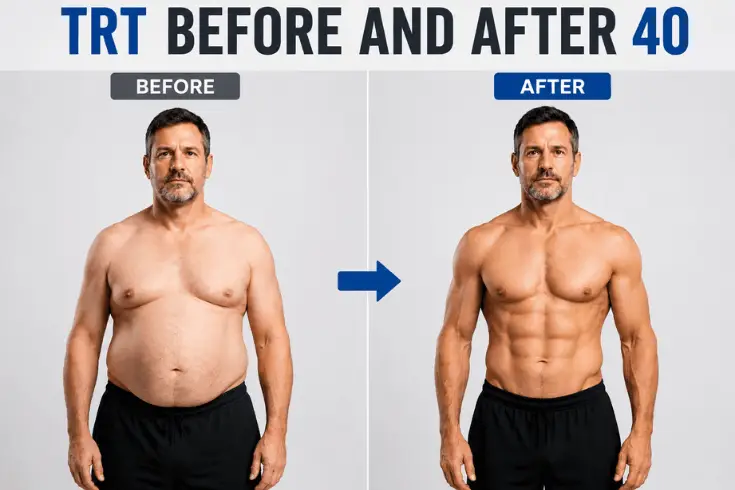
TRT before and after over 40 is a meaningfully different experience from TRT at 30 and most of the content written about it doesn’t acknowledge that. Testosterone replacement therapy (TRT) is a medical protocol that restores testosterone to an optimal physiological range in men with confirmed hypogonadism.
After 40, TRT operates within a different biological context: the natural testosterone decline compounds with cumulative health changes, the monitoring requirements become more demanding, and the concurrent conditions that can blunt treatment response are more prevalent. The clinical outcomes are real and well-documented but they come with a more active patient-provider relationship than most TRT articles describe.
This guide covers the age-specific clinical data, the four ways TRT works differently after 40, the specific monitoring protocol this age group requires, and the metabolic opportunity that makes men in their 40s with abdominal fat and low testosterone some of the best TRT candidates in clinical practice. For the complete picture of TRT transformation across all domains and ages, see the full TRT before and after guide.
What Testosterone Looks Like in Men Over 40 — Before TRT
Testosterone declines at roughly 1–2% per year after age 30. By 45, a man who had a total testosterone of 750 ng/dL at 25 may be at 500–600 ng/dL — still technically “in range” but meaningfully reduced from his hormonal prime. By 50, that decline compounds with other age-related changes: increased aromatase activity (converting more testosterone to estrogen), rising SHBG (binding more testosterone and reducing the free fraction available to tissues), and accumulating visceral fat (which directly suppresses testosterone production).
The result is not dramatic hypogonadism for most men over 40 it is a slow erosion of the hormonal environment that supported energy, muscle maintenance, fat metabolism, and libido. The symptoms of low testosterone in men over 40 frequently overlap with normal aging, sleep disorders, thyroid dysfunction, and depression — making accurate diagnosis essential and often delayed.
The “before” state for men over 40 starting TRT is almost always this cumulative picture: not a sudden hormonal collapse, but a years-long drift that has progressively dimmed the metabolic, physical, and psychological functions that testosterone supports.
| Domain | Before TRT (Low-T Over 40) | After TRT (12 Months + Training) |
| Sexual function | Declining libido; erection quality reduced | +4–7 IIEF score points (6–12 months) |
| Lean mass | Declining ~0.5–1 kg/year | +2–4 kg over 6–12 months |
| Visceral fat | Increasing; compounding low-T loop | −2–3 kg; down to −31% in metabolic syndrome cohorts |
| Energy | Fatigue, afternoon crashes, poor recovery | Stable energy; faster recovery by months 2–3 |
| Mood | Flat affect, irritability, low drive | Improved by 18–30 weeks; depressive subgroups show clearest benefit |
| Bone density | Declining, accelerating post-50 | ~5% annual gain; continues for 3+ years |
| Metabolic risk | Elevated insulin resistance | −40% diabetes progression with lifestyle + TRT (T4DM trial) |
| Monitoring requirement | Low | High: labs every 3–6 months; PSA annually |
The Clinical Data for Men in Their 40s Specifically
Most TRT research combines men across broad age ranges. A 2025 narrative review published in PMC specifically examined TRT outcomes in men aged 40–49 — the most age-targeted data set available for this decade.
Sexual function:
IIEF score improvements of 4–7 points over 6–12 months represent the most consistently documented benefit across studies in this cohort. Both erectile function and libido components improve, with intramuscular formulations showing the strongest response.
Body composition:
Lean mass gains of 2–4 kg and fat mass reductions of 2–3 kg over 6–12 months in men combining TRT with training. Without resistance training, expect the lower end of each range. For the complete body composition data and what those numbers look like visually, see our TRT before and after body composition guide.
Bone density:
Annual bone mineral density gains of approximately 5% in mid-term trials — comparable to first-line osteoporosis treatments. This benefit is significant and underemphasized: men in their 40s losing bone density before visible symptoms are ideal candidates for a treatment with this profile.
Cardiovascular safety:
The TRAVERSE trial 5,246 men followed for a median 33 months — found no significant increase in major adverse cardiovascular events compared to placebo in appropriately selected and monitored hypogonadal men. Numerical increases in atrial fibrillation, acute kidney injury, and pulmonary embolism were observed, which is why proper patient selection and ongoing monitoring are non-negotiable.
Erythrocytosis:
6–18% of men on TRT develop elevated hematocrit depending on formulation, with long-acting intramuscular forms carrying the highest risk. Hematocrit above 54% (or 52% per some guidelines) requires intervention. This is the most frequent dose-dependent safety concern in this age group.
The Four Ways TRT Works Differently After 40
Competitors add “over 40” to generic TRT content. Here is what is actually clinically distinct.
Variable 1 Response timeline is longer
Androgen receptor sensitivity changes with age. The same tissues that responded rapidly to restored testosterone at 28 require more sustained optimization to adapt at 45. This is not treatment failure — it is physiology. Men over 40 should extend their honest evaluation window to four to six months, not six to eight weeks. Recovery between training sessions also lengthens with age: the 36-hour turnaround that worked at 28 becomes a 72-hour requirement at 45 — which TRT partially, not fully, addresses. See our TRT before and after 3 months guide for a breakdown of why early results can differ from expectations.
Variable 2 The monitoring burden is substantially higher
Men over 40 on TRT require more frequent bloodwork at more markers than younger men. Erythrocytosis risk rises with age and cumulative testosterone exposure. PSA surveillance is mandatory and age-relevant. Cardiovascular markers — lipids, hematocrit, blood pressure — warrant baseline and periodic review in a way they generally don’t at 30. The monitoring protocol in Section 7 of this article reflects what this looks like specifically.
Variable 3 Concurrent conditions are more prevalent and more consequential
Sleep apnea, subclinical hypothyroidism, moderate depression, and metabolic syndrome are all significantly more prevalent in men over 40 — and all four can individually mask TRT response completely. A man with untreated sleep apnea on an otherwise optimal TRT protocol will see substantially reduced benefit because testosterone’s anabolic and mood effects occur primarily during deep sleep. A man with undiagnosed subclinical hypothyroidism on TRT may see his symptoms attributed to “not enough testosterone” when the actual driver is thyroid. These conditions require parallel management, not a TRT dose increase.
Variable 4 The fertility window is time-sensitive
Men in their early 40s typically retain meaningful sperm production. Men in their late 40s and early 50s have declining baseline fertility before TRT begins. Over 90% of men on TRT develop oligospermia or azoospermia. Starting TRT in your mid-to-late 40s without addressing fertility preservation closes a window that was still open — and that window narrows with each passing year. The TRT and fertility conversation belongs before the first injection, not after months of treatment when sperm count is already suppressed. HCG co-prescription or sperm banking are the time-sensitive decisions this variable demands.
The Metabolic Syndrome Opportunity Why This Age Group Benefits Most
For men in their 40s who carry significant abdominal fat alongside low testosterone, the two conditions create a compounding feedback loop: low testosterone promotes visceral fat accumulation, and visceral fat increases aromatase activity, converting more testosterone to estrogen, which further suppresses testosterone production. The loop accelerates without intervention.
The T4DM trial — a randomized, double-blind, placebo-controlled study — found that combining testosterone therapy with a structured lifestyle intervention reduced progression to type 2 diabetes by 40% in men with impaired glucose tolerance or newly diagnosed type 2 diabetes and low testosterone. Body composition improved simultaneously versus lifestyle intervention alone: waist circumference decreased and lean mass increased.
This data makes men in their 40s with metabolic syndrome and low testosterone some of the most clearly indicated TRT candidates in clinical practice. The combined intervention — TRT and lifestyle change — produces outcomes that neither achieves independently. For men asking “which do I treat first, the low T or the belly fat?” the T4DM trial answers: both, together, because they are part of the same metabolic cycle.
When TRT Alone Won’t Work The Concurrent Conditions You Need to Treat First
Four conditions are more prevalent in men over 40 and each can mask TRT response almost entirely.
Sleep apnea
disrupts slow-wave sleep — the phase where testosterone synthesis and anabolic recovery peak. Untreated moderate-to-severe sleep apnea can suppress testosterone by 10–15% through sleep disruption alone, independently of hormonal replacement. TRT in the presence of untreated sleep apnea also carries elevated hematocrit risk, since both conditions raise red blood cell production. If you snore heavily, wake unrefreshed, or have been told you stop breathing during sleep, get a sleep study before or alongside TRT initiation — not after months of blunted response.
Subclinical hypothyroidism
produces a symptom cluster — fatigue, weight gain, cold intolerance, low mood, cognitive slowing — that is nearly identical to low testosterone. Men in their 40s who receive a low-T diagnosis based on symptoms without thyroid panel review may have the primary cause misidentified. A full thyroid panel (TSH, free T4, free T3) at baseline is essential before attributing all symptoms to testosterone deficiency.
Depression
and low testosterone are bidirectional: low testosterone contributes to depression, and depression suppresses testosterone via HPA axis dysregulation. Untreated moderate-to-severe depression blunts the mood and motivation benefits of TRT. Concurrent treatment — psychotherapy, antidepressants where indicated, or both — alongside TRT produces better outcomes than either alone for men where both are contributing to the symptom picture.
Metabolic syndrome
requires dietary and exercise intervention alongside TRT not instead of it. For the metabolic syndrome-TRT connection and the T4DM trial data, the most effective approach is treating both simultaneously as outlined above.
The Monitoring Protocol for Men Over 40 on TRT
This is what the monitoring relationship actually looks like for this age group — not “see your doctor” but a specific protocol.
Baseline (before first dose)
- Total testosterone — two early-morning measurements (8–10 AM)
- Free testosterone and SHBG
- LH and FSH — to confirm primary vs. secondary hypogonadism
- PSA — mandatory for all men over 40; TRT is generally contraindicated with elevated PSA without urology clearance
- Hematocrit and CBC
- Lipid panel
- Fasting glucose and HbA1c
- Thyroid panel (TSH, free T4)
- Estradiol — sensitive assay
- Blood pressure
6–8 Week Draw (first critical monitoring point)
- Total and free testosterone at trough (morning of or before next injection)
- Estradiol (sensitive assay) — the estrogen plateau peaks here; see our high estrogen symptoms on TRT guide for what to look for
- Hematocrit — early erythrocytosis detection
12-Week (3-Month) Review
- Full panel: total T, free T, E2, hematocrit, PSA
- Symptomatic review alongside lab numbers
Every 3–6 Months Ongoing
- Same core panel; frequency depends on formulation and individual risk profile
Annual
- Full panel plus documented PSA comparison to baseline
- PSA velocity calculation (>0.75 ng/mL/year warrants urology referral)
- Cardiovascular markers if baseline risk factors present
- Bone density DEXA at 12 months if bone health is a clinical concern; repeat at 24 months
Thresholds requiring immediate action
- Hematocrit >54%: dose reduction, delivery method change, or therapeutic phlebotomy; discuss with provider immediately — do not wait for next scheduled lab
- PSA rise >1.4 ng/mL from baseline within any 12-month window: urology referral
- Symptomatic atrial fibrillation or unexplained dyspnea: cardiologist referral
For prostate-specific monitoring details, see our TRT and prostate health guide.
TRT Before and After: What’s Different at 40 vs. 50
Men in their early-to-mid 40s
Testosterone has declined but typically retains responsiveness. Androgen receptor sensitivity is reduced but still strong relative to the 50s cohort. Body composition responses — lean mass and fat loss — are near the top of the clinical ranges documented in trials. Sexual function response is robust (4–7 IIEF points). Fertility preservation is still viable with proper intervention. The monitoring burden is meaningful but the risk-benefit calculation is favorable for the clear majority of appropriately selected men.
Men in their late 40s and early 50s
The compound effects of age-related testosterone decline, rising SHBG, and accumulated metabolic changes produce a somewhat different starting point. Fat redistribution is more entrenched. Fertility is declining independently of TRT. Sleep apnea and subclinical thyroid dysfunction are more prevalent. Body composition responses remain meaningful but may take longer to manifest — the 6-month evaluation window is more appropriate than the 3-month window commonly referenced in general TRT content. The metabolic syndrome opportunity (T4DM data) is highly applicable to this cohort. The monitoring burden is at its highest — PSA surveillance, cardiovascular labs, and hematocrit monitoring all warrant the full protocol above.
For men in their 40s wondering about the first 90 days specifically, our TRT before and after 3 months guide addresses the week-by-week progression and why the early timeline may feel slower than general TRT content suggests.
Frequently Asked Questions
Does TRT work differently for men over 40?
Yes — across four specific variables. Response timeline is longer due to age-related changes in androgen receptor sensitivity. The monitoring burden is higher, with PSA, hematocrit, and cardiovascular labs required at regular intervals. Concurrent conditions (sleep apnea, thyroid dysfunction, depression, metabolic syndrome) are more prevalent and can independently mask TRT response. And the fertility window is time-sensitive for men who retain paternity potential — a decision that needs to be made before, not after, TRT begins.
How long does TRT take to work for men over 40?
The honest evaluation window for men over 40 is four to six months — not the six-to-eight weeks sometimes referenced for younger men. Libido typically improves within weeks three to six. Energy and mood stabilize by months two to three. Body composition changes become measurable by months three to six. Full outcomes for bone density, metabolic markers, and body recomposition develop over twelve months and beyond. For the detailed week-by-week timeline, see our TRT before and after 3 months guide.
Is TRT safe for men over 40?
The TRAVERSE trial — the largest TRT safety study to date, following 5,246 men over a median 33 months — found no significant increase in major adverse cardiovascular events in appropriately selected and monitored hypogonadal men. Numerical increases in atrial fibrillation and other events were observed, which is why proper patient selection, baseline screening (including PSA and cardiovascular markers), and ongoing monitoring are non-negotiable rather than optional.
Does TRT affect fertility for men over 40?
Over 90% of men on TRT develop oligospermia or azoospermia — significantly reduced or absent sperm counts. For men in their 40s who retain fertility potential and may want paternity, this must be addressed before starting therapy. HCG co-prescription can partially maintain testicular function during TRT. Sperm banking before initiation is the most reliable approach for preserving future options. This decision becomes more urgent with each year in the 40–48 window.
What should men over 40 monitor on TRT?
The core over-40 monitoring protocol includes: total testosterone and free testosterone drawn at trough every 3–6 months, estradiol (sensitive assay), hematocrit (with immediate action if >54%), PSA at baseline and annually with velocity tracking, fasting glucose and HbA1c, lipid panel, and blood pressure. The 6–8 week draw is the most important early checkpoint — it catches the estradiol plateau and early erythrocytosis before they become established problems.
Can TRT help with belly fat and metabolic syndrome in men over 40?
Yes — and the T4DM trial demonstrates this most clearly. Men with impaired glucose tolerance or newly diagnosed type 2 diabetes plus low testosterone who received testosterone combined with a structured lifestyle program saw a 40% reduction in diabetes progression versus lifestyle alone. Visceral fat decreases first and most dramatically — measurable by DEXA at months three to six. Subcutaneous fat (visible abdominal fat) reduces more slowly. For the complete body composition data, see our TRT before and after body composition guide.
What results can men over 40 realistically expect from TRT?
Based on the age-specific trial data: IIEF sexual function score improvements of 4–7 points over 6–12 months, lean mass gains of 2–4 kg with resistance training, fat mass reductions of 2–3 kg (visceral fat responding first), approximately 5% annual bone density gain, and meaningful energy and mood improvement by months two to four. For men with metabolic syndrome, the T4DM data adds a 40% reduction in diabetes progression risk when TRT is paired with lifestyle intervention. These are achievable outcomes for appropriately selected, well-monitored men — not ceiling figures that require supraphysiological dosing.
TRT over 40 requires a more active monitoring relationship than TRT at 30. Book a consultation with TRTNYC to get age-appropriate baseline labs, an honest conversation about what TRT will and won’t address at your age, and a protocol built around your specific risk profile and goals.