
TRT Before and After Body Composition: The Real Muscle Gain and Fat Loss Numbers
 By Trevor Jaxon
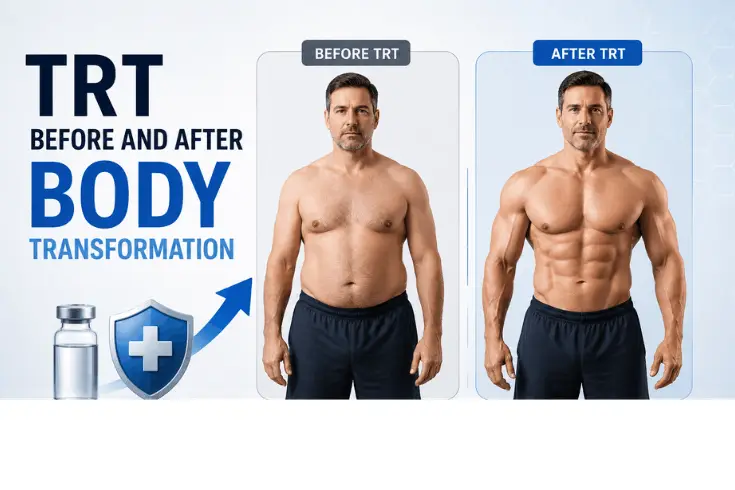
The before and after photos of TRT body transformation are everywhere. The clinical data behind them is harder to find — and meaningfully different from what the photos suggest.
Testosterone replacement therapy (TRT) is a medical protocol that restores testosterone to an optimal physiological range in men with confirmed hypogonadism. Its effects on body composition operate through three converging mechanisms: increased muscle protein synthesis via androgen receptor signaling, improved insulin sensitivity that shifts caloric partitioning toward muscle rather than fat storage, and a measurable reduction in visceral adipose tissue driven by the restoration of normal androgen activity. What this produces is documented across dozens of randomized controlled trials with numbers specific enough to set real expectations.
This guide presents those numbers, explains why the scale won’t show you what’s happening during TRT body recomposition, and draws a clear line between what therapeutic dosing actually produces and what some of those forum photos represent. For the complete picture of TRT transformation across all domains, see our TRT before and after guide.
What Low Testosterone Does to Your Body Composition Before TRT
Low testosterone doesn’t just blunt your ability to build muscle it actively shifts your body toward a fat-storing, muscle-losing metabolic state. When testosterone drops below optimal range, two things happen simultaneously.
First, androgen receptor signaling in skeletal muscle weakens, reducing the body’s capacity for muscle protein synthesis and making resistance training less effective than it should be. Second, insulin sensitivity declines the body becomes less efficient at directing calories toward muscle and more prone to storing them as fat, particularly in the visceral compartment around the abdominal organs.
The result is the low-testosterone body composition profile: more fat — especially around the abdomen and chest — less lean mass, weaker training response despite consistent effort, and a slower recovery between sessions.
| Marker | Before TRT (Low-T State) | After TRT (12 Months + Training) |
| Lean body mass | Declining; poor training response | +2–5 kg (meta-analysis range) |
| Visceral fat | Elevated; metabolically active | −2.4–3.1 kg; up to −31% in major studies |
| Subcutaneous fat | Accumulated abdomen/chest | Gradual reduction; visible months 4–6+ |
| Waist circumference | Enlarged | −3–4 cm avg; up to −16% in some studies |
| Body fat percentage | Elevated | Decreasing as lean-to-fat ratio shifts |
| Muscle definition | Poor; blunted response to training | Improved as fat-to-muscle ratio changes |
| Scale weight | Variable | May increase initially (lean mass outpacing fat loss) |
| Basal metabolic rate | Suppressed | +4–5% as lean mass builds |
Understanding low testosterone symptoms in this metabolic context is what makes the TRT body composition data interpretable — it’s restoring a system that was working against physique goals, not adding something new on top of normal function.
The Clinical Numbers: What TRT Actually Produces for Muscle and Fat
These are the numbers from verified randomized controlled trials. Not approximations, not marketing claims.
Lean mass gains
In the landmark Bhasin et al. study published in the Journal of Clinical Endocrinology & Metabolism, seven hypogonadal men received 100 mg/week testosterone enanthate for 10 weeks with a controlled protein intake of 1.5g/kg/day. Fat-free mass increased from 56.0 kg to 60.9 kg — a gain of approximately 4.9 kg in 10 weeks. Triceps cross-sectional area increased from 2,421 to 2,721 mm²; quadriceps from 7,173 to 7,720 mm². These are measurable, anatomically confirmed changes in muscle tissue — not scale weight fluctuations.
For broader populations across longer timeframes, a 2018 meta-analysis of 34 randomized controlled trials found lean body mass increased by 1–3 kg over six months in middle-aged and older hypogonadal men. The range reflects individual variation in baseline testosterone, age, training status, and protocol optimization.
Fat loss numbers
A 2020 meta-analysis of 17 randomized controlled trials involving 2,351 participants found that men on testosterone therapy lost an average of 2.4 kg more total body fat than placebo groups. Visceral fat specifically decreased by 3.1 kg — a 28% reduction. Lean mass was maintained or gained (+1.7 kg net) over the same period.
In a separate observational study following 788 men with metabolic syndrome on testosterone gel, waist circumference decreased by 16% and visceral adipose tissue volume measured by DEXA decreased by 31%. These numbers look modest on paper. Their visual impact is considerably larger than the numbers suggest — which is the point of the next section.
Visceral Fat vs. Subcutaneous Fat: Why the Dangerous Fat Drops First
TRT targets two types of body fat, and they respond on different timelines. This distinction explains one of the most frustrating experiences on TRT: significant metabolic improvement happening invisibly while the mirror shows minimal change.
Visceral fat
is stored around the abdominal organs — not visible or pinchable, but metabolically active and directly linked to insulin resistance, cardiovascular risk, and systemic inflammation. This fat is the most responsive to testosterone restoration. The 31% DEXA reduction and the 3.1 kg decrease in the 2020 meta-analysis both refer primarily to this compartment. Visceral fat begins responding at months three to six of TRT. You cannot see or feel this change in the mirror, but it is the most clinically significant fat reduction TRT produces — and it is happening even when the visible results aren’t yet apparent.
Subcutaneous fat
is the fat under the skin — what you see in the mirror and can pinch at the abdomen, chest, and flanks. This fat responds to TRT more slowly. Visible reduction in subcutaneous fat typically begins at months four to six and continues through year one and beyond. The pace is slower because subcutaneous fat is metabolically less active and less directly responsive to androgen signaling than visceral fat.
The practical implication for men at the three-to-four-month mark who aren’t seeing visible fat reduction: your visceral fat may already be down substantially. The body is changing where it matters most metabolically before it changes where it’s most visible. A DEXA scan at month three and month six makes this measurable rather than invisible.
Why the Scale Lies During TRT Body Recomposition
The scale is the least useful tool for tracking TRT body composition progress — and relying on it produces the most common false conclusion in TRT: that the therapy isn’t working.
TRT frequently produces body recomposition: simultaneous lean mass gain and fat loss. When these two processes happen concurrently, their effects on scale weight partially cancel each other. Lean mass builds faster than fat mass is lost in the early months (TRT’s anabolic effects are rapid; fat mobilization is slower), meaning the scale can go up while the body is genuinely improving.
Here is what a documented body recomposition trajectory looks like in practice: a man who gains 7 kg of lean mass and loses 9 kg of fat over 12 months on TRT shows only a 2 kg scale reduction. His body fat percentage has dropped substantially, his muscle definition has increased, his waist circumference has decreased, and his metabolic risk has improved none of which the scale captured.
What actually reflects TRT body composition progress:
- Body fat percentage — tracked via DEXA, InBody scan, or consistent skinfold caliper measurement
- Waist circumference — measured weekly at the navel; directly tracks visceral fat reduction
- How clothes fit — a blunt but honest proxy for fat redistribution
- Training performance — strength and recovery improvements as lean mass builds
- DEXA comparison scans at six-month intervals (the gold standard)
See our guide on whether TRT causes weight gain for why the scale often shows a number that doesn’t reflect what’s actually happening in your body composition.
TRT Alone vs. TRT With Training: The Numbers Side by Side
This is the most important data point for anyone evaluating TRT for body composition, and it is conspicuously absent from most clinic articles.
TRT without structured resistance training:
Meta-analysis data from sedentary populations on TRT shows lean mass gains of 1.5–3.5 kg over 12 months. Fat mass decreases modestly — visceral fat drops first and most significantly, but without training to drive lean mass growth, the body composition shift is real but visually modest.
TRT with structured resistance training (60+ minutes, progressive overload):
A 2024 case report published in PMC tracked a 40-year-old man on 150–180 mg/week testosterone combined with consistent exercise over six months. Results:
- Phase 1 (months 1–3): lean body mass +6%, skeletal muscle +6.9%, body fat −1.7%, basal metabolic rate +4.5%
- Phase 2 (months 4–6): additional lean mass +3.8%, skeletal muscle +3.9%, body fat −1.3%, BMR +3.2%
The difference between the two scenarios is not marginal. TRT creates the hormonal environment for muscle protein synthesis to operate at full capacity: androgen receptors occupied, insulin sensitivity improved, recovery accelerated. But without progressive resistance training providing the mechanical stimulus, that anabolic capacity has no physical structure to build. The muscle does not build itself.
For physique outcomes specifically, the data supports TRT producing two to three times the lean mass gain when combined with structured resistance training versus TRT alone — alongside compounding fat loss as the higher lean mass increases basal metabolic rate. Our TRT workout plan guide covers what that training protocol should look like in practice.
TRT Body Composition Timeline: What Changes at Each Stage
Months 1–3
Lean mass begins accumulating as androgen receptor signaling intensifies and protein synthesis efficiency improves. Visceral fat begins responding — measureable by DEXA but not yet visible. The scale may not move or may increase as lean mass outpaces the early fat loss. Energy and training recovery improve, which supports better training quality and output.
Months 3–6
Body composition changes become measurable. Lean mass gains of 1–2 kg are confirmed by DEXA in men combining TRT with training. Visceral fat reduction is now significant — the waist circumference change becomes noticeable for most men. Subcutaneous fat begins reducing in the abdominal and chest regions. Training performance continues improving: strength records get broken, recovery between sessions shortens. For the complete week-by-week picture of the first 90 days, see our TRT before and after 3 months guide.
Months 6–12
The most visually apparent changes occur in this window. The fat-to-muscle ratio shift becomes clearly visible: leaner abdomen, improved muscle definition, sharper physique contours. Lean mass accumulation continues compounding — particularly for men with consistent training. For men who began TRT with metabolic syndrome or significant overweight, the T4DM trial data suggests the metabolic benefits also extend to reduced insulin resistance and improved lipid profile in this window.
Beyond 12 Months
Body recomposition continues for men on consistent TRT with aligned lifestyle. Long-term registry data shows continued fat reduction through years two to three for men who maintain training and protocol management. Bone density improvement also compounds in this period — a body composition benefit that is invisible but clinically significant for long-term health.
The Forum Photo Reality Check: Therapeutic TRT vs. Supraphysiological Dosing
Many of the dramatic body transformation photos on TRT forums and men’s health social media do not represent therapeutic testosterone replacement therapy. They represent supraphysiological dosing — testosterone at 300–600 mg per week or more, often stacked with other anabolic compounds in a blast-and-cruise protocol.
Therapeutic TRT for confirmed hypogonadism targets total testosterone in the 700–1,000 ng/dL range, which typically corresponds to 80–200 mg per week of testosterone cypionate or enanthate depending on the individual’s metabolism, shbg levels, and hematocrit response.
The visual outcomes of these two approaches are categorically different:
Therapeutic TRT (80–200 mg/week):
Leaner body composition, measurably better training response, 2–5 kg lean mass gain over 12 months with consistent training, significant visceral fat reduction, improved muscle definition within the natural physiological range. A meaningful but proportionate transformation.
Supraphysiological (300–600+ mg/week):
Rapid, dramatic muscle gain that exceeds the natural physiological ceiling for protein synthesis. The transformation photos that generate forum engagement and unrealistic expectations.
Men who measure their therapeutic TRT results against supraphysiological photos and conclude their therapy “isn’t working” are comparing against results produced by doses four to eight times larger than therapeutic. Their therapy is producing exactly what the clinical literature predicts — the expectation was calibrated against the wrong benchmark.
For the full distinction between therapeutic and performance-enhancement contexts, see our guide on TRT vs. steroids.
Frequently Asked Questions
How much muscle can you gain on TRT?
Clinical research shows lean body mass gains of 1–3 kg over six months in randomized trials of hypogonadal men. With structured resistance training, a 2024 case study documented a 6% lean body mass increase in the first three months and an additional 3.8% over the next three months. The range in practice — 2–5 kg over 12 months — reflects individual variation in baseline testosterone, age, training consistency, and protocol optimization.
How long does it take for TRT to change body composition?
Lean mass begins accumulating within the first six to twelve weeks as androgen receptor signaling strengthens and training response improves. Visceral fat reduction becomes measurable at months three to six. Visible subcutaneous fat reduction — the change you see in the mirror — typically begins at months four to six. Full body recomposition outcomes develop over twelve months and continue improving beyond that for men maintaining consistent training and protocol management.
Does TRT build muscle without working out?
TRT produces lean mass gains of approximately 1.5–3.5 kg over 12 months even without structured resistance training — primarily through improved nitrogen balance and water distribution into muscle tissue rather than true hypertrophy. Visible muscle building requires resistance training to provide the mechanical stimulus that testosterone’s anabolic environment is primed to respond to. TRT without training produces modest, often invisible physical change.
Will TRT help me lose belly fat?
Yes — and the abdominal visceral fat is the compartment that responds fastest and most dramatically. The 2020 meta-analysis of 17 clinical trials found visceral fat decreased by 3.1 kg (-28%) in men on TRT. A 788-man metabolic syndrome study found a 31% reduction in visceral adipose tissue by DEXA. This fat begins responding at months three to six, before visible subcutaneous fat change appears.
Is TRT good for body recomposition?
TRT is one of the most effective medical interventions for body recomposition in men with confirmed hypogonadism — because it addresses the hormonal root of both the muscle-building resistance and the fat accumulation simultaneously. Simultaneous lean mass gain and fat loss (the definition of body recomposition) is well-documented in TRT trials. The scale may not move during this process, which is why body fat percentage and DEXA measurement are the correct tracking tools.
Why isn’t the scale moving on TRT?
Because the scale measures the net balance of simultaneous lean mass gain and fat loss — not either process separately. When lean mass increases at approximately the same rate fat mass decreases, the scale is flat. When lean mass increases faster (common in the early months), the scale can go up while body composition is genuinely improving. Track waist circumference, body fat percentage, and training performance instead of scale weight.
What body composition results are realistic at 12 months on TRT?
For men combining therapeutic TRT with consistent resistance training: lean mass gains of 3–5 kg, visceral fat reduction of 2–3 kg (plus ongoing subcutaneous fat reduction), measurably improved muscle definition, and a lower body fat percentage despite potential stable or increased scale weight. Without training: lean mass gains of 1.5–3 kg, meaningful visceral fat reduction, but limited visible physique change. The training variable is the single largest determinant of where in those ranges you land.
Body composition changes on TRT are real but the scale alone won’t show you what’s happening. Book a consultation with TRTNYC to get comprehensive baseline labs and a protocol built around your specific hormonal profile, training capacity, and body composition goals.