
TRT Before and After 3 Months: A Realistic Week-by-Week Breakdown
 By Trevor Jaxon
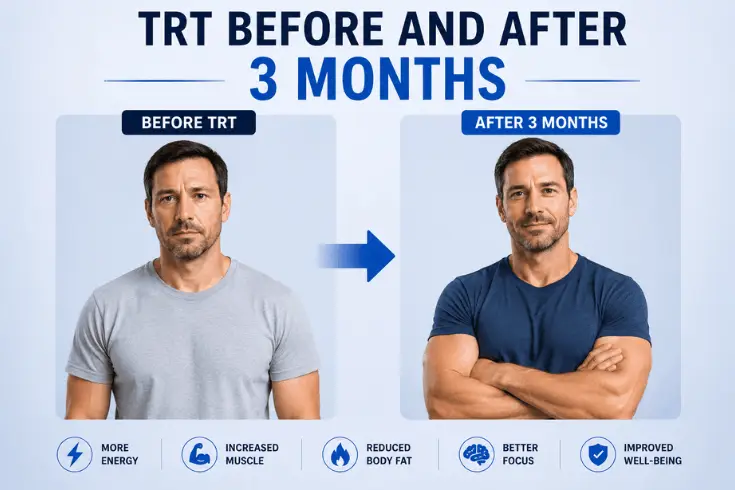
TRT before and after at three months is one of the most searched and most misunderstood milestones in testosterone therapy. Testosterone replacement therapy (TRT) is a long-term hormonal protocol, and three months is its first definitive evaluation checkpoint: enough time for testosterone to reach steady state, for androgen receptors throughout the body to fully respond, and for the real pattern of benefits and side effects to reveal itself. That pattern is almost always non-linear — and the non-linearity is where most articles, and most men’s expectations, fall short.
This guide covers the real week-by-week progression, including the estradiol plateau at weeks 4–8 that no standard timeline article explains, what your labs should show at 90 days, and what to do if you’re not feeling the results you expected. For a broader view of what TRT produces across all time horizons, see our complete TRT before and after guide.
Why Steady State Matters and Why the Real Timeline Starts at Week 4
Most men begin TRT and start evaluating whether it’s working within the first two weeks. Clinically, that’s too early.Testosterone injections (the most common delivery method) reach steady-state blood levels the point where each dose builds on the previous rather than fluctuating widely — at approximately four to six weeks. Gels and creams reach steady state faster but produce less predictable peak levels. Pellets take the longest to reach stable output.
What this means practically: anything you feel in weeks one and two is pre-evaluative. Some men notice a subtle energy lift or marginal mood improvement in this window, reflecting early androgen signaling. Others feel nothing at all. Both responses are normal and neither tells you whether TRT will work for you.
The real timeline the one that maps actual hormonal change starts when testosterone has stabilized. That’s week four onward for most injection protocols. Everything before that is the body adjusting, not the body responding.
TRT Before and After 3 Months: A Week-by-Week Breakdown
Here is what the research and clinical pattern actually show across the first 12 weeks — including the divergence point most timelines omit.
| Timeframe | Primary Changes | Key Mechanism | What to Watch |
| Weeks 1–2 | Subtle energy lift; improved sleep for some; libido unchanged | T rising but below steady state | Note baseline — not yet evaluating |
| Weeks 3–4 | Libido increasing; morning erections returning; mood begins lifting | T approaching steady state; androgen receptors engaging | Libido is the first reliable signal |
| Weeks 4–8 | Early gains may plateau or reverse; water retention; mood volatility; libido dip for some | Estradiol rising as aromatase converts T to E2 — the critical divergence point | 6–8 week labs essential — full panel |
| Weeks 9–12 | Energy fully stable; fat mass reduction beginning; lean mass building underway | Steady-state T maintained; anabolic environment established | Body comp changes underway — not yet visible |
| 90-Day mark | New hormonal baseline set; side effects resolved; mental clarity and mood stable | System fully adjusted; benefit/side effect profile now predictable | Protocol adjustment window |
Weeks 1–2: Pre-evaluative
Testosterone levels begin climbing after the first injection but haven’t stabilized. A subset of men notice marginal improvements in sleep quality and motivation — an early response to rising androgen levels. Most feel little. Don’t interpret the absence of change in this window as a sign of anything.
Weeks 3–4: First Real Signals
Research confirms that effects on sexual interest appear within three weeks and plateau around six weeks. For most men, this is when TRT first announces itself: libido climbs noticeably, morning erections return, and mood begins lifting. If you feel nothing here, it’s worth checking that your injection technique and site rotation are consistent — absorption issues are more common than assumed in early weeks.
Weeks 4–8: The Divergence
This is the window where the non-linear pattern emerges. Some men continue improving through week eight with no disruption. Others — a significant subset — experience what feels like a reversal: libido that returned at week four drops again, water retention appears, mood becomes erratic. This is the estradiol plateau, covered in the next section, and it is both predictable and manageable.
Weeks 9–12: Stabilization and Early Body Composition
Testosterone has reached a fully stable therapeutic level for most injection protocols. Energy is consistently better than pre-TRT baseline. Fat mass reduction — particularly visceral fat — has begun at the metabolic level even if it is not visible on the body yet. Lean mass building is underway for men who are training consistently. The system is now calibrated.
The 90-Day Mark
At three months, the hormonal environment is established. Most early side effects have resolved. The question at this checkpoint is not “is TRT working?” — it is “is my protocol optimized?” That answer requires bloodwork, not a mirror.
The Week 4–8 Estradiol Trap: Why Many Men Feel Worse Before They Feel Better
This is the most important section in this guide, and it is missing from every major competitor. When testosterone levels rise — as they do in the first four to six weeks of TRT — the aromatase enzyme converts a portion of that testosterone into estradiol. Higher testosterone means higher aromatase activity. For many men, this estradiol surge outpaces what the body can comfortably balance, producing a cluster of symptoms that feel exactly like TRT stopping working:
- Libido that improved at weeks 3–4 drops again
- Energy becomes erratic or dips below the initial lift
- Water retention appears — often in the face, hands, and midsection
- Mood shifts from lifted to volatile or flat
- Morning erections that returned may reduce in frequency
This is not treatment failure. This is the most predictable, reversible phase of early TRT, and it is the primary reason men abandon therapy at weeks six to eight without ever understanding why.
The mechanism is straightforward: testosterone rises faster than the body adapts its estrogen-clearing capacity, and the window of elevated estradiol produces symptoms that mimic low testosterone even while testosterone itself is in range.
The fix is labs, not stopping. An estradiol test (sensitive assay, drawn at trough — the morning of or morning before your next injection for injection protocols) compared against target range (typically 20–40 pg/mL) tells you whether this is driving your symptom plateau. If it is, your provider can adjust the protocol — whether through dose timing, dose reduction, or adding an aromatase inhibitor like anastrozole at the appropriate dose. For a full list of high estrogen symptoms on TRT to check against, see that guide.
Men who hit this window, don’t know what’s causing it, and don’t have a provider who addresses it are the most likely to stop TRT and conclude it “didn’t work for them.”
What Your Labs Should Show at 3 Months on TRT
Two lab draws matter in the first 90 days. Most men only schedule one.
The 6–8 Week Draw (Often Skipped Should Not Be)
This is the most clinically important bloodwork in your first three months. Draw at trough — the morning of or morning before your next injection. Request:
- Total testosterone: Target 700–1,000 ng/dL for most men on TRT
- Free testosterone: Target upper quartile of your lab’s reference range
- Estradiol (E2, sensitive assay): Target 20–40 pg/mL; above 50 pg/mL with symptoms warrants discussion
- Hematocrit: Should remain below 54%; elevated hematocrit is the most common dose-dependent safety concern with TRT
This draw catches the estradiol divergence at its peak and allows protocol adjustment before month three. Skipping it and waiting for the 90-day draw means living through weeks 6–12 with a correctable problem unaddressed.
The 90-Day Draw (Protocol Review)
Run the same panel as above, plus:
- PSA (prostate-specific antigen) — baseline monitoring; testosterone is not associated with causing prostate cancer but monitoring is standard
- CBC (complete blood count) — hematocrit and RBC tracking
- Lipid panel — testosterone affects HDL/LDL in some men
One distinction matters at this draw: “in range” testosterone is not the same as optimized testosterone. A total T of 400 ng/dL sits in the reference range. Most men report no symptom resolution at that level. If your 90-day labs show T in range but you still feel symptomatic, the conversation with your provider should be about optimization — not about whether TRT is working.
What “Before and After 3 Months” Actually Looks Like — and What Isn’t Done Yet
Three months on TRT is primarily an internal transformation — symptoms, function, and labs. It is not yet a visible physical transformation for most men.
What is reliably different at 90 days:
- Libido is at its early stable plateau (for men with managed estradiol)
- Morning erections have returned to consistent frequency
- Energy is stable through the day; afternoon energy crashes largely gone
- Mood is at an improved baseline; irritability and flat affect reduced
- Sleep quality measurably better for most men
- Testosterone is in therapeutic range and, if the 6–8 week draw was done and acted on, estradiol is managed
What is still developing and nowhere near complete:
- Visible muscle gain: The anabolic environment is established, but visible muscular change requires consistent training built on top of months two through four, not just month one through three
- Significant fat loss: Visceral fat reduction is measurable on DEXA at month three for men who are training; it is rarely visible to the eye until months four to six
- Full erectile function: This continues improving until the six-month mark — the three-month window is mid-progress, not final outcome
- Peak mood benefit: Research shows maximum psychological benefit arrives at 18–30 weeks; at 90 days you are at roughly half of the eventual improvement
- Bone density: Doesn’t begin accumulating until month six
The men most disappointed at three months are those comparing their experience to before/after photos — which almost always represent results at nine to twelve months, not three. Month three is when TRT has done its foundational work; the visible results are what that foundation builds on over the following months.
Not Feeling Results at 3 Months? Work Through This Before Changing Anything
If you are at twelve weeks with minimal improvement, do not stop TRT and do not assume it doesn’t work for you. Work through these four questions first.
Are your testosterone levels actually in an optimal range — not just “normal”?
“Normal” and “optimal” are not the same number. If your total testosterone is 380 ng/dL, you are “in range” and likely symptomatic. If it is 850 ng/dL with free T in the upper quartile, you are optimized. Request your actual numbers and compare them against the targets in the section above, not just the lab’s reference range flag.
Is your estradiol elevated?
If you felt improvement at weeks three to four and then plateaued or declined, elevated estradiol is the primary suspect. If your 6–8 week labs didn’t include an estradiol (sensitive assay), request it now. Compare against the 20–40 pg/mL target. Elevated E2 with symptoms is a protocol adjustment, not a reason to stop therapy.
Are you sleeping seven to eight hours consistently?
TRT’s anabolic and mood effects occur primarily during deep sleep. Men with untreated sleep apnea or chronic sleep debt consistently underperform on the same TRT protocol as sleep-adequate men. If sleep hasn’t been addressed, TRT cannot deliver its full effect — not because the hormone isn’t working, but because the conditions for it to work aren’t present.
Are you training with progressive resistance?
If body composition is your primary complaint at three months and you are not consistently resistance training, the therapy is not the variable that needs changing. TRT creates the hormonal environment for muscle building; progressive overload provides the stimulus. One without the other produces limited change. See our guide on TRT side effects for what a fully optimized protocol looks like in practice.
If you’ve answered all four questions honestly and still see no progress, the appropriate next step is a provider consultation — with your labs in hand, not a general “it’s not working” complaint.
Frequently Asked Questions
What happens after 3 months on TRT?
At the three-month mark, testosterone has reached a stable therapeutic level and the hormonal environment is established. Most men have resolved the early estradiol plateau (if it was addressed), energy and mood are at a stable improved baseline, libido is restored, and the body is in the early stages of body composition change. Visible physical transformation is still developing — the three-month before and after is primarily a functional and symptomatic story.
Why did I feel better on TRT and then feel worse?
This is the estradiol plateau — one of the most common and least explained experiences in early TRT. As testosterone rises in weeks four to six, the aromatase enzyme converts more of it to estradiol. Elevated estradiol produces symptoms that mimic low testosterone: libido dip, water retention, mood volatility, energy decline. It is not treatment failure. A sensitive estradiol blood test drawn at trough tells you whether E2 is the cause, and protocol adjustment resolves it.
When should I get bloodwork after starting TRT?
The first critical draw is at six to eight weeks — not at twelve weeks. Draw at trough (the morning of or before your next injection for injection protocols) and request total testosterone, free testosterone, estradiol (sensitive assay), and hematocrit. This catches the estradiol plateau at its peak and allows adjustment before you spend months three through six with a correctable problem unaddressed. The 90-day draw adds PSA, CBC, and lipid panel.
How much muscle can you gain in 3 months on TRT?
The body is in the early stages of building lean mass at month three, but visible change typically requires months four to six. Clinical data shows average lean mass gains of 2–4 kg over 12 months for men combining TRT with resistance training. At three months, men who are training consistently may have gained 0.5–1 kg of lean mass — measurable on a DEXA scan, not yet obvious in the mirror.
Is 3 months enough time to know if TRT is working?
Three months is enough time to evaluate whether TRT is addressing your hormonal symptoms — energy, libido, mood, sleep, erection frequency — not whether it is producing visible body composition change. If your symptomatic picture hasn’t shifted meaningfully and your labs are optimized (not just “in range”), that warrants a protocol review. If your symptoms are improving but your body hasn’t visually transformed, that is exactly on schedule for the three-month point.
What should my testosterone levels be at 3 months?
Target total testosterone of 700–1,000 ng/dL with free testosterone in the upper quartile of your lab’s reference range. “In range” testosterone — even 400–500 ng/dL, which is technically above the 300 ng/dL clinical threshold — is not the same as optimized. Most men do not feel full symptom resolution below 600–700 ng/dL. If your 90-day labs show lower numbers alongside persistent symptoms, that is a dose or protocol discussion, not a sign that TRT doesn’t work for you.
What are the first signs TRT is working in the first few weeks?
The most reliable early signal is libido returning — typically at weeks three to four. Morning erection frequency increasing is the second signal. Mood stability and energy improvements follow at weeks three to six. If none of these appear by weeks five to six, that is worth flagging to your provider — not because TRT isn’t working, but because the 6–8 week lab draw should be run to confirm levels and rule out the estradiol plateau.
If you’re at the 3-month mark and results aren’t where you expected, the most useful next step is a labs review — not stopping therapy. Book a consultation with TRTNYC to have your testosterone, estradiol, and hematocrit reviewed and your protocol adjusted to where it should be, based on your actual numbers.