Can Low Testosterone Cause Stomach Issues?
 By Tejanshu Jaluthria
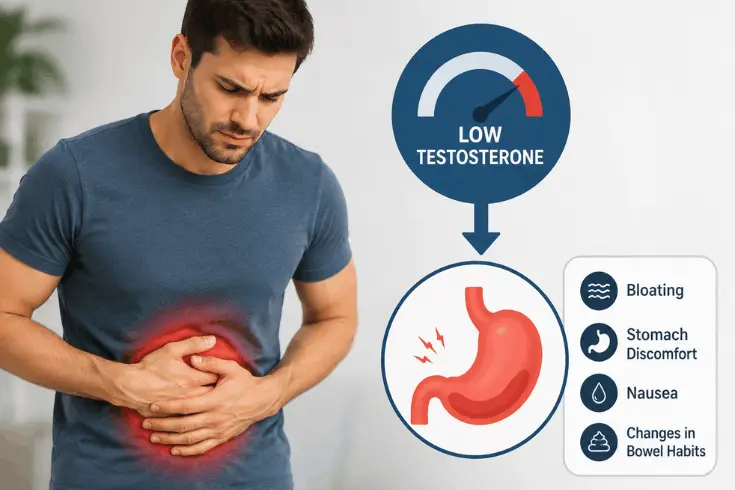
Unexplained bloating, persistent constipation, and acid reflux that don’t improve with diet changes may have a hormonal root cause — one that most gastroenterologists never test for.
Low testosterone is a condition in which the body produces insufficient testosterone, typically defined as total testosterone below 300 ng/dL in men. While the most recognized symptoms involve sexual function, energy levels, and muscle mass, testosterone also binds to receptors throughout the gastrointestinal tract. When levels fall, the gut notices. Smooth muscle contractions slow, gut bacteria shift out of balance, and inflammation rises — producing digestive symptoms that are frequently misattributed to standalone GI conditions.
This article covers the exact mechanisms behind the low testosterone–stomach connection, the symptom patterns that indicate a hormonal driver, and the specific labs to request if you suspect hormones are behind your gut problems.
How Low Testosterone Disrupts Your Digestive System
Androgen receptors the binding sites testosterone uses to communicate with cells — are found throughout the gastrointestinal tract: in the stomach wall, small intestine, and colon. When testosterone activates these receptors, it supports two functions that are central to normal digestion.
The first is gut motility. Testosterone maintains smooth muscle tone in the intestinal wall, driving the rhythmic contractions (peristalsis) that move food through the system. When testosterone falls, these contractions slow. Food spends more time sitting in the gut, ferments, and produces excess gas — resulting in bloating, constipation, and irregular bowel movements. This slowing is one of several low testosterone symptoms that develop gradually and are easy to attribute to aging or diet rather than hormones.
The second is lower esophageal sphincter tone. This valve between the esophagus and stomach depends on muscle tone to stay closed. Weakened tone from low testosterone allows stomach acid to reflux upward causing heartburn without any structural reason like a hiatal hernia.
Low Testosterone and Your Gut Bacteria: The SIBO Connection
Testosterone promotes populations of beneficial gut bacteria while suppressing pathogenic strains. When levels drop, this protective influence weakens and dysbiosis develops — a state where harmful bacteria gain the upper hand over beneficial ones.
In some men, dysbiosis progresses to Small Intestinal Bacterial Overgrowth (SIBO) — a condition in which bacteria colonize the small intestine in abnormal numbers, producing chronic bloating, excess gas, and unpredictable bowel function that doesn’t respond to dietary interventions. Men whose bloating and gut irregularity have been unresponsive to probiotics, elimination diets, and dietary fiber adjustments should consider whether SIBO driven by hormonal dysregulation is involved.
The relationship runs in both directions. Gut dysbiosis generates systemic inflammation that suppresses the hypothalamic-pituitary-gonadal (HPG) axis — the hormonal pathway that signals the testes to produce testosterone. This means a gut imbalance caused by low testosterone can further reduce testosterone output, creating a feedback loop that neither gastroenterology treatment nor hormone therapy alone will fully break. Addressing both simultaneously is the more effective path.
Stomach Symptoms That May Signal Low Testosterone
The following symptoms, particularly when appearing in clusters or alongside other signs of low T, suggest a hormonal contribution to gut dysfunction:
- Chronic bloating — persistent abdominal distension after meals that dietary changes do not resolve
- Constipation — infrequent or difficult bowel movements, with a sense that food “sits” longer than it should
- Acid reflux or heartburn — especially if it developed gradually without a clear dietary trigger
- Nausea — particularly in the morning or shortly after eating
- Abdominal cramping — diffuse discomfort rather than sharp, localized pain
- Early satiety — feeling full quickly, accompanied by a noticeable drop in appetite
- Excessive flatulence — gas that persists despite removing common triggers like dairy or high-fiber foods
The pattern that separates hormone-driven gut symptoms from a standalone GI condition: these symptoms appearing alongside fatigue, low libido, mood changes, brain fog, or loss of muscle mass. If your gastroenterologist has run a standard workup — colonoscopy, upper endoscopy, H. pylori test — and found nothing, and your symptoms seem to track with energy levels and stress rather than what you eat, testosterone belongs in the differential diagnosis.
The Inflammation Factor: How Low Testosterone Makes Your Gut More Reactive
Testosterone suppresses pro-inflammatory cytokines, including interleukin-6 (IL-6) and C-reactive protein (CRP). When levels drop, these markers rise, increasing baseline inflammatory activity throughout the body — including in the gut lining. Elevated gut inflammation lowers pain threshold, disrupts the mucus barrier protecting the intestinal wall, and increases intestinal permeability.
For men who already deal with irritable bowel syndrome (IBS), low testosterone amplifies symptom severity. Research published in the Journal of Clinical Investigation found that men with IBS had significantly lower free testosterone levels than men without the condition, with testosterone levels inversely correlated with symptom severity — meaning the lower the testosterone, the worse the IBS symptoms tended to be.
This extends beyond IBS. Any gut condition with an inflammatory component — gastritis, non-specific gut reactivity, or heightened visceral sensitivity — can worsen when testosterone is low and CRP is elevated. Treating the inflammation without addressing the hormonal source leaves the underlying driver intact.
Can Testosterone Replacement Therapy Improve Digestion?
For men whose gut symptoms are driven by low testosterone, TRT can help — but the improvements arrive in stages rather than all at once.
Inflammation reduction is typically fastest. CRP and IL-6 levels begin falling within 2–4 weeks of starting TRT. Gut motility improvement follows as smooth muscle function normalizes — most men report better bowel regularity within 4–8 weeks. Microbiome shifts take the longest: meaningful changes in gut bacterial composition generally require 3–6 months of consistently optimized testosterone levels. Understanding what a normal testosterone dose looks like helps set expectations for what “optimized” means in practice.
TRT is not a replacement for condition-specific GI treatment. A man with confirmed celiac disease, structural acid reflux, or active inflammatory bowel disease needs those conditions managed directly. If digestive symptoms don’t improve meaningfully within 3 months of reaching and maintaining therapeutic testosterone levels, a separate GI workup is warranted — the two issues may be concurrent rather than one causing the other.
This is also the honest answer to who TRT is NOT the right call for: men whose stomach symptoms are clearly and consistently food-triggered, men with a fully explanatory GI diagnosis already in place, and men whose testosterone comes back in the normal range.
What to Do If You Suspect Low Testosterone Is Behind Your Stomach Problems
If your gut symptoms haven’t responded to standard treatment and you recognize the symptom pattern above, here is the specific panel to request.
Labs to ask for:
- Total testosterone — the baseline measure; below 300 ng/dL is the clinical hypogonadism threshold; optimal for most men sits between 500–900 ng/dL
- Free testosterone — the biologically active fraction; total testosterone can look normal while free T is low if SHBG is elevated
- SHBG (sex hormone binding globulin) — high SHBG binds testosterone and reduces what’s available to tissues, including gut muscle
- LH and FSH — distinguishes testicular (primary hypogonadism) from pituitary-origin (secondary hypogonadism) and guides treatment decisions
- CRP and IL-6 — quantifies the inflammatory burden; elevated levels alongside low testosterone confirm the gut-hormone connection
The symptom cluster that points toward hormone testing over standalone GI workup:
- GI symptoms that developed gradually over months, not acutely
- Standard GI evaluation (colonoscopy, endoscopy, imaging) returned normal or inconclusive results
- Symptoms correlate with energy and stress levels rather than specific foods
- Other low testosterone symptoms are present simultaneously — fatigue, reduced libido, mood changes, or muscle loss
Consider a 44-year-old man who presents to a gastroenterologist with chronic bloating, constipation, and morning nausea he’s had for two years. His colonoscopy is normal. Dietary changes produce minimal improvement. His gastroenterologist recommends probiotics and a high-fiber diet. Two years in, he tests his testosterone: total testosterone at 218 ng/dL. Starting TRT brings him to 640 ng/dL within 10 weeks. His bloating and constipation resolve substantially by month three. His nausea disappears by week six. This scenario occurs more frequently than the gastroenterology literature formally acknowledges — because the two specialties rarely coordinate testing.
At TRTNYC, we specialize in testosterone evaluation and replacement therapy. If your digestive symptoms have not responded to standard GI treatment, book a testosterone evaluation at TRTNYC. We run a full hormone panel — total testosterone, free testosterone, SHBG, and inflammatory markers — and can determine within one appointment whether low T is the source of your gut problems.
Frequently Asked Questions About Low Testosterone and Stomach Issues
Can low testosterone cause digestive problems?
Low testosterone directly contributes to digestive problems through three mechanisms: reduced gut motility from lower smooth muscle tone, gut microbiome disruption leading to dysbiosis, and elevated systemic inflammation that increases gut reactivity. These mechanisms produce bloating, constipation, acid reflux, nausea, and IBS-like symptoms in affected men.
Does testosterone affect gut health and microbiome?
Testosterone supports beneficial gut bacteria populations and suppresses pathogenic strains. When testosterone falls, dysbiosis can develop, and in some men this progresses to SIBO. Research also shows that gut dysbiosis suppresses the HPG axis, further lowering testosterone production — making the gut-hormone relationship bidirectional.
Can low testosterone cause bloating and constipation?
Bloating and constipation are among the most common GI symptoms associated with low testosterone. Reduced smooth muscle contractions slow intestinal transit, allowing food to ferment longer in the gut and producing persistent gas and difficult bowel movements.
Does TRT (testosterone replacement therapy) help with stomach issues?
TRT can improve gut symptoms in men whose digestive issues are driven by low testosterone. Inflammation typically reduces within 2–4 weeks, bowel motility improves within 4–8 weeks, and microbiome normalization occurs over 3–6 months. TRT does not replace treatment for concurrent GI conditions.
Can low testosterone cause or worsen IBS?
Research links lower free testosterone in men to more severe IBS symptoms. Testosterone’s anti-inflammatory properties help regulate gut reactivity; when levels fall, IBS symptoms can worsen in men who had previously managed them. This makes hormone testing worth considering in men with IBS that has become harder to control over time.
How does testosterone affect gut motility?
Testosterone binds to androgen receptors in the intestinal wall and supports smooth muscle tone. Low testosterone reduces the strength and frequency of peristaltic contractions, slowing transit time throughout the digestive tract and contributing to constipation and bloating.
Can low testosterone cause nausea or loss of appetite?
Nausea and reduced appetite are reported GI symptoms of low testosterone, particularly in men experiencing delayed gastric emptying. The stomach holds food longer than normal, producing a persistent sense of fullness and nausea that is most noticeable in the morning.
What stomach symptoms should prompt a man to test his testosterone levels?
Test testosterone when GI symptoms — bloating, constipation, reflux, or nausea — appear alongside fatigue, low libido, mood changes, or muscle loss; when a standard GI workup returns normal results; or when symptoms correlate with energy levels and stress rather than specific food triggers.