
Enclomiphene on TRT: The Truth About Boosting Testosterone Without Losing Fertility
 By TRT NYC Editorial Team
For many men, testosterone replacement therapy is a major quality-of-life intervention. But it comes with a trade-off that younger men — especially those who haven’t finished building their families — find genuinely difficult: TRT suppresses natural testosterone production and shuts down sperm production, often completely.
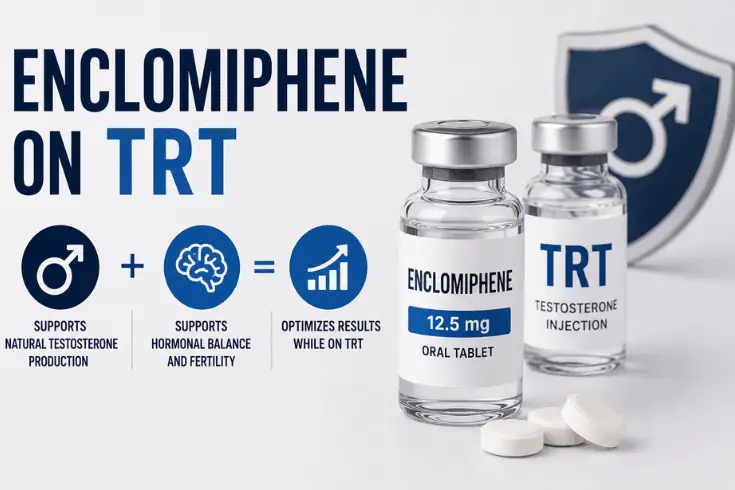
Enclomiphene on TRT is one of the most talked-about strategies for solving exactly this problem — giving men the reliable hormone optimization of testosterone replacement therapy while keeping the fertility-preserving pathways that traditional therapy switches off.
According to a clinical study published in Fertility and Sterility, enclomiphene citrate raises testosterone while preserving sperm production — a combination exogenous testosterone cannot offer. Here’s how that works and where it fits in a broader strategy.
Why Traditional TRT Creates a Fertility Problem
When you introduce external testosterone, your body’s feedback system — the hypothalamic-pituitary-gonadal (HPG) axis — senses adequate circulating testosterone and shuts down its own signals. The hypothalamus drops GnRH; the pituitary sharply reduces LH and FSH, the two hormones essential for testicular function.
What Happens to Your HPG Axis on TRT
Without LH, the testes stop making testosterone naturally. Without FSH, spermatogenesis halts. Exogenous testosterone suppresses LH, FSH, and sperm production, pushing a large share of men into oligospermia (severely low sperm count) or azoospermia (zero sperm) within months.
Two consequences follow:
- Fertility suppression: most men on TRT can’t father children through natural conception while on therapy — an expected outcome, not a small risk. (See our guide on TRT and fertility.)
- Testicular atrophy: without LH, the testes commonly shrink 20–30% — a change that’s psychologically significant and can complicate later efforts to restore production.
This is the problem enclomiphene addresses. For the complete hormonal mechanism, see how TRT works.
What Is Enclomiphene — and How Is It Different?
Enclomiphene is a selective estrogen receptor modulator (SERM) — the isolated trans-isomer of clomiphene citrate. Its mechanism is the opposite of TRT’s suppression:
- It blocks estrogen receptors in the hypothalamus and pituitary
- Those regions read this as low sex-hormone levels
- The hypothalamus increases GnRH
- The pituitary raises LH and FSH
- The testes increase natural testosterone production
- FSH simultaneously stimulates spermatogenesis, maintaining sperm production
Clinical data show enclomiphene can raise total testosterone by roughly 150–300 ng/dL while preserving or improving sperm count and motility — something exogenous testosterone cannot do.
Enclomiphene vs Clomid (Clomiphene): Why It Matters
Many men have heard of clomiphene citrate (Clomid), used off-label for male hypogonadism for years. Clomiphene contains two isomers: enclomiphene (the beneficial trans-isomer) and zuclomiphene (a cis-isomer with weak estrogenic properties that can cause mood instability, visual disturbances, and estrogenic effects). Enclomiphene isolates only the trans-isomer, removing zuclomiphene entirely:
- Fewer visual disturbances
- Reduced estrogenic side effects and gynecomastia risk
- Better mood stability with long-term use
- More predictable pharmacokinetics
- A cleaner signal to the HPG axis
That makes enclomiphene more practical than clomiphene for ongoing use alongside TRT.
Enclomiphene on TRT: The Strategy and the Evidence
The rationale: can you get reliable testosterone from TRT while keeping the HPG axis partially active with enclomiphene to preserve fertility? In many cases, yes — but it requires honest nuance.
The challenge: exogenous testosterone provides direct negative feedback through testosterone receptors, independent of estrogen receptors. Enclomiphene blocks estrogen receptors, but testosterone itself still suppresses the axis. In practice:
- At lower TRT doses (targeting 600–800 ng/dL), enclomiphene meaningfully maintains LH, FSH, natural production, and sperm output.
- At higher doses (above 1,000 ng/dL), testosterone-mediated suppression may overwhelm enclomiphene’s effect.
- Individual response varies — some men keep strong fertility markers, others find exogenous testosterone suppresses the axis regardless.
The 2014 Fertility and Sterility study found enclomiphene raised testosterone while maintaining sperm production in a way testosterone replacement alone could not. Benefits when the combination works: measurable (if reduced) sperm counts, testicular volume closer to normal, LH and FSH above complete suppression, and faster fertility recovery when transitioning off TRT. For the broader benefits profile when fertility isn’t the concern, see benefits of TRT.
Enclomiphene vs TRT: A Direct Comparison
| Traditional TRT | Enclomiphene Monotherapy | Enclomiphene + TRT | |
|---|---|---|---|
| Testosterone source | External | Natural | Both |
| HPG axis effect | Suppressed | Stimulated | Partially maintained |
| Fertility impact | Severe suppression | Preserved/improved | Partial preservation |
| Testicular atrophy | Common | Prevented | Reduced |
| Testosterone consistency | High | Moderate | High |
| Oral administration | No | Yes | Mixed |
| Regulatory status | FDA-approved | Not FDA-approved (compounded) | Not FDA-approved (compounded) |
For men with secondary hypogonadism, a signaling failure at the hypothalamus or pituitary — enclomiphene monotherapy may restore testosterone with no exogenous testosterone at all. That’s the cleanest option for fertility-focused men who can reach adequate levels through natural stimulation. Comparing what is TRT helps clarify how these approaches differ.
Dosing, Timing, and What to Expect
Enclomiphene for use alongside TRT is prescribed off-label through compounding pharmacies under physician supervision.
Typical dosing: conservative 6.25–12.5 mg daily (lower TRT doses); standard 12.5–25 mg daily (moderate TRT doses, most common).
| Traditional TRT | Enclomiphene + TRT |
|---|---|
| 100–200 mg testosterone weekly | 60–120 mg weekly + enclomiphene |
| Complete HPG suppression | Partial HPG maintenance |
| Severe fertility suppression | Partial fertility preservation |
Timeline: LH and FSH begin rising in weeks 2–4; energy, libido, and mood improve in weeks 4–6; semen analysis is meaningful only after ~3 months (spermatogenesis takes ~74 days); testicular size changes gradually over months 3–6.
Essential Monitoring
| Test | Frequency | Why |
|---|---|---|
| Total + free testosterone | Every 6–8 weeks initially | Confirm therapeutic levels |
| LH and FSH | Every 6–8 weeks | Key indicator enclomiphene is working |
| Estradiol (sensitive) | Every 6–8 weeks | Watch for excess estrogen |
| Hematocrit / CBC | Every 3 months | Polycythemia monitoring |
| Semen analysis | Baseline + every 3–6 months | Verify sperm production maintained |
Signs the combination is working: LH above zero, detectable FSH, sperm present on analysis, and testosterone in the 600–1,000 ng/dL range. Our guide on how to test testosterone covers a proper morning panel, and understanding free testosterone vs total testosterone matters when interpreting a combination protocol. Estrogen balance is also critical — see anastrozole and TRT.
Who Is the Right Candidate?
Best candidates: men actively trying to conceive who need testosterone optimization; younger men (under 40) with longer reproductive horizons; men concerned about testicular atrophy; those targeting 600–800 ng/dL; and men transitioning off TRT who want to restore natural production. For ongoing strategy, see maintaining fertility on TRT and how to preserve sperm production.
Approach with caution: men with primary testicular failure (can’t respond to LH stimulation); those needing very high testosterone (suppression overrides enclomiphene); and men with completed family planning, where fertility preservation isn’t a priority. Reviewing the full TRT side effects profile helps weigh the trade-offs.
Using Enclomiphene to Come Off TRT
Beyond concurrent use, enclomiphene helps restart natural production after stopping testosterone:
- Weeks 1–2: allow exogenous testosterone to clear
- Weeks 3–16: enclomiphene 12.5–25 mg daily; monitor hormones every 4–6 weeks
- Week 16+: assess whether natural production has recovered adequately
Recovery timelines vary — some men restore adequate production in 8–12 weeks, others need longer. Our guide on what happens when you stop TRT covers what discontinuation involves.
The Bottom Line on Enclomiphene on TRT
Enclomiphene on TRT is a genuinely useful strategy for men who want testosterone optimization without sacrificing fertility or testicular health. The mechanism is sound, the rationale is evidence-supported, and for the right patient — particularly younger men on moderate doses who are actively trying to conceive — it can preserve what traditional TRT would suppress.
What matters most:
- Enclomiphene stimulates the HPG axis — the opposite of TRT’s suppression
- It’s preferable to clomiphene (Clomid) for male use because zuclomiphene is removed
- It works best at moderate TRT doses targeting 600–800 ng/dL
- Monitoring LH, FSH, estradiol, and semen analysis is essential
- It also plays a valuable role in post-TRT recovery
This is an off-label, compounded, individualized protocol requiring physician oversight — not a self-directed supplement strategy. Book a consultation with TRT NYC to find out whether enclomiphene on TRT fits your situation, and to build a fertility-preserving protocol with proper LH, FSH, and semen monitoring.
Frequently Asked Questions
Does enclomiphene on TRT really preserve fertility?
It can, but results vary by individual and testosterone dose. The combination maintains measurable LH, FSH, and sperm production in many men on lower TRT doses. Treat it as partial fertility preservation, not guaranteed protection — semen analysis every 3–6 months is the only way to confirm for each person.
What dose of enclomiphene should I use with TRT?
Most protocols use 12.5–25 mg daily, with some physicians starting at 6.25–12.5 mg and adjusting on bloodwork. The optimal dose depends on the individual and the testosterone dose used, so physician guidance and regular monitoring are essential.
Is enclomiphene better than hCG with TRT?
hCG directly mimics LH, requires injection, and may raise estrogen more. Enclomiphene is oral, works upstream through the pituitary, and may produce more physiological hormone patterns. Individual response determines which works better — clinical evaluation is the only reliable way to know.
How long before I see results from enclomiphene on TRT?
Energy, libido, and well-being usually improve within 4–6 weeks, and LH and FSH may rise within 2–4 weeks. Semen analysis should wait at least 3 months, and testicular size changes gradually over several months.
Can enclomiphene help me come off TRT completely?
Yes — it accelerates HPG-axis restart after discontinuation, shortening the low-testosterone window and improving fertility recovery. Some men restore adequate natural levels; others return to replacement therapy. Prior TRT duration strongly influences the outcome.
What blood tests do I need on enclomiphene and TRT?
Total testosterone, free testosterone, estradiol (sensitive assay), LH and FSH, CBC, and a comprehensive metabolic panel — every 6–8 weeks initially, then quarterly. Add semen analysis at baseline and every 3–6 months if fertility is the priority.
Medical Disclaimer: For educational purposes only. Not medical advice, diagnosis, or treatment. Consult a qualified healthcare provider. TRT NYC is licensed in New York State. Individual outcomes vary.