
How to Start a TRT Clinic: A Step-by-Step Business Guide
 By Trevor Jaxon
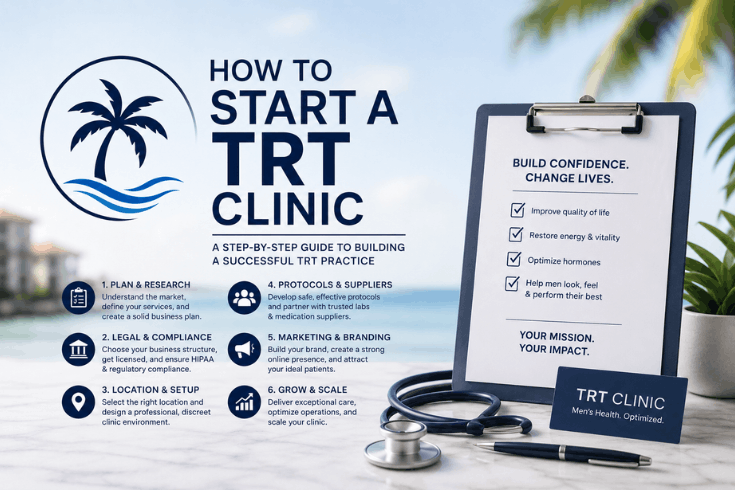
The men’s health and testosterone replacement therapy market has a documented supply gap. Roughly 13 million U.S. men have clinically low testosterone, fewer than 10% receive treatment, and demand through telehealth and men’s health clinics has grown sharply year over year. For licensed clinicians or healthcare entrepreneurs, a TRT-focused practice is one of the few areas in healthcare where the business model is simple, patient lifetime value is high, and overhead is low relative to revenue.
This guide walks through every step — from choosing a business model to your first year of operations — including the legal requirements most guides understate, the startup costs you should actually budget for, and the retention math that decides whether a membership TRT practice is profitable.
Step 1: Choose Your Business Model
Three viable structures exist, and your choice drives startup cost, regulatory complexity, and revenue.
Telehealth-only: The lowest-cost entry. You run everything through a HIPAA-compliant platform, partner with a CLIA-certified lab for bloodwork, and use a DEA-registered pharmacy for fulfillment.
Startup runs: $15,000–$50,000 depending on whether you build your own tech stack or use a white-label provider. Margins are highest because overhead is minimal.
Brick-and-mortar: A physical location with in-person consults, on-site phlebotomy, and possibly in-office administration. Higher trust and retention,
higher cost: $150,000–$400,000 for buildout and equipment, and $400,000–$780,000 total including six months of working capital.
Hybrid: Most scaling practices combine telehealth (initial consults, monitoring, remote patients) with one or more physical locations. The broadest market, the most operational complexity.
Most new entrants start telehealth-only: less capital, faster to first revenue, and a way to validate protocols before committing to physical infrastructure.
Step 2: Understand the Legal Requirements
This is where most guides are imprecise and where mistakes get expensive.
Physician-led. A physician with an active state license and individual DEA registration can prescribe testosterone in any state where they’re licensed. Testosterone is a Schedule III controlled substance, so DEA registration is mandatory. If you store testosterone on-site for in-office use, that physical address needs its own DEA registration — each location separately.
NP-led and PA-led. In full practice authority states — Arizona, Colorado, Oregon, Washington, New Mexico, and 20-plus others — an NP can independently own and operate a clinic, prescribe Schedule III substances, and hold their own DEA registration with no physician collaboration. Restricted states require a collaborating physician. These rules change quickly, so confirm current status before choosing where to operate.
Telehealth prescribing and the Ryan Haight Act. The Ryan Haight Act generally requires at least one in-person evaluation before a controlled substance is prescribed via telehealth. That requirement was waived during the COVID-19 public health emergency — and as of 2026, DEA and HHS issued a fourth temporary extension that lets clinicians prescribe controlled substances (including testosterone) via telehealth without a prior in-person visit, extended through December 31, 2026, while DEA finalizes a permanent rule. Because this is a temporary extension and a final rule is pending, confirm the live status with a healthcare attorney before launching — and build for the possibility that permanent rules add registration or recordkeeping requirements.
Entity formation. Most TRT clinics form a Professional Corporation (PC) or Professional LLC, structured to comply with your state’s corporate-practice-of-medicine doctrine. Some states require physician ownership of the medical entity; others permit a management services organization (MSO) that separates the clinical entity from business operations. Have a healthcare attorney review your structure before launch.
Step 3: Budget Your Actual Startup Costs
Telehealth-only (realistic):
- Telehealth platform + EHR: $500–$2,000/mo, or $10,000–$30,000 custom build
- DEA registration: $888 per registrant per three-year period
- State medical licenses (multi-state): $200–$700 each
- Legal and compliance setup: $5,000–$15,000
- Malpractice insurance: $2,500–$5,000/mo for a solo prescriber
- Lab partnership setup: $0–$5,000
- Marketing (first 3 months): $5,000–$20,000
- Realistic total to first patient: $25,000–$60,000
Brick-and-mortar (realistic):
- Buildout and equipment: $150,000–$400,000
- Medical supplies and initial hormone inventory: $40,000–$60,000
- Secure refrigeration for controlled substances: $10,000–$15,000
- EHR with EPCS: $500–$2,000/mo
- Malpractice insurance: $3,500–$5,000/mo
- Lease deposit (first/last): $10,000–$30,000
- Staffing payroll: $15,000–$25,000/mo
- Realistic total to first patient: $300,000–$780,000
The figures online suggesting you can open a physical TRT clinic for $75,000 ignore full buildout, working capital, and staffing. Budget for what the numbers actually require.
Step 4: Build Your Clinical Infrastructure
Medical director: If you’re not a physician, you need a medical director with an active license, DEA registration, and hormone-therapy experience — typically $2,000–$5,000/mo for protocol oversight, chart review, and compliance. A name-only, non-engaged director is a compliance liability, not a shortcut.
Lab partnerships: Every patient needs baseline and monitoring labs every 3–6 months. Partner with a CLIA-certified lab (Quest, LabCorp) offering 24–48 hour hormone-panel turnaround. For telehealth patients, at-home phlebotomy or direct-draw cards cut friction. Negotiate pricing on projected volume.
Clinical protocols: Evidence-based, documented, and director-reviewed. At minimum: eligibility criteria, baseline/monitoring panels, dosing and delivery selection, a contraindications checklist, informed consent, and management protocols for the common issues, elevated hematocrit, estrogen imbalance, and infertility concerns. Standardized protocols lower clinical risk and make the practice scalable.
Step 5: Technology Stack
EHR with EPCS: Electronic prescribing of controlled substances is legally required in a growing number of states and is best practice everywhere. Choose an EHR with built-in EPCS (AthenaHealth, DrChrono, or telehealth-first specialty platforms) rather than bolting on a third-party tool.
HIPAA-compliant communication: Email, SMS, and video must all be HIPAA-compliant, with a Business Associate Agreement (BAA) signed by every vendor that touches protected health information. This is a frequent violation area for new practices.
Lab and pharmacy integration: Automated lab ordering and result delivery into the chart cuts admin work and prevents missed results. A prescription workflow that transmits straight to your pharmacy partner reduces errors — confirm partners are DEA-registered, state-licensed in every state you serve, and compliant with USP Chapter 795/797 for compounded preparations.
Step 6: Pricing and the Math That Matters
The standard model charges a monthly membership covering provider access, protocol management, and medication, with labs and initial consults billed separately.
Typical pricing: $149–$249/mo for medication plus provider access; initial consult $0–$200; baseline labs $150–$350.
Profitability math:
- Average revenue per patient/month: ~$200
- Monthly overhead (telehealth): $15,000–$25,000
- Break-even: 75–125 active patients
At 200 active patients, a lean telehealth operation generates ~$480,000 annual revenue; at a 30% net margin, roughly $144,000 annual profit for a solo operator.
The single biggest variable is retention, this is a subscription business. At a 6-month average tenure, lifetime value is $1,200; at 24 months, it’s $4,800. With acquisition costs of $200–$600 per patient, the gap between 6-month and 24-month tenure is the gap between breaking even and scaling. Retention comes from clinical outcomes, responsive communication, and protocol quality: men who feel better stay; men whose symptoms aren’t resolved cancel.
Step 7: Marketing and Patient Acquisition
SEO: targeting informational and local terms — “testosterone therapy near me,” low testosterone symptoms, TRT cost — builds lower-cost acquisition over 6–12 months.
Paid search: (Google, Meta) drives patients from day one at $300–$600 per acquired patient in most markets.
Video: on YouTube and TikTok is outsized in men’s health — men research testosterone heavily before contacting a clinic, so a provider creating educational content builds trust before first contact.
Referral networks: are underused. PCPs, urologists, and endocrinologists see low-T men constantly but often won’t manage ongoing TRT — a simple referral relationship can produce steady flow.
Step 8: Compliance and Risk Management
- Malpractice insurance: $2,500–$5,000/mo, confirmed to cover telehealth and controlled-substance prescribing. Required by most lab and pharmacy partners.
- HIPAA risk assessment: a documented security risk assessment is legally required (4–8 hours, $500–$2,000). Skipping it is a real liability, not a checkbox.
- PDMP queries: most states require a Prescription Drug Monitoring Program check before prescribing a Schedule III substance. Build it into the workflow from day one.
- Informed consent: every patient signs documented consent covering risks, benefits, alternatives, and fertility implications — stored in the chart and updated when protocols change.
What Kills Most TRT Clinics in Year 1
Three failure modes dominate:
- Compliance problems found post-launch — DEA registration errors, missing BAAs, or a medical-director arrangement that doesn’t meet state rules. Cheap to fix before launch, catastrophic after an audit.
- Acquisition cost exceeding lifetime value — running paid ads without knowing your retention numbers builds a practice that grows in patient count while losing money on each one.
- Underestimating clinical workload — a membership is not passive income. A solo operator without support staff usually hits a ceiling at 100–150 patients. Plan staffing before you hit the wall.
Frequently Asked Questions
Do you need to be a physician to open a TRT clinic?
Not in every state. In full practice authority states, a nurse practitioner can independently own and operate a TRT clinic, prescribe testosterone, and hold their own DEA registration with no physician collaboration. Restricted states require a collaborating physician. Check your state’s current NP authority before building around a physician-free model.
How much does it cost to start a TRT clinic?
A telehealth-only operation runs $25,000–$60,000. A brick-and-mortar clinic needs $300,000–$780,000 in total startup capital once buildout, equipment, working capital, malpractice, and staffing are included. Figures under $100,000 for a physical clinic aren’t realistic.
Can a nurse practitioner open a TRT clinic?
Yes, in full practice authority states — over 20 currently grant NPs independent prescribing including Schedule III substances. There, an NP can own the medical entity, hold a DEA registration, and operate without a collaborating physician. Confirm your state’s rules with a healthcare attorney first.
How do you get DEA registration for a TRT clinic?
Individual practitioners apply through the DEA’s online system at deadiversion.usdoj.gov. You need an active state license, a registered business address, and the substance schedules you’ll prescribe. Each physical location storing controlled substances needs its own facility registration. The fee is $888 per registrant for a three-year period.
How many patients do you need to be profitable?
A lean telehealth practice with $15,000–$20,000 monthly overhead breaks even around 75–100 active members at ~$200 average monthly revenue. A physical clinic with $40,000–$60,000 overhead needs 200–300 patients. These are operational break-evens before owner pay.
What is the Ryan Haight Act and how does it affect TRT telehealth?
The Ryan Haight Act generally requires one in-person evaluation before prescribing a controlled substance via telehealth, and testosterone is Schedule III. As of 2026, DEA and HHS extended pandemic-era flexibilities through December 31, 2026, allowing telehealth testosterone prescribing without an in-person visit while a permanent rule is finalized. Because the extension is temporary, confirm the current status with a healthcare attorney before launching.