
TRT Before and After Face: How Testosterone Changes Your Appearance and What It Doesn’t
 By Trevor Jaxon
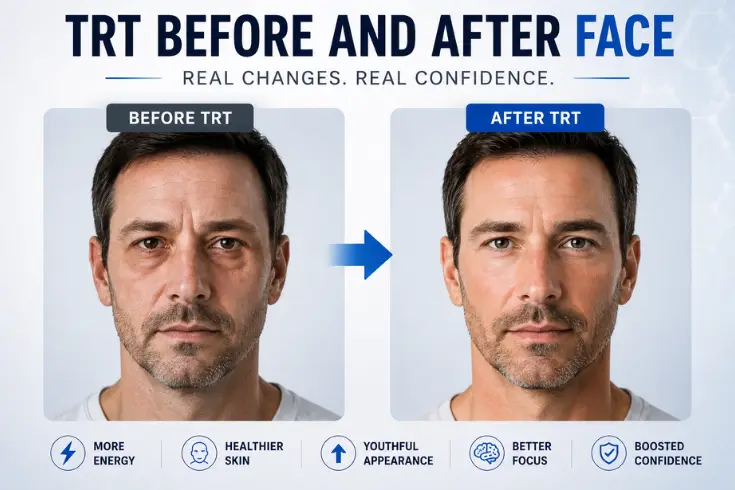
TRT before and after face results are real — but they don’t all work the same way, they don’t all happen on the same timeline, and two of them come with trade-offs that most clinic articles won’t tell you about.
Testosterone replacement therapy (TRT) is a medical protocol that restores testosterone to an optimal physiological range in men with confirmed hypogonadism. Its effects on the face operate through four distinct biological mechanisms — fat redistribution, collagen and skin quality, DHT-driven sebum production, and facial muscle tone — each working on a different timeline, each producing results that range from reliable to genetics-dependent.
This guide maps all four, covers what can temporarily make your face look worse after starting TRT, names the specific trade-off with your scalp, and gives the honest list of what testosterone cannot change about your face. For the full picture of what TRT produces across your body, see our complete TRT before and after guide.
What Low Testosterone Actually Does to Your Face Before TRT
The “before” picture matters here because it determines how much the “after” changes. When testosterone falls below optimal range, fat distribution shifts. The body preferentially stores more subcutaneous fat and the face reflects this with increased fullness in the cheeks, softness under the chin, and reduced jaw-neck definition. This facial softening is compounded by a slowdown in collagen synthesis: lower testosterone levels mean less androgen receptor stimulation in the skin’s dermal fibroblasts, producing skin that loses thickness, firmness, and elasticity faster than it otherwise would.
The result is the low-testosterone facial profile: rounder, softer, puffier, with less definition at the jaw and cheekbones and skin that looks less vibrant than it once did. Men with longstanding low T often describe this as “looking tired” or “looking older than I feel” — neither of which is explained by a single identifiable cause, which is why it often goes unrecognized as hormonal in origin.
The symptoms of low testosterone extend far beyond the face, but the face is often where the cumulative effect of years of hormonal decline is most visible.
The Four Ways TRT Changes Your Face and Which Ones You Can Count On
Lumping all facial TRT changes together produces vague expectations. Separating the four mechanisms tells you which changes are reliable, which depend on genetics, and which come with a trade-off.
Mechanism 1: Fat Redistribution the most reliable change
This is the primary driver of the facial transformation most men describe. Testosterone regulates fat storage systemically, and low testosterone is directly associated with increased facial fat particularly in the cheeks, jawline, and submental area (under the chin). As TRT restores testosterone and body fat begins redistributing away from these areas, the jaw-neck separation becomes clearer, cheeks appear less full, and the overall profile becomes more angular. This change is reliable and proportional to how much facial fat was present men who carry more facial fat see a more dramatic change; men who were already lean see subtler results.
Mechanism 2: Collagen and Skin Quality substantial but slow
Testosterone supports collagen synthesis through androgen receptor activity in dermal fibroblasts. Research on androgen receptor signaling and skin collagen content confirms that androgens play a direct role in collagen production, with androgen-deficient subjects showing measurably decreased dermal collagen. TRT restoring testosterone to optimal levels supports improved collagen synthesis over months, producing firmer skin, improved texture, and a reduction in the progression of fine lines. This change is real and clinically supported — but it operates over six to twelve months, not weeks.
Mechanism 3: DHT, Sebum, and the Acne Trade-Off a two-sided mechanism
Testosterone converts to dihydrotestosterone (DHT) via the 5-alpha reductase enzyme in the skin. DHT has high affinity for androgen receptors in the sebaceous (oil) glands and strongly stimulates sebum production. This produces two outcomes simultaneously: better-hydrated, more resilient skin (positive) and, for a meaningful subset of men, increased oiliness and acne — particularly along the jawline, chin, and forehead — in the early weeks of therapy. Research cites TRT-related acne rates between 0.6% and 9% of men on therapy, with injectable forms producing more pronounced flare-ups due to testosterone peaks post-injection. This is a mechanism to manage, not one to fear more on that in the acne section below.
Mechanism 4: Facial Muscle Tone minor contributor
Testosterone’s anabolic effects on skeletal muscle extend to the facial musculature, including the masseter and surrounding jaw muscles. The effect here is subtle — marginally increased jaw muscle development may contribute to a slightly more defined lower face profile over six to twelve months. This is not the primary driver of the jawline definition most men attribute to TRT; that is almost entirely the fat redistribution mechanism. Expect this to be a modest contributor at best.
TRT Before and After Face: What Changes at Each Stage
| Facial Change | Before TRT (Low-T State) | After TRT (Months 3–12) | Timeline |
| Facial fat / puffiness | Rounder, softer; puffiness in cheeks and under chin | Leaner contours; clearer jaw-neck separation | 3–6 months |
| Skin quality | Dull, thinning, dry; fine lines more visible | Firmer, better-hydrated; improved texture | 3–6 months |
| Sebum / oiliness | Decreased sebum, drier skin | Normalized; possible oily/acne phase early | Weeks 4–12, then stabilizes |
| Jawline definition | Soft, undefined | More angular as fat reduces | 3–6 months |
| Facial hair | Slower or thinner growth | Thickens for genetically responsive men | 6–12 months |
| Scalp / hairline | Stable or improving (lower DHT) | DHT rise may accelerate loss in susceptible men | Variable |
| Acne | Minimal | Possible flare; resolves for most by week 16 | Weeks 4–12 |
| Skin aging | Progressing with collagen loss | Slows or partially reverses | 6–12 months |
Months 1–3
The earliest visible facial change is usually reduction in puffiness — particularly if elevated estradiol was contributing to fluid retention before TRT. Skin oiliness increases for some men in this window as DHT stimulates sebum glands; this is also when initial acne is most likely. Jawline definition does not yet change significantly — body fat redistribution takes longer to register at the face.
Months 3–6
Fat redistribution becomes visible. Jaw-neck separation improves; cheeks appear leaner. Skin quality begins improving — texture firms, dullness reduces. For men with genetically responsive facial follicles, beard density may start increasing in this window. This is also when the skin oiliness from weeks 4–8 typically stabilizes for most men.
Months 6–12
The facial changes reach their most visible expression. The jawline is at its clearest definition — still built on fat reduction and muscle tone, not bone remodeling. Skin quality is measurably better: collagen synthesis has been supported for six-plus months, producing skin that is firmer, more hydrated, and less lined. Facial hair growth, if it was going to respond, is thicker now. This is the window that produces the before/after photos most associated with TRT transformation.
For the week-by-week breakdown of the first 90 days, see our TRT before and after 3 months guide.
The Trade-Off Nobody Mentions: Better Face, Potentially Worse Scalp
This is the honest conversation about DHT that most TRT clinic articles omit.
DHT is the mechanism behind two simultaneous outcomes on TRT: facial hair follicles are stimulated (beard growth, potentially improved facial definition), and scalp hair follicles in men with androgenetic alopecia are progressively miniaturized (thinning, recession). Both effects are driven by the same DHT elevation. TRT typically raises DHT two to three times above pre-treatment levels, depending on dose and delivery method.
The clinical reality: a man who starts TRT may see his face become leaner, his skin improve, and his beard fill in — while his hairline recedes simultaneously. This is not a complication or a side effect in the traditional sense. It is a predictable androgenic effect in men who carry the genetic predisposition for androgenetic alopecia.
For men with a family history of male-pattern hair loss, this conversation belongs before TRT starts, not after. The options are not “TRT or hair” — they are concurrent DHT management alongside TRT. How to avoid hair loss on TRT covers those options in detail. For men with no genetic predisposition, the DHT rise is unlikely to produce meaningful scalp changes. See TRT and hair loss for the full picture.
When TRT Temporarily Makes Your Face Look Worse The Estrogen Effect
In weeks four to eight of TRT, as testosterone levels rise and the aromatase enzyme converts a portion to estradiol, some men experience facial puffiness and water retention the opposite of the leaner, more defined outcome they expected.
This is the estrogen-face problem, and it explains the most common negative facial experience on early TRT: “I started therapy and my face looked puffier, not more defined.” The mechanism is the same estradiol plateau that causes the week 4–8 symptom reversal in many men — elevated E2 drives fluid retention systemically, including in the face.
For most men, this resolves as the body adapts and estradiol stabilizes, typically by weeks 10–12. For men whose estradiol remains elevated above 40–50 pg/mL — confirmed by a blood test drawn at trough — the puffiness persists until estrogen is managed through protocol adjustment.
The diagnostic check is straightforward: if facial puffiness appeared alongside other high estrogen symptoms on TRT — water retention in the hands or midsection, mood changes, breast tissue sensitivity request an estradiol (sensitive assay) test. If E2 is elevated, anastrozole or protocol adjustments can address it without stopping TRT.
What TRT Cannot Change About Your Face The Honest Limits
Adult bone structure.
Every article correctly states this, but it bears specificity: TRT supports ongoing bone mineral density improvement — particularly in men who start therapy before 50 — but it cannot remodel the structural geometry of an adult face. The size of your jaw, the width of your cheekbones, the position of your brow ridge — these are determined by genetics and development, not by hormone levels in adulthood.
Genetics-driven fat distribution patterns.
Where your body stores residual fat — including in the face — has a significant genetic component. TRT will reduce overall body fat, and the face will reflect some of that reduction. But men who carry fat predominantly in the face regardless of body weight will see a less dramatic change than men whose facial fat is primarily a consequence of systemic fat accumulation.
Existing skin damage.
TRT supports better collagen synthesis going forward and can slow further skin aging. It does not reverse scarring, sun damage, deep rhytids (wrinkles from repeated muscle movement), or accumulated photodamage. The skin improvement from TRT is meaningful but is in the category of slowing and partially reversing aging — not resetting it.
Existing structural aging changes.
Volume loss in the mid-face, descent of fat pads with gravity, and structural bony changes from decades of aging will not reverse with TRT. The hormonal component of facial aging is real and addressable with TRT; the structural and gravitational component is not.
Acne on TRT: What to Expect, When It Resolves, and What to Do If It Doesn’t
Acne and oily skin from TRT are real, predictable, and manageable. They are not a reason to stop therapy.
What to expect:
Increased oiliness and possible acne typically begin at weeks four to eight, coinciding with testosterone reaching steady state and DHT levels rising. The most common pattern is jawline and chin acne — areas with the highest density of androgen-sensitive sebaceous glands. For most men, oiliness peaks by weeks six to eight and begins subsiding by weeks twelve to sixteen as the body adapts to the new hormonal environment. Research from the American Academy of Dermatology recognizes testosterone-related acne as its own clinical category with specific management protocols.
Step 1 Basic skincare for mild oiliness:
A twice-daily non-comedogenic cleanser and oil-free moisturizer is sufficient for most men in the first twelve weeks. Avoid abrasive scrubs that strip the skin barrier and trigger compensatory oil production.
Step 2 Topical treatment for moderate acne:
Topical benzoyl peroxide (2.5–5%) applied to the jaw, chin, and forehead addresses most TRT-related breakouts. Topical retinoids (adapalene, tretinoin) are effective for persistent cases and support the collagen benefits of TRT simultaneously.
Step 3 Injection frequency adjustment:
TRT acne correlates with testosterone spikes. Men on once-weekly injections who develop acne often see significant improvement by splitting to twice-weekly dosing at half the volume which reduces peak-to-trough swings and the associated DHT spike.
Step 4 Dermatology referral for persistent acne beyond week 16:
Oral doxycycline is used for testosterone-related acne that doesn’t respond to topical management. See your TRT side effects guide for what protocol-level adjustments look like in practice.
Frequently Asked Questions
Does TRT change your face?
Yes — primarily through fat redistribution, collagen improvement, and DHT-driven skin changes. The most reliable change is a leaner facial contour as body fat decreases systemically. Skin quality improves over months as collagen synthesis is supported. Beard growth may increase in genetically responsive men. These changes are real but gradual — visible results develop over three to twelve months, not weeks.
How long does it take to see facial changes on TRT?
Reduced facial puffiness from fat redistribution begins at three to six months. Skin quality improvement is detectable at three to six months and continues through twelve months and beyond. Jawline definition — which depends on fat reduction and not bone remodeling — follows the same three-to-six-month trajectory. Beard growth responds over six to twelve months in genetically responsive men. For the week-by-week breakdown of the first 90 days, see our TRT before and after 3 months guide.
Can TRT give you a more defined jawline?
Yes, but almost entirely through fat redistribution rather than structural change. As body fat decreases on TRT, the face becomes leaner and the existing jaw structure becomes more visible. Marginally increased jaw muscle tone contributes modestly over six to twelve months. TRT cannot remodel adult facial bone structure — the definition comes from revealing the structure you already have, not building a new one.
Does TRT cause acne or oily skin?
Acne and oiliness occur in a meaningful subset of men — research cites rates between 0.6% and 9% — due to DHT stimulating sebaceous glands. It typically appears at weeks four to eight and resolves by weeks twelve to sixteen for most men. It is manageable without stopping TRT through skincare routine, topical treatments, and injection frequency adjustment if needed.
Does TRT change your bone structure?
No — not in any meaningful way in adult men. TRT supports ongoing bone mineral density improvement, which is clinically significant for long-term skeletal health, but adult facial bone geometry cannot be remodeled by hormone therapy. The facial changes from TRT come from soft tissue — fat, skin, and muscle — not skeletal structure.
Does testosterone make you look younger?
TRT can produce a measurably younger-looking face through fat redistribution (leaner contours), collagen support (firmer, better-hydrated skin), and the general improvement in body composition that reduces the physical markers of metabolic aging. However, it does not reverse structural aging, existing skin damage, or gravity-related changes. A realistic description: TRT can make you look like a healthier, leaner version of yourself — not like a different person.
What happens to your face if you stop TRT?
Facial changes from TRT reverse gradually over months following discontinuation. Fat redistribution reverses as testosterone drops and fat storage patterns return to pre-treatment baseline. Skin quality regrades as collagen synthesis support is removed. Beard growth progress is largely maintained (follicles already activated don’t typically revert). Acne, if it was present, typically resolves after stopping. The timeline for reversal parallels the timeline for improvement — roughly three to six months for most changes.
If you’re seeing facial changes — positive or negative — that you want to understand or manage, the underlying labs tell the story. Book a consultation with TRTNYC to get your testosterone, estradiol, and DHT levels reviewed and a protocol designed around your specific response.