
What Is an Anti-Ageing Injection? The Two Types and How They Work
 By Trevor Jaxon
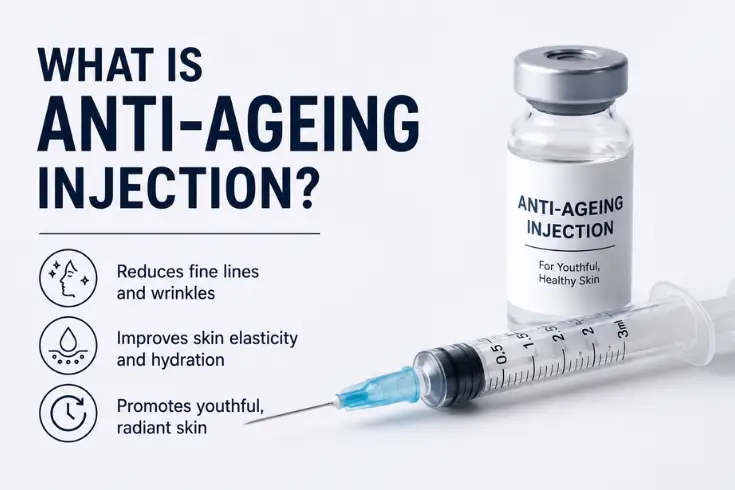
If you’ve searched what an anti-ageing injection is, you’ve probably found the same answer everywhere: Botox and fillers. That answer is half the picture. An anti-ageing injection is a minimally invasive treatment that delivers a medicine, gel, or biological compound beneath the skin or into the body to reduce the signs of ageing. These injections fall into two broad categories: cosmetic injections like Botox and dermal fillers that smooth or fill the visible signs of ageing on the face, and regenerative injections like peptides and NAD+ that target the biological processes of ageing from within.
Most articles cover only the first category. This guide covers both — how each type works, what they cost, how strong the evidence is, and which one fits your specific goal and stage of life.
The Two Categories of Anti-Ageing Injections
The single most useful thing to understand about anti-ageing injections is that “anti-ageing injection” is an umbrella term for two fundamentally different approaches.
Cosmetic injections work from the outside in
They target the visible signs of ageing on the face — wrinkles, lost volume, sagging — at a specific location. Botox relaxes the muscles that create expression lines; dermal fillers replace volume that has been lost. These are localized, fast-acting, and address how ageing looks. They do not change the underlying biology; they manage its visible effects on the surface.
Regenerative injections work from the inside out
They target the biological processes that drive ageing — declining collagen production, falling hormone levels, reduced cellular energy and repair capacity. Peptides, NAD+, and growth hormone secretagogues like sermorelin fall into this category. Their effects are systemic (whole-body, not one spot), gradual, and aimed at how ageing works rather than only how it looks.
Neither category is “better” — they do different jobs. A person wanting to soften forehead lines needs a cosmetic injection. A person wanting to support skin quality, energy, and recovery as their body’s own systems decline is looking at the regenerative category. Many people eventually combine both. Understanding which problem you’re actually solving is the first step to choosing correctly.
Cosmetic Anti-Ageing Injections: Botox, Fillers, and More
Cosmetic injectables are the most familiar — and the most evidence-backed — anti-ageing injections.
Botulinum toxin (Botox, Dysport, Xeomin)
Botox is the most common anti-ageing injection in the world. It works by temporarily blocking the nerve signals that tell certain facial muscles to contract. When those muscles relax, the dynamic wrinkles they create — forehead lines, frown lines between the brows, crow’s feet around the eyes — soften and smooth. Results appear within three to five days and last about three to four months, after which the treatment is repeated. According to the American Society of Plastic Surgeons, botulinum toxin is among the most-performed minimally invasive cosmetic procedures, with a strong, decades-long safety record in trained hands.
Dermal fillers (Juvederm, Restylane)
Fillers do the opposite job of Botox. Instead of relaxing muscles, they add volume. Most modern fillers are made of hyaluronic acid — a gel-like substance the body produces naturally — injected to restore fullness to cheeks that have hollowed, plump lips, and smooth deeper static lines that are present even when the face is at rest. Results are immediate and last anywhere from six months to two years depending on the product and the area. This is the key distinction most people get wrong: Botox relaxes, fillers fill they solve different problems.
Collagen stimulators and PRP
A third group works more gradually. Collagen stimulators (such as poly-L-lactic acid) prompt the skin to build its own collagen over months, improving firmness rather than filling a specific line. Platelet-rich plasma (PRP) — the “vampire facial” — uses a concentrate from your own blood to stimulate skin renewal. These sit at the boundary between cosmetic and regenerative, because they work by stimulating your tissue rather than simply masking a wrinkle.
Regenerative Anti-Ageing Injections: Peptides, NAD+, and Hormonal Support
This is the category most “what is an anti-ageing injection” articles skip — and it’s where the science of ageing is moving fastest.
Sermorelin and growth hormone peptides
Sermorelin is a growth hormone secretagogue — a compound that prompts your pituitary gland to release more of your body’s own growth hormone, which naturally declines with age. Rather than injecting synthetic growth hormone directly, sermorelin works with your body’s natural rhythms. Supporters use it to support collagen production, skin firmness, sleep quality, fat metabolism, and recovery. It is a prescription medication and requires medical supervision.
NAD+ injections
NAD+ (nicotinamide adenine dinucleotide) is a coenzyme present in every cell, central to energy production and DNA repair. NAD+ levels fall with age, and the theory behind NAD+ injections and IV therapy is that restoring it supports cellular energy, repair processes, and metabolic function. The research is genuinely promising but still emerging — NAD+ is one of the most actively studied molecules in longevity science.
Collagen-stimulating and repair peptides
A range of peptides — short chains of amino acids that signal specific cellular processes — are used to stimulate collagen, support tissue repair, and improve skin quality from within. As a category, peptides target the biology of skin ageing rather than its surface appearance.
Where hormone optimization fits
For many adults, the most significant driver of how their body ages is the decline of their own hormones. Restoring a hormonal baseline that has dropped below optimal — through medically supervised testosterone replacement therapy in men, for example — is itself a regenerative anti-ageing strategy, supporting muscle maintenance, bone density, energy, skin quality, and metabolic health. It addresses ageing at a systemic, biological level rather than cosmetically.
Cosmetic vs. Regenerative: A Side-by-Side Comparison
| Dimension | Cosmetic Injections (Botox, Fillers) | Regenerative Injections (Peptides, NAD+, Sermorelin) |
| What they target | Visible signs on the face (wrinkles, volume loss) | Underlying biology of ageing (cellular repair, collagen, hormones) |
| How they work | Relax muscles (Botox) or add volume (fillers) | Stimulate the body’s own repair, hormone, or energy systems |
| Where they act | Localized — the injection site | Systemic — whole-body effects |
| Onset of results | Botox 3–5 days; fillers immediate | Gradual — weeks to months |
| Duration | Botox 3–4 months; fillers 6–24 months | Ongoing while treatment continues |
| Evidence base | Strong — FDA-approved, decades of data | Emerging — promising but less robust |
| Typical cost | Botox ~$150–500/session; fillers $600–1,200+/syringe | Varies; often $200–600+/month |
| Best for | Targeted wrinkle and volume correction | Whole-body ageing, energy, skin quality, longevity |
What Anti-Ageing Injections Cost
Cost is where most guides go vague. Here are realistic ranges.
Botox / botulinum toxin
The American Society of Plastic Surgeons reports an average cost around $528 per session, with individual treatments commonly ranging from $150 to $500 depending on the number of units and the area treated. Because results last three to four months, budgeting for three to four sessions per year is realistic — roughly $600–2,000 annually.
Dermal fillers
Typically $600–1,200 or more per syringe, with many people needing one to two syringes per area. Because fillers last six months to two years, the annual cost varies widely based on how many areas are treated and how often.
Regenerative injections
These vary the most. Peptide and sermorelin protocols often run $200–600+ per month depending on the compound and provider. NAD+ therapy is frequently priced per session or as part of a package. Hormone optimization costs depend on the protocol and monitoring involved.
Cosmetic injections are almost never covered by insurance, since they are elective. Regenerative and hormonal treatments may be partly covered when prescribed for a diagnosed medical condition (such as clinically low testosterone) rather than purely for anti-ageing.
Are Anti-Ageing Injections Safe? An Honest Look at the Evidence
Safety depends heavily on both the type of injection and the skill of the provider — and the two categories have very different evidence profiles.
Cosmetic injectables
have a strong safety record when administered by trained, licensed professionals. Botox and hyaluronic acid fillers are FDA-approved with decades of clinical data. Side effects are usually mild and temporary — bruising, swelling, or redness at the injection site. Research found roughly 16% of people receiving botulinum toxin in the upper face experienced mild side effects. Serious complications are uncommon but rise sharply when injections are performed by untrained injectors, which is why provider selection matters more than any other safety factor.
Regenerative injectables
require more honesty about the evidence. Peptides, sermorelin, and NAD+ show genuine promise, and the underlying science of cellular ageing is advancing quickly — but the long-term clinical evidence base is less mature than it is for Botox and fillers. These are not magic, and anyone marketing them as guaranteed age-reversal is overstating the case. Sermorelin and similar peptides are prescription medications that should only be used under medical supervision, with appropriate baseline testing and monitoring.
Who anti-ageing injections are not for
anyone seeking a single permanent fix (all of these require ongoing treatment), anyone pregnant or breastfeeding (cosmetic injectables are generally avoided), and anyone pursuing regenerative injections without medical supervision. Realistic expectations and a qualified provider are non-negotiable for both categories.
Which Anti-Ageing Injection Is Right for You?
The right injection depends on your goal and, to some extent, your stage of life.
If your goal is a specific wrinkle or expression line
forehead lines, frown lines, crow’s feet — Botox is the targeted answer. This is the most common entry point, often beginning in the 30s as a preventative measure to soften lines before they become deeply etched.
If your goal is restoring lost volume
hollow cheeks, thinning lips, deep static folds — dermal fillers are the tool. Volume loss tends to accelerate in the 40s and 50s, making this a common mid-life choice.
If your goal is whole-body
supporting energy, skin quality, recovery, and metabolic health as your own systems decline — the regenerative category (peptides, NAD+, hormone optimization) targets ageing at its biological source. This suits people focused on longevity and overall function, not just facial appearance, and is appropriate at any adult age with proper medical workup.
Many people combine categories
A common longevity-minded approach pairs targeted cosmetic injections for specific facial concerns with a regenerative protocol addressing systemic ageing. The two are complementary, not competing — one manages how ageing looks, the other targets how it works.
Frequently Asked Questions
What are the different types of anti-ageing injections?
There are two broad categories. Cosmetic injections — Botox (relaxes wrinkle-causing muscles), dermal fillers (restore lost volume), and collagen stimulators — target the visible signs of ageing on the face. Regenerative injections — peptides, sermorelin, NAD+, and hormone optimization — target the underlying biology of ageing from within, supporting collagen, cellular energy, and hormonal balance systemically rather than at a single site.
How much do anti-ageing injections cost?
Botox averages around $528 per session ($150–500 per treatment), repeated three to four times a year. Dermal fillers run $600–1,200 or more per syringe and last six months to two years. Regenerative injections like peptides and sermorelin often cost $200–600+ per month. Cosmetic injections are rarely covered by insurance; hormonal treatments may be partly covered when prescribed for a diagnosed condition.
Are anti-ageing injections safe?
Cosmetic injectables like Botox and hyaluronic acid fillers are FDA-approved with strong safety records when performed by trained, licensed professionals — side effects are usually mild and temporary. Regenerative injections show promise but have a less mature evidence base and should only be used under medical supervision. For both categories, provider qualification and realistic expectations are the most important safety factors.
How long do anti-ageing injections last?
It depends on the type. Botox lasts three to four months. Dermal fillers last six months to two years depending on the product and area. Collagen stimulators build results over months that can last one to two years. Regenerative injections like peptides and NAD+ work gradually and maintain their effects only while treatment continues — they are ongoing protocols rather than one-time procedures.
At what age should you start anti-ageing injections?
There is no fixed age. Preventative Botox is commonly started in the early-to-mid 30s to soften expression lines before they deepen. Volume-restoring fillers are more common in the 40s and 50s as facial fat naturally declines. Regenerative injections targeting systemic ageing can be appropriate at any adult age with proper medical evaluation — the right time depends on your goals and your baseline health, not a number.
Do anti-ageing injections really work?
Cosmetic injections work reliably and visibly — Botox demonstrably softens dynamic wrinkles and fillers demonstrably restore volume, both backed by extensive clinical evidence. Regenerative injections target ageing biology and show genuine promise, but their evidence base is still emerging, and results are gradual and subtler than the immediate cosmetic effect. Both work within realistic expectations; neither stops ageing entirely.
What is the best anti-ageing injection?
There is no single best — it depends on your goal. For a specific wrinkle, Botox is best. For lost facial volume, fillers are best. For whole-body ageing, energy, and skin quality from within, the regenerative category (peptides, NAD+, hormone optimization) is the better fit. The “best” injection is the one matched to the problem you’re actually trying to solve.
If you’re exploring anti-ageing injections that work from the inside — peptides, growth hormone support, or hormonal optimization — the right starting point is understanding your own biology. Book a consultation with TRTNYC to get baseline bloodwork, a review of which regenerative injections fit your goals, and a medically supervised plan built around how your body is actually ageing.