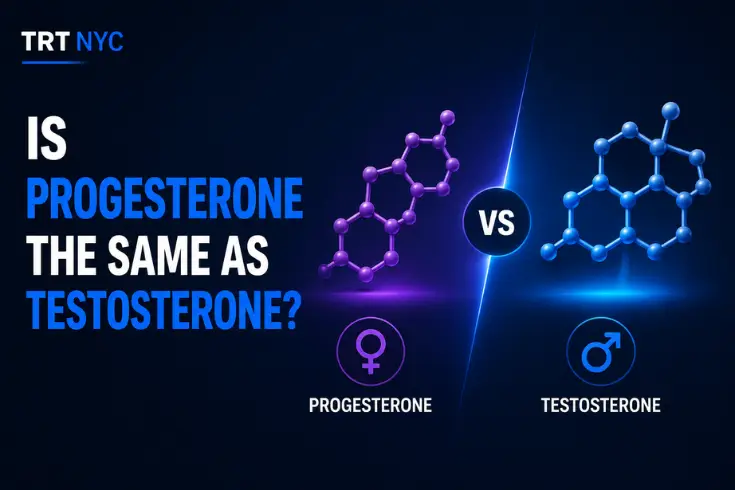
Is Progesterone the Same as Testosterone? Key Differences
 By TRT NYC Editorial Team
TL;DR — Key Takeaways
- No, progesterone and testosterone are not the same hormone.
- Testosterone is the main male sex hormone (an androgen) — muscle, libido, male traits.
- Progesterone is mainly a female hormone (a progestogen) — the menstrual cycle and pregnancy.
- Both are steroid hormones made from cholesterol (via pregnenolone), so they’re related but distinct.
- Twist: progesterone is a precursor the body can convert toward testosterone — but they act very differently.
No, progesterone and testosterone are not the same. Both are steroid hormones from cholesterol, but they differ greatly. Testosterone is the main male sex hormone (an androgen) — muscle, libido, male traits. Progesterone is mainly a female hormone (a progestogen) — the menstrual cycle and pregnancy, though men make small amounts. Different structures, receptors, and roles.
They sound similar and share a family tree, so the confusion is understandable. Here’s exactly how they differ — and how they’re connected. (For the overview, see our complete TRT guide.)
Is Progesterone the Same as Testosterone?
No. They’re different hormones in different classes with different jobs:
Key fact: Progesterone and testosterone are both steroid hormones, but they’re not the same testosterone is the main male androgen, while progesterone is primarily a female progestogen.
They are related — both are steroid hormones built from cholesterol through the same early pathway — but the end products and effects are distinct.
Progesterone vs Testosterone: Key Differences
| Progesterone | Testosterone | |
| Class | Progestogen | Androgen |
| Primary role | Menstrual cycle, pregnancy | Male traits, muscle, libido |
| Main producers | Ovaries, adrenals, placenta | Testes (Leydig cells), adrenals |
| Predominant in | Women (men have small amounts) | Men (women have small amounts) |
| Made from | Cholesterol → pregnenolone | Cholesterol → pregnenolone → androgens |
| Acts on | Progesterone receptor | Androgen receptor |
What Testosterone Does
Testosterone is the primary male sex hormone, made mainly by the Leydig cells of the testes (with a small amount from the adrenals). It drives muscle, libido, energy, mood, bone, and male characteristics, and it works by binding the androgen receptor inside cells, as explained in how testosterone moves across the cell membrane. Low levels cause the classic low testosterone symptoms.
What Progesterone Does
Progesterone is chiefly a female reproductive hormone, central to the menstrual cycle and pregnancy, produced by the ovaries, adrenal glands, and the placenta. Men do have small amounts — mostly as a precursor hormone, but it isn’t a major male hormone. Its role in men is niche, which is why the topic mostly comes up around progesterone and testosterone together.
How They’re Connected: The Precursor Pathway
Here’s the twist that fuels the confusion. Both hormones sit on the same steroid-synthesis pathway: cholesterol → pregnenolone → progesterone / DHEA → testosterone. So progesterone can act as a precursor the body converts toward testosterone in certain (mostly adrenal) pathways. That shared origin is exactly why pregnenolone — the “mother hormone” — is discussed for testosterone, and why pregnenolone vs DHEA comes up. But being a precursor doesn’t make them the same — the end hormones have different structures, receptors, and effects.
Why This Matters
Understanding the difference helps you avoid two common mistakes:
- Assuming a “progesterone supplement” will raise testosterone — it won’t reliably (see the precursor caveats above).
- Confusing the two on lab work — if you’re checking your testosterone, that’s a specific test; see what testosterone test you need and whether TRT is right for you if levels are low.
The Bottom Line
Is progesterone the same as testosterone? No. They’re both steroid hormones made from cholesterol and share a synthesis pathway, but testosterone is the primary male androgen (muscle, libido, male traits) while progesterone is mainly a female progestogen (menstrual cycle, pregnancy). Progesterone can serve as a precursor toward testosterone, but the two are distinct hormones with different receptors and effects. If your goal is testosterone, test and treat testosterone specifically.
👉 Want to know your actual testosterone (not a related hormone)? Check your levels with an at-home test kit and review the results with a licensed provider.
Frequently Asked Questions
Is progesterone the same as testosterone?
No. They’re different hormones in different classes — progesterone is a progestogen, testosterone is an androgen. Both are steroid hormones made from cholesterol and share a synthesis pathway, but they have different structures, receptors, and roles in the body.
What’s the difference between progesterone and testosterone?
Testosterone is the main male sex hormone, made mainly in the testes, driving muscle, libido, and male traits. Progesterone is primarily a female hormone, made in the ovaries, adrenals, and placenta, central to the menstrual cycle and pregnancy. They act on different receptors.
Do men have progesterone?
Yes, but only small amounts, produced mainly by the adrenal glands and testes, largely as a precursor for other hormones. It’s a normal part of male physiology at low levels, but progesterone is not a major male hormone the way testosterone is.
Are progesterone and testosterone both steroid hormones?
Yes. Both are steroid hormones synthesized from cholesterol through the same early pathway (via pregnenolone). That shared origin makes them related, but the final hormones — progesterone and testosterone — are distinct, with different classes, receptors, and effects.
Can progesterone turn into testosterone?
Partly, in the body’s steroid pathway. Progesterone can act as a precursor that’s converted toward testosterone, particularly through adrenal pathways. However, being a precursor doesn’t mean taking progesterone reliably raises testosterone — they remain distinct hormones with different effects.
Does progesterone lower testosterone?
It can, in some contexts, since progesterone can have mild anti-androgen effects at higher doses. This is why its use in men is niche and best discussed with a doctor. It’s not a reliable way to raise testosterone, and effects vary by individual and dose.
Written by: TRT NYC Editorial Team, Last updated: June 2026 · Reviewed against: endocrinology references and Endocrine Society guidance (see References).
Medical disclaimer: This article is for educational purposes only and is not medical advice, diagnosis, or treatment. trtnyc.com is an independent informational resource, not a medical provider. Always consult a licensed healthcare provider about hormone therapy.