Does Pregnenolone Increase Testosterone? What the Science Says
 By Tejanshu Jaluthria
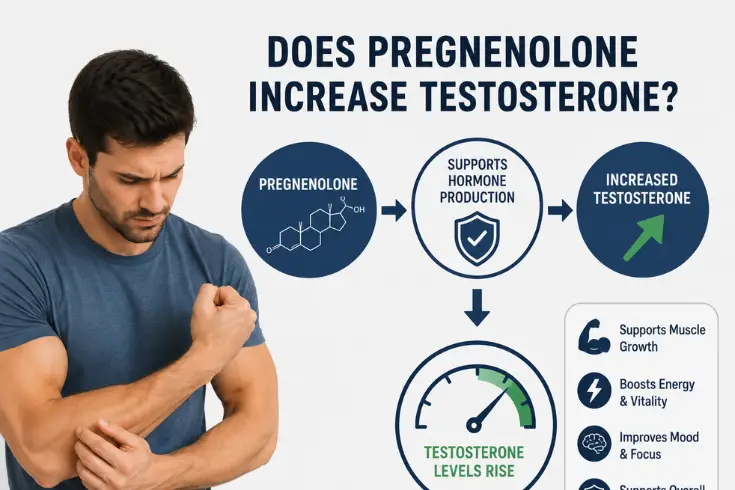
Short answer: not directly, and not reliably. Pregnenolone is a precursor your body can use to build testosterone, but taking it as a supplement does not dependably raise your testosterone levels. In controlled studies, oral pregnenolone produced little to no change in serum testosterone — it mostly converted into other hormones instead. Here is the full picture before you spend money on it.
If you are a man trying to optimize your testosterone — maybe you are already on TRT, maybe you are trying to avoid it — you have probably seen pregnenolone sold as the “mother of all hormones” that fuels testosterone production. That label is biochemically true and practically misleading. Pregnenolone is a steroid hormone made from cholesterol in your adrenal glands, brain, and gonads, and it sits at the top of the chain that builds DHEA, testosterone, progesterone, estrogen, and cortisol. On its own it has little hormonal activity; its job is to be converted, step by step, into the hormones your body actually uses. The question is whether feeding your body more raw material at the top of the chain reliably produces more testosterone at the bottom. The honest answer is no — and this guide explains exactly why, what the research shows, and what to do instead if higher testosterone is your real goal.
How pregnenolone is supposed to become testosterone
Pregnenolone is the first hormone your body makes from cholesterol, which is why it earns the “mother hormone” nickname. From there, it branches. To become testosterone, pregnenolone has to travel a multi-step path: pregnenolone converts to DHEA, DHEA converts to androstenedione, and androstenedione finally converts to testosterone.
That is at least three enzymatic steps, and pregnenolone does not turn into testosterone directly. At the very first branch, your body has a choice. Pregnenolone can head down the androgen branch toward DHEA and testosterone, or it can head down a separate branch toward progesterone and cortisol — the stress-hormone pathway. Which way it goes depends on your enzymes, your stress load, and your existing hormone levels, none of which you control by swallowing a capsule.
This is the core reason the “precursor” sales pitch falls apart. More raw material at the top does not force more finished product at the bottom. If the downstream enzymes are working at capacity, or if your body is prioritizing cortisol because you are chronically stressed, extra pregnenolone simply gets routed elsewhere. A testosterone precursor is only useful if the conversion machinery actually favors testosterone — and in most healthy men, supplemental pregnenolone does not move that needle.
What the research actually shows about your testosterone
This is where most articles stop short, because they don’t cite any studies. The data is not flattering to pregnenolone as a testosterone booster.
When researchers give men oral pregnenolone and measure their blood, serum testosterone barely changes. Controlled work has found little to no change in total testosterone, free testosterone, DHEA, DHEA-S, androstenedione, cortisol, or estradiol after supplementation. What rises instead are neurosteroids — particularly allopregnanolone — along with progesterone. In other words, the body takes the extra pregnenolone and routes it toward the brain-and-calm pathway, not the testosterone pathway. That is consistent with WebMD’s overview of pregnenolone, which notes the evidence for most hormonal claims is limited.
There is one finding people often misread as proof. A 2023 study of male shift workers, published in the International Journal of Environmental Research and Public Health, found that men working rotating night shifts had both lower pregnenolone and lower testosterone than daytime workers. It is tempting to read that as “low pregnenolone causes low testosterone, so raising it fixes T.” But this is a correlation: disrupted circadian rhythm appears to suppress the whole steroid-making system at once. It does not show that supplementing pregnenolone raises testosterone.
It is also worth knowing what major medical bodies do not say. Pregnenolone does not appear in clinical guidelines for treating low testosterone or hypogonadism — those guidelines center on testosterone formulations themselves, gonadotropins, and SERMs. If pregnenolone reliably raised testosterone, it would be in those protocols. It isn’t. If you suspect your testosterone is genuinely low, the more productive first move is to confirm it — these silent signs of low testosterone are a better starting point than a precursor supplement.
Pregnenolone vs DHEA vs TRT: which actually raises testosterone?
A lot of the confusion comes from lumping precursors together with testosterone itself. They are not the same lever. Here is how the three options compare on the only question that matters — do they actually raise your testosterone?
| Dimension | Pregnenolone | DHEA | TRT (testosterone) |
| What it is | “Mother” precursor hormone | Downstream precursor (made from pregnenolone) | The actual hormone |
| Steps to testosterone | 3+ (→ DHEA → androstenedione → T) | 2 (→ androstenedione → T) | 0 — it is testosterone |
| Reliably raises serum T? | No — little/no change in studies | Sometimes, modestly, mainly if deficient | Yes — directly |
| Best-supported benefit | Neurosteroids, mood, cognition | Mild androgen support in deficiency | Restores testosterone to normal range |
| Estrogen conversion risk | Yes (indirect) | Yes (notable) | Yes (managed with monitoring) |
| In clinical T guidelines? | No | Not first-line | Yes — standard of care |
| Typical dose | 10–50 mg/day | 25–50 mg/day | Prescribed and monitored |
The pattern is clear: the closer a compound is to testosterone, the more reliably it raises it. Pregnenolone sits farthest away and is the least reliable. DHEA is one step closer and can help modestly, mostly in men who are genuinely deficient. TRT skips the conversion lottery entirely because you are administering the finished hormone. If your goal is mood, sleep, or cognition, pregnenolone is a reasonable thing to discuss with a doctor. If your goal is a higher number on a testosterone blood test, it is the wrong tool. (Note that another popular supplement, DIM, is also widely misunderstood — see what DIM actually does to your hormones before adding it either.)
The catch: pregnenolone doesn’t only make testosterone
Here is the part the “mother hormone” marketing leaves out. Because pregnenolone sits at the top of every steroid pathway, anything you add can flow into hormones you did not want more of.
Two branches matter most. The androgen branch leads to DHEA, testosterone — and estrogen, because testosterone aromatizes into estradiol. So a man taking pregnenolone hoping for more testosterone can also end up converting some of it toward estrogen, which is the opposite of what most men optimizing T are after. The other branch leads to progesterone and cortisol. Men under heavy chronic stress often shunt raw material toward cortisol, which is why the forum saying “pregnenolone gets stolen by cortisol” has a kernel of truth.
This is also why pregnenolone’s effects are so individual. Two men taking the identical dose can get different results depending on stress, body fat, and enzyme activity. If your estrogen or your SHBG is already working against you, adding an upstream precursor is a blunt instrument. For men whose real problem is too much testosterone bound up and unavailable, the smarter focus is lowering SHBG to increase free testosterone — a targeted fix rather than a hormonal shotgun.
If you still want to try it: dosage, timeline, and testing
Some men take pregnenolone for its mood, sleep, and cognitive effects, and notice they feel better even if their testosterone doesn’t change. If that is you, a few practical points apply.
- Dose: Reported dosing varies widely, from 10–20 mg per day for general well-being up to 25–50 mg per day when the goal is hormonal support. Men on TRT sometimes use higher amounts under medical supervision. More is not better — higher doses raise the odds of side effects without raising the odds of more testosterone.
- Timeline: Mood, energy, and cognitive changes are often reported within 2–4 weeks. Any hormonal shift, if it happens at all, develops gradually over 6–12 weeks and tends to occur only in men who were deficient to begin with.
- Test, don’t guess: The only way to know if pregnenolone is doing anything to your testosterone is bloodwork before and after. Check total testosterone, free testosterone, and estradiol so you can see if you are simply converting it to estrogen. If you are not sure which panel you need, this symptom-to-test decision guide will point you to the right one.
A realistic example: a 45-year-old man with low-T symptoms and high stress takes 25 mg of pregnenolone daily for ten weeks hoping to avoid TRT. He reports sharper focus and better sleep — genuine neurosteroid effects — but his follow-up labs show his total testosterone is essentially unchanged and his estradiol has crept up. That outcome is common, and it is exactly what the conversion biology predicts.
Is pregnenolone safe, and who should avoid it?
For most healthy men, short-term use at low doses is generally well tolerated, and clinical trials in mood disorders did not find a side-effect burden meaningfully different from placebo. But “tolerated” is not the same as “well studied for testosterone,” and there are real cautions.
Reported side effects include irritability, anxiety or mood swings, insomnia or disrupted sleep at higher doses, headaches, acne, and a bloated or “puffy” feeling. Because pregnenolone feeds estrogen and cortisol pathways too, those side effects often trace back to unintended hormone shifts rather than the testosterone you wanted.
You should not treat pregnenolone as a casual purchase if any of the following apply:
- You have or are at risk for a hormone-sensitive cancer, especially prostate cancer. Feeding upstream of testosterone and estrogen is not advisable here without a specialist’s guidance.
- You are a competitive or tested athlete. Pregnenolone is prohibited at all times by the U.S. Anti-Doping Agency as a precursor/anabolic agent — taking it can cause a failed drug test.
- You are already on TRT. Exogenous testosterone suppresses your natural signaling, which can lower your own pregnenolone, but adding it back is a clinical decision your prescriber should make and monitor, not a self-experiment.
- You have unmanaged anxiety, sleep, or mood conditions, since pregnenolone’s neurosteroid effects can cut both ways.
The long-term safety of routine pregnenolone supplementation in men simply has not been established, and its cardiovascular profile is unstudied. That uncertainty, not just the modest testosterone effect, is why it stays out of mainstream treatment.
The bottom line
Pregnenolone is a genuine testosterone precursor, but being a precursor is not the same as being a booster. The research shows your serum testosterone barely moves on supplemental pregnenolone, the raw material gets routed toward neurosteroids, estrogen, and cortisol, and no clinical guideline treats it as a testosterone therapy. It may still be worth discussing with a doctor for mood, sleep, or cognition — just not for the number on your testosterone lab.
If your real goal is higher testosterone, find out where your levels actually stand. Book a hormone evaluation with TRT NYC to get full testosterone, free testosterone, and estradiol testing and a treatment plan matched to your bloodwork — instead of guessing with a precursor supplement.
Frequently asked questions
Does pregnenolone convert to testosterone?
Indirectly and in several steps, not directly. Pregnenolone converts to DHEA, then to androstenedione, then to testosterone. At each step your body can divert it toward estrogen, progesterone, or cortisol instead, so conversion to testosterone is never guaranteed.
How long does pregnenolone take to work?
Mood, sleep, and cognitive effects are often reported within 2–4 weeks. Any effect on hormone levels, if it occurs at all, develops gradually over 6–12 weeks and mainly in men who were deficient. The only way to confirm a testosterone change is before-and-after bloodwork.
Is pregnenolone safe for men?
At low doses for short periods it is generally well tolerated, and trials in mood disorders found side effects similar to placebo. Long-term safety is not established, and men with prostate or other hormone-sensitive conditions, and tested athletes, should avoid it without medical guidance.
Does pregnenolone increase estrogen?
It can, indirectly. Because pregnenolone sits upstream of both testosterone and estrogen, some of what you take can be converted toward estradiol. This is why men optimizing testosterone should test estradiol when using it, not just testosterone.
How much pregnenolone should a man take?
Reported doses range from 10–20 mg daily for general well-being to 25–50 mg daily for hormonal support, with higher medically supervised doses in some TRT users. Higher doses increase side-effect risk without reliably increasing testosterone, so lower and tested is safer.
Can you take pregnenolone with TRT?
Some men do, because TRT can lower natural pregnenolone production. But this should be a monitored decision with your prescriber, who can check the relevant hormones, rather than something added on your own.
Pregnenolone vs DHEA — which raises testosterone more?
DHEA is one step closer to testosterone and can modestly raise it in deficient men, while pregnenolone shows little to no reliable effect on serum testosterone. Neither is in clinical guidelines for low testosterone, and neither matches TRT for directly raising levels.
What are the side effects of pregnenolone?
Reported side effects include irritability, anxiety, mood swings, insomnia, headaches, acne, and bloating. Many of these stem from unintended conversion into estrogen, progesterone, or cortisol rather than from testosterone itself.