BMI and Testosterone: Does Your Weight Lower Your T Levels?
For many men, yes. Research consistently links a higher body mass index (BMI) with lower testosterone, and the drop tends to grow as BMI rises. The…
For many men, yes. Research consistently links a higher body mass index (BMI) with lower testosterone, and the drop tends to grow as BMI rises. The relationship between BMI and testosterone also works both ways: extra body fat can push T down, and low T can make it easier to gain fat. The good news is that a weight-related drop in testosterone can often be partly reversed.
Want to know where you stand? Check your number in under a minute with our free BMI calculator, then read on to learn what it may mean for your hormones.
Key Takeaways
- The link between BMI and testosterone is strong. A higher BMI is associated with lower total testosterone.
- Genetic research suggests that a higher BMI can actually cause lower testosterone.
- Much of the drop comes from lower SHBG, so free testosterone often matters more.
- BMI can’t tell muscle from fat. Measuring your waist adds useful context.
- Meaningful weight loss is often linked with higher testosterone.
What Does the Research Say About BMI and Testosterone?
The connection between BMI and testosterone is one of the most consistent findings in men’s health research.
Large U.S. data: In the Hypogonadism in Males (HIM) study, obese men were far more likely to have low testosterone than lean men. Among obese men who also had diabetes, about half had low readings (University at Buffalo).
Evidence of cause: Most studies only show that two things happen together. A 2017 genetic study of 7,446 European men went further. Using a method called Mendelian randomization, it found that a higher BMI had a causal effect on lower testosterone (Eriksson et al., 2017).
An important caveat: Many studies in this area are snapshots taken at one point in time. They show a strong association, but they can’t prove that weight is the only reason a particular man has low T. Other causes, such as medications, pituitary problems, or poor sleep, still need to be considered.
Why Extra Weight Can Lower Testosterone
Body fat isn’t just stored energy. It’s active tissue that affects your hormones. Several processes connect BMI and testosterone.
SHBG Drops
Sex hormone-binding globulin (SHBG) is the protein that carries testosterone in your blood. Excess weight and high insulin levels tend to lower SHBG, so total testosterone reads lower on a lab report. A 2025 review in the Journal of Clinical Endocrinology & Metabolism concluded that this SHBG drop explains most of the lower testosterone measured in men with obesity (Muir et al., 2025). Read more about what SHBG is and why it matters.
Fat Turns Testosterone Into Estrogen
Fat tissue contains an enzyme called aromatase, which converts testosterone into estradiol. More belly fat can mean more conversion. Higher estradiol may then signal the brain to slow testosterone production. Our guide to the testosterone to estrogen ratio explains this balance.
Insulin Resistance and Poor Sleep
Excess visceral fat is tied to insulin resistance and inflammation, and both are associated with lower T. A higher BMI also raises the risk of obstructive sleep apnea. Broken sleep can lower testosterone because much of the body’s daily testosterone release happens during sleep. If you snore loudly or wake up tired, try our STOP-BANG sleep apnea screener.
The Cycle Runs Both Ways
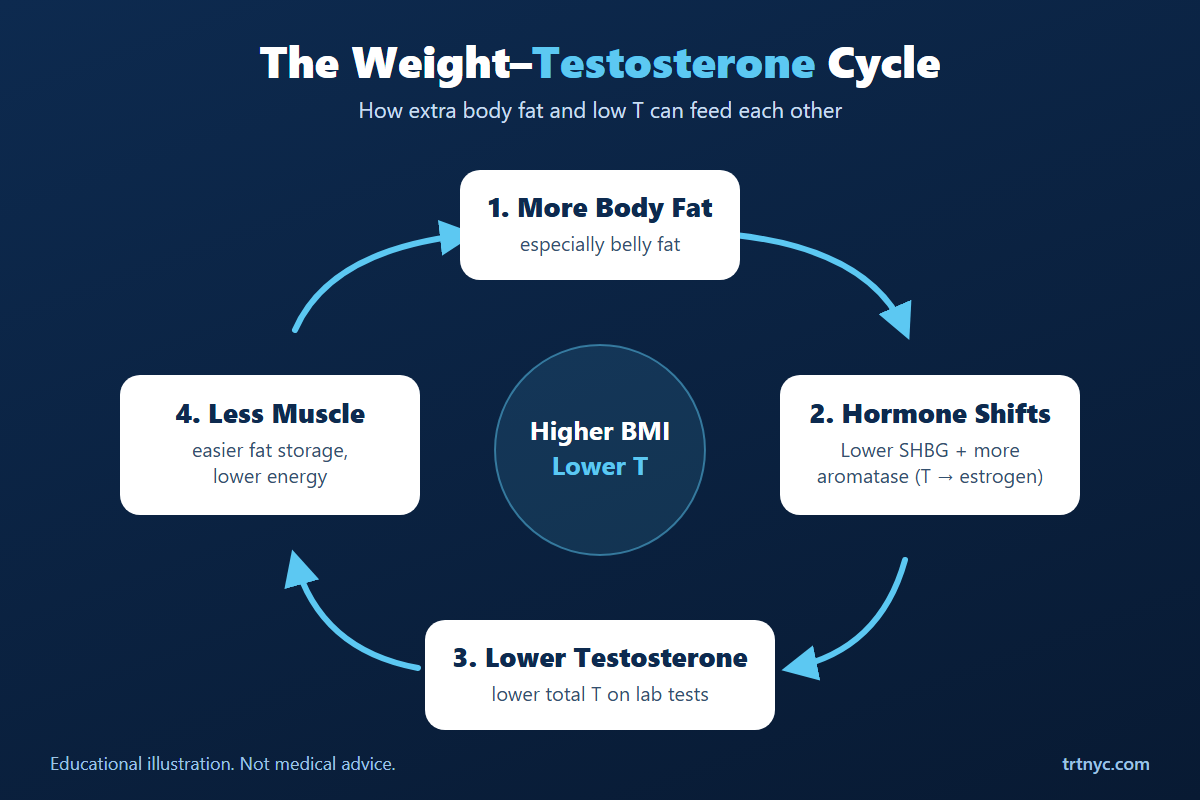
Low testosterone can make it easier to lose muscle and store fat. More fat then lowers testosterone further. For many men, breaking this cycle is the real goal.
BMI Categories and What They May Mean for Testosterone
BMI is your weight in kilograms divided by your height in meters squared. The CDC uses these adult categories:
| BMI Range | Category | Possible Effect on Testosterone |
| Below 18.5 | Underweight | Under-eating can also suppress hormones |
| 18.5–24.9 | Healthy weight | Weight is less likely to be a major factor |
| 25.0–29.9 | Overweight | Small drops are possible, especially with a large waist |
| 30.0–34.9 | Obesity (Class 1) | Low total testosterone becomes more common |
| 35.0 and above | Obesity (Class 2–3) | Strongest link with low testosterone |
These are general patterns of BMI and testosterone, not a diagnosis. Some men with a BMI over 30 have normal T, and some lean men have low T for other reasons. Use the TRT NYC BI calculator to find your category, then bring the result to your next checkup.
Why BMI Isn’t the Whole Story
BMI is a quick screening tool, but it has blind spots when you’re looking at BMI and testosterone together.
- It can’t separate muscle from fat: A muscular man who lifts weights may be labeled “overweight” while carrying little fat.
- It ignores where fat sits: Belly fat is more closely linked to hormone and metabolic problems than fat elsewhere.
- It can miss hidden fat:An older man with low muscle mass may have a “healthy” BMI and still carry excess fat.
That’s why waist size is a smart second check. For men, a waist over 40 inches is generally linked with higher metabolic risk (NHLBI). Measure at the top of your hip bones after breathing out.
Can Losing Weight Raise Testosterone?
For many men, the evidence says yes. The 2025 review by Muir and colleagues notes that meaningful weight loss can substantially reverse obesity-related drops in testosterone. In other words, when BMI comes down, testosterone often moves up.
Newer data point the same way. At ENDO 2025, researchers presented a study of 110 men with obesity or type 2 diabetes using GLP-1-based weight-loss medications. With about 10% weight loss, the share of men with normal total and free testosterone rose from 53% to 77% (Endocrine News). This was an early observational study, so more research is needed.
Habits that support healthy weight loss include:
- Strength training two to three times a week
- Eating enough protein and fewer ultra-processed foods
- Sleeping seven to nine hours a night
- Limiting alcohol
- Losing weight gradually instead of crash dieting
BMI and Testosterone Testing: Tips for Men With a High BMI
If your BMI is high and you notice low energy, low sex drive, or muscle loss, a blood test can help. A few details make the results more reliable:
- Test in the morning: when testosterone is usually highest.
- Repeat low results: The Endocrine Society recommends confirming low testosterone with at least two morning tests (Bhasin et al., 2018).
- Ask about free testosterone: Because SHBG is often low in men with a high BMI, total T can look lower than what your body can actually use. See our guide to free vs total testosterone.
- Know that ranges vary: Each lab sets its own reference range. Our overview of normal testosterone levels in men gives helpful context.
Is TRT the Answer for Men With a High BMI?
Not automatically, and the science of BMI and testosterone explains why. Clinicians are advised to look for reversible causes first, such as obesity, poor sleep, and certain medications. When low T is mainly tied to weight, the 2025 review suggests diet and lifestyle changes often work better than testosterone therapy at fixing the root problem.
Some men with a high BMI do have true hypogonadism, and a doctor may consider TRT after confirming it. TRT also carries risks, including higher hematocrit, worsening sleep apnea, and reduced sperm production. Learn more about whether TRT causes weight gain. Never start or change testosterone based on online information.
When to See a Doctor
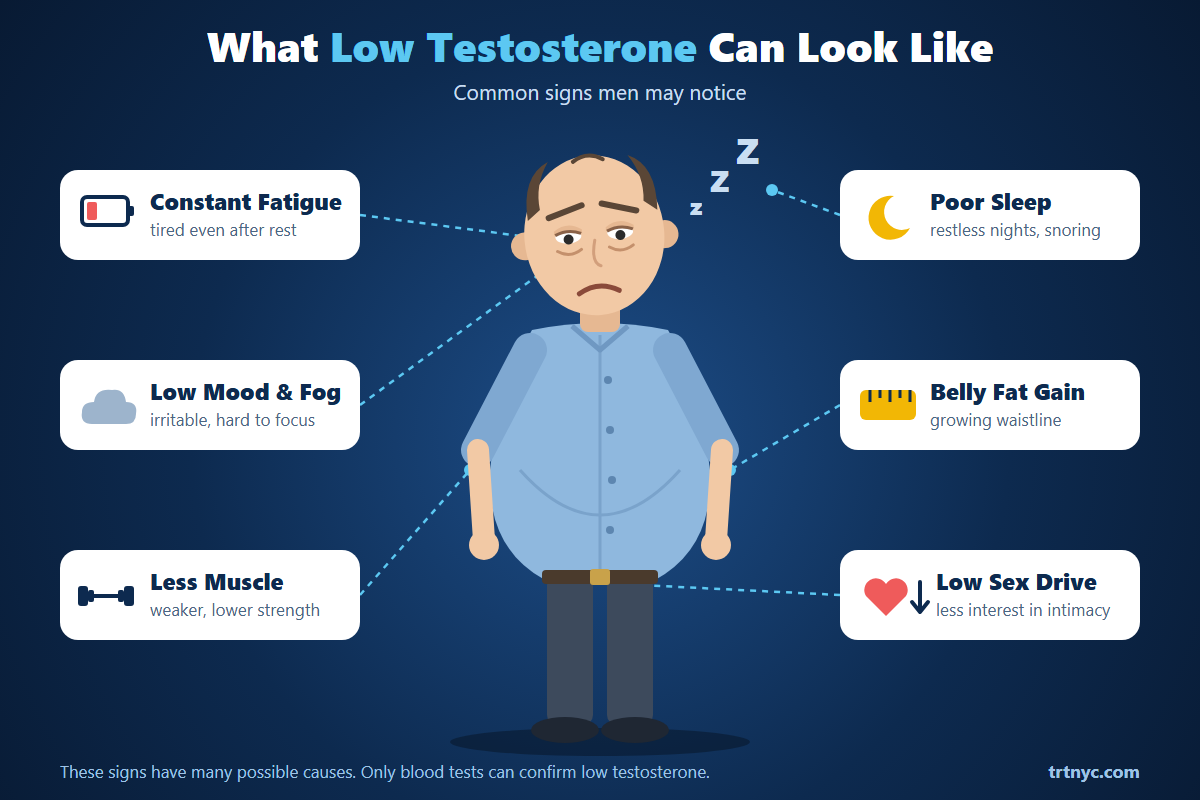
Talk to a qualified healthcare professional if you:
- Have a BMI of 30 or higher plus fatigue, low libido, or erectile problems
- Notice a growing waistline along with falling energy or strength
- Snore loudly or wake up exhausted
- Have diabetes or prediabetes along with new low testosterone symptoms
The Bottom Line
The link between BMI and testosterone is real and well studied. A higher BMI often means lower T, mostly because of lower SHBG, more estrogen conversion, insulin resistance, and poor sleep. Your waist size, symptoms, and repeat morning blood tests complete the picture. For many men, steady weight loss is linked with a meaningful rise in testosterone.
Start by checking your number with our free BMI calculator, then use it to start an informed conversation with your doctor. You can also explore all of our free testosterone tools on TRT NYC.
Frequently Asked Questions
How are BMI and testosterone related?
In men, BMI and testosterone usually move in opposite directions. As BMI rises, total testosterone tends to fall, mainly because SHBG drops and fat converts more testosterone into estrogen.
What BMI is linked to low testosterone?
Low T becomes noticeably more common at a BMI of 30 or higher. Only blood tests, ideally repeated in the morning, can confirm low testosterone.
Does losing weight increase testosterone?
In many men with excess weight, yes. Meaningful weight loss can reverse much of an obesity-related drop, though results vary from person to person.
Is BMI accurate for muscular men?
Not always. BMI uses only height and weight, so muscular men may be labeled overweight. Adding a waist measurement gives a clearer picture.