Does CJC-1295 Increase Testosterone? What the Science Says
 By Tejanshu Jaluthria
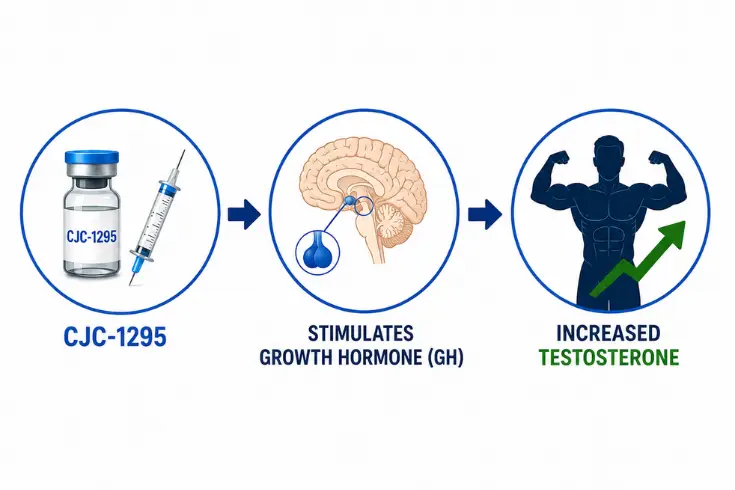
Short answer: no — CJC-1295 does not increase testosterone. CJC-1295 raises growth hormone and IGF-1, not testosterone, because it works on a completely different hormonal pathway than the one that controls your testosterone. It can be used alongside testosterone therapy, but on its own it has no direct mechanism to raise your testosterone levels. Here’s exactly how CJC-1295 works, why it doesn’t touch testosterone, and how it compares to TRT.
If you’ve seen CJC-1295 marketed as an anabolic or “hormone-optimizing” peptide and want to know whether it will move your testosterone numbers, you’re asking the right question before injecting anything. CJC-1295 is a synthetic analog of growth-hormone-releasing hormone (GHRH). It binds GHRH receptors in the pituitary gland and triggers a sustained release of growth hormone, which in turn raises insulin-like growth factor 1 (IGF-1). It’s used — though not FDA-approved — for muscle, recovery, fat loss, and anti-aging goals. The key fact for this question: CJC-1295 acts on the growth-hormone axis, not the testosterone axis. This guide breaks down the mechanism, cites the human study behind it, compares CJC-1295 vs testosterone directly, and covers the dosage, side effects, and legal status most pages skip.
The Short Answer: Does CJC-1295 Increase Testosterone?
No. CJC-1295 does not directly increase testosterone, and there is no human study showing it raises serum testosterone. Its proven, measured effect is to elevate growth hormone and IGF-1. The confusion comes from lumping all “anabolic” or “performance” compounds together — but growth hormone and testosterone are different hormones, made in different places, controlled by different signals. CJC-1295 boosts one of them, and it isn’t testosterone.
What Is CJC-1295 and How Does CJC-1295 Work?
CJC-1295 is a peptide that mimics GHRH, your body’s natural signal to release growth hormone. By binding GHRH receptors in the pituitary, it prompts the gland to secrete more growth hormone in a sustained, longer-lasting way than your own GHRH would. There are two common versions: one with DAC (Drug Affinity Complex), which extends its half-life for days, and “modified GRF (1-29)” without DAC, which is shorter-acting.
CJC-1295 and Growth Hormone
The whole point of CJC-1295 is growth hormone. In the key human study Teichman and colleagues, published in the Journal of Clinical Endocrinology & Metabolism in 2006 — single injections of CJC-1295 produced 2-to-10-fold increases in growth hormone that lasted for days, with no testosterone outcome reported because that isn’t what it does. Growth hormone, not testosterone, is the hormone it elevates.
CJC-1295 and IGF-1
Growth hormone travels to the liver, which responds by producing IGF-1 — the hormone that carries out most of growth hormone’s muscle, recovery, and metabolic effects. In the same study, IGF-1 rose 1.5-to-3-fold and stayed elevated for up to 11 days after a single dose, with levels remaining above baseline for weeks after repeated dosing. So the real CJC-1295 hormonal signature is higher GH and higher IGF-1 — a growth-hormone story from start to finish, with testosterone nowhere in the chain.
Why CJC-1295 Doesn’t Increase Testosterone Directly
To understand why CJC-1295 can’t raise testosterone, you have to know how testosterone is actually made. It comes from a feedback loop called the hypothalamic-pituitary-gonadal (HPG) axis.
CJC-1295 and the HPG Axis (LH and Leydig Cells)
Your hypothalamus releases GnRH, which tells the pituitary to release luteinizing hormone (LH). LH then signals the Leydig cells in your testes to produce testosterone. That is the only “on switch” for natural testosterone production. CJC-1295 does not interact with this loop at any point — it doesn’t raise GnRH, it doesn’t raise LH, and it doesn’t signal the Leydig cells. It works on a parallel system, the growth-hormone axis, which runs through the pituitary and the liver, not the testes. Because CJC-1295 never sends the testosterone signal, it has no direct way to raise your testosterone, no matter the dose. This is the part clinic marketing tends to gloss over with vague “hormone optimization” language.
Can CJC-1295 Increase Testosterone Indirectly?
This is where honesty matters, because the answer is “maybe a little, in theory, but don’t count on it.” Some clinics claim CJC-1295 “supports testosterone” because healthier growth hormone and IGF-1 levels contribute to a better overall hormonal environment, and because IGF-1 may help maintain Leydig cell function. That mechanism is plausible, but there is no human evidence that CJC-1295 produces a meaningful rise in serum testosterone through it. Any indirect effect would be small, secondary, and unproven — not a reason to use CJC-1295 as a testosterone strategy. If your testosterone is genuinely low, treating it directly through the proper channel is the approach with actual evidence behind it; the silent signs of low testosterone are a better starting point than a growth-hormone peptide.
CJC-1295 vs Testosterone (TRT): How They Compare
The clearest way to settle the question is to put CJC-1295 and testosterone side by side. They are not competing tools — they do different jobs.
| Dimension | CJC-1295 | Testosterone (TRT) |
| What it is | GHRH analog (a peptide) | The hormone testosterone itself |
| Primary hormone raised | Growth hormone → IGF-1 | Testosterone |
| Hormone axis | GH axis (pituitary → liver) | HPG axis (LH → Leydig cells) |
| Raises serum testosterone? | No — not directly | Yes — directly |
| Main goals | Recovery, body composition, sleep, anti-aging | Restoring testosterone, energy, libido, muscle |
| FDA-approved? | No | Yes (prescription) |
| WADA status | Prohibited (S2), all times | Regulated; prohibited in tested sport |
| Human evidence | GH/IGF-1 elevation shown; long-term safety unknown | Decades of clinical use and guidelines |
If your goal is more testosterone, testosterone therapy is the tool that raises it; CJC-1295 is not. Many men on TRT do add CJC-1295 (often with ipamorelin) for recovery and body composition, and because the two work on separate axes, they can be used together under medical supervision. But that’s stacking two different tools — not CJC-1295 raising testosterone. If you want to understand the tool that actually does, start with the basics of testosterone replacement therapy.
CJC-1295 Dosage, Side Effects, and Safety
Before anyone considers CJC-1295, the practical and legal realities matter as much as the mechanism.
CJC-1295 Dosage and the Ipamorelin Stack
CJC-1295 is most often combined with ipamorelin, a growth-hormone secretagogue that amplifies GH pulses without the cortisol spikes of older compounds. The pairing is dosed in micrograms, typically via subcutaneous injection, and protocols vary widely between sources because there is no FDA-approved label to standardize them. That lack of an approved protocol is itself a red flag: you are relying on clinic or community dosing, not regulated guidance.
CJC-1295 Side Effects and Risks
Reported side effects include injection-site reactions, water retention, flushing, headache, tingling or numbness, and changes in blood sugar — consistent with elevated growth hormone. The deeper problem is the unknown: no high-quality, long-term human trials have established the safety profile of CJC-1295, and sustained elevation of GH and IGF-1 carries theoretical risks that haven’t been fully studied in this context.
Is CJC-1295 Legal? FDA and WADA Status
CJC-1295 is not FDA-approved for any medical use — in 2024 the FDA declined to add it to the substances compounding pharmacies may use, and it’s widely sold as a “research chemical” not approved for human consumption. It is also banned in sport: the World Anti-Doping Agency lists CJC-1295 as prohibited at all times under the S2 peptide-hormone category, so any tested athlete using it commits a doping violation. Anyone considering it should weigh that legal and safety uncertainty seriously.
Should You Use CJC-1295 for Testosterone? Who It’s For and Who It’s Not
CJC-1295 is not for you if your goal is raising testosterone — it doesn’t do that, and using it as a testosterone fix means ignoring the lever that actually works. It also isn’t appropriate for tested athletes (it’s a doping violation) or for anyone uncomfortable using a non-FDA-approved compound with unknown long-term safety. It may have a role, under a knowledgeable clinician, for adults pursuing growth-hormone-related goals like recovery and body composition who understand the risks.
A realistic example: a 42-year-old man on TRT adds a CJC-1295/ipamorelin stack hoping to push his testosterone higher and recover faster. Three months later his sleep and recovery feel better and his IGF-1 is up on labs — but his testosterone is exactly where his TRT dose put it, unchanged by the peptide. That’s the expected outcome, because the peptide was never acting on his testosterone in the first place. If you suspect your real issue is low or bound-up testosterone, lowering SHBG to raise free testosterone is a more relevant lever, and the right testosterone test will tell you where you actually stand.
The Bottom Line on CJC-1295 and Testosterone
CJC-1295 does not increase testosterone. It’s a growth-hormone-releasing peptide that raises GH and IGF-1, it never touches the LH-to-testosterone pathway, and no human study shows it lifting serum testosterone. It can sit alongside TRT for recovery and body-composition goals, but it is not a testosterone treatment — and it carries real caveats, being neither FDA-approved nor permitted in tested sport, with an unknown long-term safety profile.
If you want higher testosterone, a growth-hormone peptide won’t get you there — measuring your hormones will. Book a testosterone evaluation with TRT NYC to get total testosterone, free testosterone, LH, and IGF-1 tested and a plan matched to your bloodwork, whether that’s TRT, peptides, or both.
Frequently Asked Question
Can you take CJC-1295 with testosterone (TRT)?
Yes, because they work on separate hormonal pathways — CJC-1295 on the growth-hormone axis and testosterone on the HPG axis — so they don’t directly interfere. Many men on TRT add CJC-1295 for recovery and body composition. This should be done under medical supervision, and it does not mean CJC-1295 is raising your testosterone.
Does CJC-1295 affect fertility or suppress natural testosterone?
Unlike anabolic steroids or TRT, CJC-1295 does not suppress the HPG axis, so it doesn’t shut down natural testosterone or sperm production through that mechanism. It also doesn’t stimulate them. Its effects run through growth hormone and IGF-1, separate from the fertility and testosterone pathway.
What are the side effects of CJC-1295?
Reported side effects include injection-site reactions, water retention, flushing, headaches, tingling or numbness, and changes in blood sugar, consistent with elevated growth hormone. The bigger concern is that no long-term human safety trials exist, so the full risk profile is unknown.
Is CJC-1295 FDA approved or legal?
No. CJC-1295 is not FDA-approved for any use and is sold as a research chemical not approved for human consumption. It is also prohibited at all times in sport by WADA, making it a doping violation for tested athletes.
Does CJC-1295 build muscle?
It may support muscle and recovery indirectly by raising growth hormone and IGF-1, which aid protein synthesis and tissue repair. It is not a direct anabolic like testosterone, and the muscle-building evidence in humans is limited compared with its well-documented effect on GH and IGF-1.
What is the best peptide to increase testosterone?
No peptide reliably raises testosterone the way TRT does. Peptides like kisspeptin or gonadorelin act on the LH pathway and are studied in fertility and hormone contexts, but CJC-1295 is not among them — it’s a growth-hormone peptide. If raising testosterone is the goal, testosterone therapy is the evidence-based tool.
Does CJC-1295 increase growth hormone and IGF-1?
Yes — this is its actual, measured effect. In a 2006 human study, CJC-1295 produced multi-fold, sustained increases in growth hormone and IGF-1 lasting days to weeks. Raising GH and IGF-1, not testosterone, is what CJC-1295 does.
What’s the difference between CJC-1295 and ipamorelin?
CJC-1295 is a GHRH analog that increases the amount of growth hormone released, while ipamorelin is a growth-hormone secretagogue (a ghrelin-receptor agonist) that strengthens GH pulses. They’re combined because they boost growth hormone through complementary mechanisms — neither raises testosterone.