Does DIM Lower Testosterone? What It Really Does to Your Hormones
 By Tejanshu Jaluthria
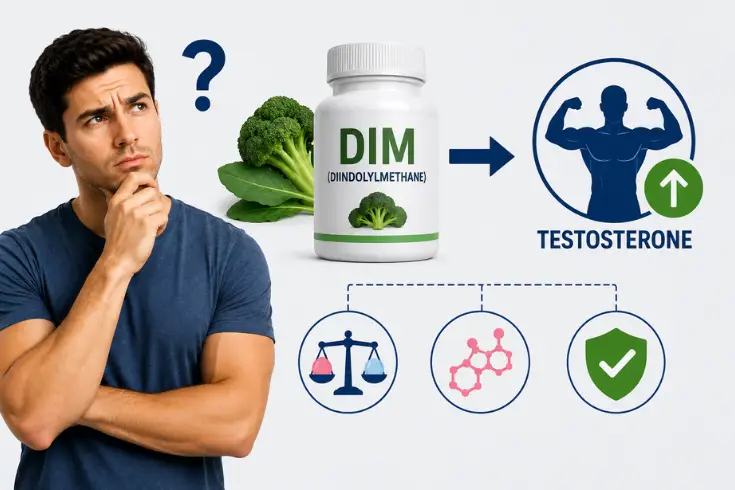
You’ve probably seen DIM marketed two opposite ways: as a gentle “hormone balancer” that protects your testosterone, and as a “potent anti-androgen” that blocks it. Both contain a grain of truth, which is exactly why the answer confuses people. The short version: DIM does not lower the testosterone your body produces at normal supplement doses — but at high doses it may interfere with how that testosterone works. DIM (diindolylmethane) is a compound your body forms when you digest cruciferous vegetables like broccoli, cabbage, and Brussels sprouts, sold as a supplement for hormone balance. It’s not a hormone, a steroid, or a testosterone booster; it works mainly by changing how your body metabolizes estrogen and by mildly slowing the enzyme that turns testosterone into estrogen. This guide untangles the contradiction, explains what DIM actually does, and covers dosing and where it fits if you’re on TRT.
Does DIM Lower Testosterone?
At the doses most men take — roughly 100 to 200 mg a day — there’s no human evidence that DIM lowers your testosterone level. It doesn’t suppress the testes or shut down the signal from your brain that drives testosterone production. It’s also not a testosterone booster: it won’t raise your levels either. What it does is work on the estrogen side of your hormone picture, and a healthier estrogen balance can make your existing testosterone feel more effective.
So if your worry is “will DIM show up as a lower number on my bloodwork,” the honest answer for typical use is no. The more nuanced concern — and the reason the “anti-androgen” warnings exist — is about something different: whether DIM blocks testosterone’s effects rather than its level. That distinction is the whole ballgame, and it’s worth understanding before you add DIM to your routine alongside any other supplements you take on TRT.
Lowering Testosterone vs. Blocking Its Effects: The Key Distinction
The reason articles seem to contradict each other is that “lower testosterone” can mean two completely different things.
The first is lowering the amount of testosterone your body produces — your actual blood level. DIM does not appear to do this at normal doses; it isn’t a production suppressor. The second is blocking what testosterone does once it’s made, by occupying the androgen receptors that testosterone and DHT need to bind to in order to act. At high doses, there’s evidence DIM can do this — which means your blood testosterone could read perfectly normal while its effects are partly blunted.
| Question | Lowering production (blood level) | Blocking effects (receptor) |
| What it means | Less testosterone made | Testosterone made but can’t fully act |
| Does DIM do it? | Not at normal doses | Possibly, at high doses |
| Shows up on bloodwork? | Yes — total T drops | No — total T can look normal |
| Evidence | No human evidence DIM suppresses production | Lab/cancer-cell + high-dose data |
| Who should care most | Most users — reassuring | Lifters and high-dosers chasing gains |
So “does DIM lower testosterone?” is best answered this way: it doesn’t lower your level, but in large amounts it may interfere with how that testosterone works. If you track total versus free testosterone on your labs, this is why the numbers alone won’t always tell you how you’ll feel.
What DIM Actually Does to Your Hormones
DIM’s real job is on estrogen, and it works through a couple of linked mechanisms:
- It shifts estrogen metabolism toward “good” metabolites. DIM pushes your body to produce more of the weaker, more favorable estrogen breakdown products (like 2-hydroxyestrone) and fewer of the stronger ones. It’s not blocking estrogen — it’s changing the type you make.
- It mildly inhibits aromatase. Aromatase is the enzyme that converts testosterone into estrogen. By slowing it down a little, DIM can help preserve a favorable testosterone-to-estrogen ratio — which, if anything, leans in testosterone’s favor rather than against it.
This is why some men feel better on DIM: not because their testosterone rose, but because their estrogen balance improved. For men dealing with the high-estrogen symptoms that often get ignored on TRT — water retention, moodiness, nipple sensitivity — addressing the estrogen side can make the whole hormonal picture feel cleaner without touching testosterone production at all.
The Anti-Androgen Concern at High Doses
This is where the scarier claims come from, and they deserve an honest hearing. Laboratory research — including work by Le and colleagues in 2003 — showed DIM acts as a strong androgen antagonist in prostate cancer cells, occupying androgen receptors and blocking testosterone and DHT from binding. A Phase I clinical trial in advanced prostate cancer patients used DIM specifically for this anti-androgen effect and found it well tolerated. Some sources also note that very high doses may interfere with growth-signaling pathways involved in building muscle, which is the root of the “DIM kills gains” worry among lifters.
The context that’s almost always missing: these effects appear at high doses and in cancer-cell or therapeutic settings — not necessarily at the 100 to 200 mg a typical man takes for estrogen balance. One supplement source argues receptor blocking starts above roughly 100 mg of isolated pure DIM, but bioavailable formulations and individual response vary widely, so there’s no fixed, proven threshold. The practical takeaway: at sensible doses the anti-androgen effect is unlikely to be meaningful, but megadosing DIM in pursuit of “more estrogen control” is where you could start working against your own testosterone. More is not better here, and your baseline testosterone range is worth knowing before you experiment.
DIM on TRT: Natural Estrogen Control vs. an Aromatase Inhibitor
If you’re on TRT, you’ve probably wondered whether DIM can replace a prescription aromatase inhibitor like anastrozole for keeping estrogen in check. It can — for the right person.
- DIM is mild. It nudges estrogen metabolism and gently slows aromatase. That makes it a reasonable option for mild to moderate estrogen elevation, and it’s far less likely to crash your estrogen than a true AI.
- Anastrozole is potent. A real aromatase inhibitor strongly shuts down testosterone-to-estrogen conversion and is better suited to significantly elevated estrogen that needs rapid correction — but it carries a real risk of driving estrogen too low, which brings its own problems (joint pain, low libido, mood issues).
- Crashed estrogen is its own problem. Many men over-correct with aggressive AIs and feel worse. DIM’s gentleness is a feature, not a weakness, when your estrogen is only modestly high.
The honest catch: if your estradiol is genuinely high and symptomatic, DIM may not be strong enough, and you’ll need the prescription route. Don’t stack DIM on top of an AI without monitoring, and don’t self-diagnose high estrogen from symptoms alone — they overlap heavily with other issues. The full trade-offs of the prescription option are covered in our guide to anastrozole dosing on testosterone therapy, and if gynecomastia is your concern, raising testosterone itself is part of that conversation too.
How Much DIM Should a Man Take?
Most men use 100 to 200 mg per day, taken with food for better absorption. Research suggests roughly 200 mg may be the practical ceiling for getting a benefit without raising the odds of side effects — which lines up with the earlier point that megadosing is where you risk the anti-androgen effect.
A few safety notes:
- Take it with food — DIM is fat-soluble and absorbs poorly on an empty stomach.
- Side effects are usually mild — most commonly minor digestive upset. Rare reports include headache and, at high intake, changes in urine color.
- It’s not for everyone. DIM can be risky for women of reproductive age, may reduce the effectiveness of birth control, and isn’t appropriate during pregnancy — so this is a male-hormone tool, not a general household supplement.
The smartest move isn’t to guess a dose — it’s to find out whether you need DIM at all. Estrogen problems are diagnosed with bloodwork, not vibes, which is why knowing how to test your hormones and the best time to test matters before you start.
The Bottom Line
If you’re taking DIM to manage estrogen — or thinking about it because of high-estrogen symptoms on TRT — find out whether you actually need it before you guess. Book a hormone panel with TRT NYC: we’ll measure your testosterone and estradiol, tell you whether your estrogen is genuinely high, and recommend whether DIM, a prescription aromatase inhibitor, or no change at all is the right call for your numbers.
Frequently Asked Questions
Does DIM lower testosterone?
Not your blood level, at normal doses. DIM doesn’t suppress testosterone production. At high doses it may block testosterone’s effects at the androgen receptor, but that’s different from lowering how much you make.
Does DIM block testosterone or act as an anti-androgen?
It can act as an anti-androgen at high doses — lab studies show it occupies androgen receptors and blocks testosterone and DHT from binding. At typical supplement doses (100–200 mg), this effect is unlikely to be meaningful.
Does DIM increase testosterone?
No. DIM is not a testosterone booster and won’t raise your levels. It may make your existing testosterone feel more effective by improving estrogen balance, but it doesn’t stimulate production.
Can you take DIM while on TRT?
Many men do, to help manage estrogen. It’s a reasonable option for mild to moderate estrogen elevation, but it’s milder than a prescription aromatase inhibitor. Don’t combine DIM with an AI without monitoring your estradiol.
How much DIM should a man take per day?
Most men take 100–200 mg daily with food, with about 200 mg considered the practical upper limit for benefit without added side-effect risk. Higher doses are where the anti-androgen concern becomes more relevant.
Does DIM lower estrogen in men?
It doesn’t block estrogen outright. It shifts estrogen toward weaker, more favorable metabolites and mildly slows the conversion of testosterone to estrogen, which can improve your testosterone-to-estrogen ratio.
Is DIM safe for men, and what are the side effects?
For most men it’s well tolerated, with mild digestive upset being the most common complaint. It’s not appropriate for women who are pregnant or of reproductive age, and it can affect birth control. Check with your doctor before starting.