How Long for Testosterone Pellets to Work? A Week-by-Week Timeline
 By Tejanshu Jaluthria
You had the pellets placed, the soreness is fading, and now you’re watching for the moment you start feeling like yourself again. The honest timeline: most men notice early effects within two to four weeks, and the full benefit lands somewhere around three to six months. Testosterone pellets are small, rice-grain-sized cylinders of crystallized testosterone placed under the skin of the hip or buttock during a quick in-office procedure. Once in, they dissolve slowly and release a steady dose of testosterone into your bloodstream over several months no daily gels, no weekly injections. This guide breaks down what to expect week by week, why the effects build gradually instead of hitting all at once, and the exact point at which you should call your clinic if nothing is happening.
How Soon Will You Feel Testosterone Pellets Working?
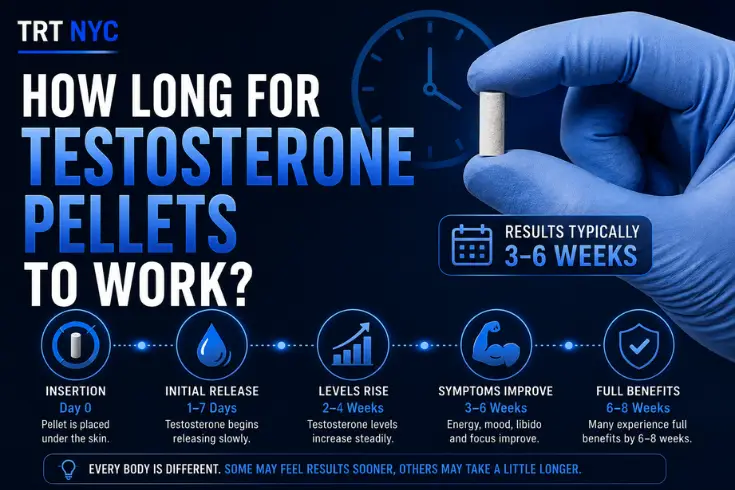
There’s no single switch-flip moment. For most men, the first noticeable changes a lift in energy, mood, mental sharpness, and sex drive, show up somewhere in the two-to-four-week window. The deeper, physical changes like better strength, workout recovery, and shifts in body composition take longer, generally building from two to four months and reaching their peak around the three-to-six-month mark.
Your personal timeline depends on a few things: the dose and number of pellets, your metabolism, your starting testosterone level, and how low your symptoms were to begin with. A man starting from a very low baseline often feels the change sooner and more dramatically than someone who was only mildly low. If you don’t feel transformed in the first week, that’s completely normal, and the next section explains why. (If you’re still unsure whether your symptoms were ever testosterone-related, it’s worth reviewing the symptoms of low testosterone.)
Why Testosterone Pellets Work Gradually, Not Instantly
Pellets are engineered to release hormone slowly, and that design is the whole reason the timeline runs in weeks. Research on testosterone pellet implants measured a steady release of roughly 1.3 mg of testosterone per day from each 200 mg pellet, with the pellets dissolving at an almost perfectly linear rate over the first three months. In other words, the dose feeds in at a constant trickle rather than a flood.
That’s the opposite of a testosterone injection, which delivers a large dose that peaks within a couple of days and then steadily falls until the next shot. Because pellets release a small, continuous amount, your blood testosterone climbs over days to weeks and then holds at a stable level, which is why many men report fewer mood and energy swings on pellets than on injections. The trade-off is patience: a steady trickle takes longer to fill the tank than a single big pour. Understanding how TRT works at the delivery level makes the wait a lot easier to sit with.
Testosterone Pellet Timeline: Week by Week
Here’s what the build typically looks like for men. Treat it as a map, not a guarantee, individual timing varies.
| Timeframe | What most men notice | What’s happening |
| Days 1–3 | Soreness, mild swelling, or bruising at the insertion site | Normal healing; pellets beginning to release |
| Week 1–2 | Early superficial signs: oilier skin, mild acne, a bit more body hair; some feel an early lift in drive | Testosterone entering the bloodstream and rising |
| Week 2–4 | Better energy, sharper focus, improved mood, returning libido | Levels approaching a steady state |
| Week 4–6 | Steadier mood and sleep; libido and energy more consistent | Blood levels stabilized — bloodwork confirms the dose |
| Month 2–4 | Strength, faster workout recovery, and body-composition changes begin | Deeper, tissue-level effects take hold |
| Month 3–6 | Full benefit; effects then gradually taper as pellets dissolve | Pellets near depletion — time to re-dose |
One pattern worth flagging: some men feel a noticeable lift in the first week or two and then feel it “level off.” That isn’t the pellets failing — it’s the difference between the early rise and reaching a steady state. The early surge is your body responding to climbing levels; once those levels plateau, the feeling becomes a steadier baseline rather than a daily high. Many men describe the most meaningful changes showing up around the three-month mark, once the physical effects have had time to accumulate.
How Long Do Testosterone Pellets Last?
Most men get three to six months from a single insertion. In the pellet-implant research, men returned for re-implantation at an average of about 5.8 months when there were no complications. Your dose, the number of pellets, and your metabolism all influence where you land in that range.
As the pellets near the end of their life and dissolve away, testosterone delivery tapers off and many men feel that “dip” in the final few weeks before their next appointment: energy and drive soften, and the old symptoms start to creep back. That’s your signal it’s time to re-dose, ideally scheduled before you fully crash so your levels never bottom out. This steady-but-finite cycle is one of the main ways pellets differ from testosterone shots.
What If Your Testosterone Pellets Don’t Seem to Be Working?
Feeling little at three or four weeks is common and usually not a problem your levels are still climbing toward steady state. But if you hit the six-to-eight-week mark with no change at all, that’s the point to call your provider rather than keep waiting. Three things explain most “not working” cases:
- The dose was too low for your body and needs to be increased at your next insertion.
- A placement or extrusion issue the pellets were placed too shallow, or one worked its way back out through the incision. Extrusion happens in only a small share of procedures, but it does happen.
- Your symptoms aren’t actually testosterone-driven. Fatigue, low mood, and low libido have other causes, and pellets can’t fix what isn’t a hormone problem.
A blood test settles which of these it is, which is why bloodwork matters so much in the first month. It’s also worth knowing the normal side effects of TRT so you can tell ordinary adjustment from a real problem. If you have pus, spreading redness, or bleeding that won’t stop at the insertion site, call your clinic right away, that’s a wound issue, not a hormone one.
When to Get Bloodwork After Pellet Insertion
Bloodwork is how you confirm the pellets are absorbing before your symptoms fully catch up your levels are measurable in the blood weeks before you necessarily feel 100%. The standard checkpoint is about four weeks after insertion, once levels have had time to stabilize. Ask for:
- Total testosterone: confirms the pellets are releasing into your system
- Free testosterone: the usable fraction that tracks how you actually feel
- A morning draw: when testosterone naturally peaks, for the most reliable reading
Compare these numbers to your pre-pellet baseline. If your levels have risen into a healthy range, the pellets are working even if the full benefit hasn’t arrived yet, you just need more time. If they’ve barely moved, that’s objective evidence to adjust your dose next round. For the practical details, see how to test testosterone and the best time to test.
Do Pellets Work Faster Than Injections?
No, injections typically feel faster up front. A testosterone injection floods your system and peaks within a couple of days, so the initial “kick” can be quicker. Pellets take longer to ramp because they release slowly, so the onset is more gradual over two to four weeks.
The trade-off favors pellets on consistency. Injections create a peak-and-trough pattern, you feel strong early in the cycle and flatter toward the end, sometimes with mood and energy swings. Pellets deliver a steadier level, so once they kick in, the day-to-day feel is more even. Neither is universally “better”; the right choice depends on whether you value a fast onset and dose control or set-it-and-forget-it steadiness, which is exactly the pellets-vs-injections decision worth thinking through before you commit.
The Bottom Line
If you’ve had testosterone pellets placed and want to know they’re actually doing their job, get your levels checked at the four-week mark. Book a follow-up testosterone panel with TRT NYC: we’ll measure your total and free testosterone, compare it to your pre-pellet baseline, and tell you whether your dose is dialed in or needs adjusting at your next insertion.
Frequently Asked Questions
How long does it take for testosterone pellets to start working?
Most men notice early effects, better energy, mood, focus, and libido, within two to four weeks. Some feel an early lift within the first week or two as levels climb. Physical changes like strength build over two to four months.
How long do testosterone pellets last?
Typically three to six months per insertion, with most men re-dosing around the five-to-six-month mark. Dose, pellet count, and metabolism affect where you fall in that range.
Why are my testosterone pellets not working?
The three usual causes are a dose that’s too low for your body, a placement or extrusion issue, or symptoms that aren’t actually caused by low testosterone. A blood test at the four-week mark identifies which it is.
What happens if testosterone pellets don’t work after 8 weeks?
No change by eight weeks warrants a follow-up. Your provider will check your bloodwork and the insertion site to confirm the pellets absorbed and weren’t extruded, and adjust your dose at the next insertion if needed.
Do testosterone pellets work faster than injections?
Injections usually produce a faster initial kick because they peak within days. Pellets ramp up more gradually over two to four weeks but then deliver steadier levels without the peaks and troughs of injections.
When should I get bloodwork after pellet insertion?
About four weeks after insertion, once levels have stabilized. Request total and free testosterone, drawn in the morning, and compare the results to your pre-pellet baseline.
How long until testosterone pellets reach their full effect?
Full benefit generally lands around three to six months, once both the early hormonal effects and the slower physical changes — strength, recovery, body composition, have had time to develop.