Testosterone Shot vs Pellet: Which Is Better? (2026)
Testosterone shots are injections given every few days to weeks cheap, flexible, and easy to adjust, but they require self-injecting and can cause…
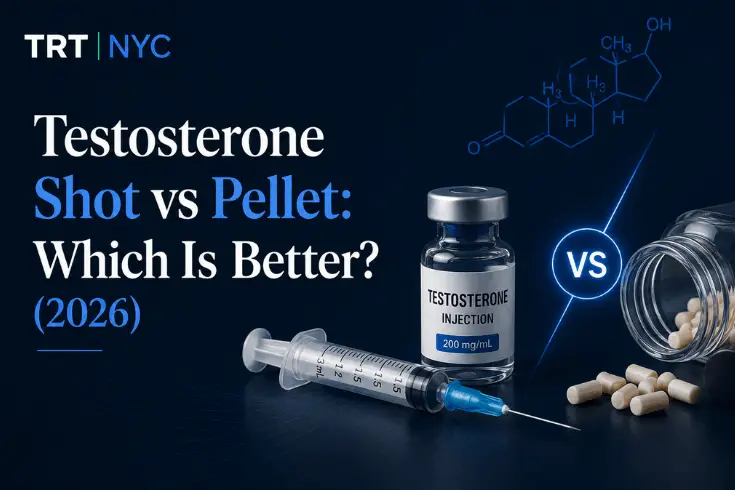
Testosterone shots are injections given every few days to weeks cheap, flexible, and easy to adjust, but they require self-injecting and can cause level swings. Testosterone pellets are tiny implants placed under the skin every 3–6 months, convenient and steady, but pricier, surgical to place, and hard to adjust once in. Shots suit hands-on dosers; pellets suit set-and-forget.
Two of the most popular ways to take TRT, two very different experiences. Here’s how testosterone shots and pellets really compare. (For all delivery options, see our complete TRT guide.)
Testosterone Shot vs Pellet: Quick Comparison
| Factor | Shots (injections) | Pellets |
|---|---|---|
| Frequency | Every ~3.5–14 days | Every 3–6 months |
| Cost | Low | Higher |
| How it’s given | Self-injection at home | Minor in-office procedure |
| Dosing control | Easy to adjust | Hard once placed |
| Level stability | Can swing peak-to-trough | Steady release |
| Convenience | Frequent, hands-on | Set-and-forget |
What Are Testosterone Injections (Shots)?
Shots deliver testosterone (commonly cypionate or enanthate) into muscle or under the skin on a regular schedule. They’re the most common and most affordable form of TRT, and they give you precise control over dose and frequency. The trade-off: you handle needles which is why men research what size needle for a testosterone injection and what size needle to draw testosterone from a vial and levels can rise and fall between doses if spaced too far apart.
What Are Testosterone Pellets?
Pellets (e.g., Testopel) are tiny testosterone cylinders implanted under the skin, usually in the hip/buttock, during a quick in-office procedure. They slowly release testosterone over 3–6 months, so there’s nothing to do day to day. The downsides: they cost more, require a minor procedure (with a small risk of extrusion or infection), and can’t easily be adjusted or removed once placed.
Shot vs Pellet: Cost
Shots win on cost, vials of testosterone are inexpensive, and many men find them the cheapest route (related: how to get testosterone online and whether Medicaid covers testosterone). Pellets cost more per treatment because of the procedure and the implant itself.
Shot vs Pellet: Convenience and Frequency
Pellets win on convenience, a few visits a year versus injecting every few days to weeks. If needles or remembering a schedule are dealbreakers, pellets are appealing. If you don’t mind a quick routine and like being hands-on, shots are simple once you learn them, part of learning to start TRT safely.
Shot vs Pellet: Dosing Control and Side Effects
This is where it matters most:
Shots are easy to fine-tune — if your bloodwork shows high hematocrit or other TRT side effects, you can lower the dose or inject more frequently for smoother levels.
Pellets are fixed — once placed, you can’t easily dial them back, so a side effect means waiting or a procedure. Both can raise hematocrit; smaller, more frequent shots tend to spike it least.
Which Should You Choose?
- Choose shots :- if you want low cost, precise dose control, and don’t mind needles.
- Choose pellets :- if you value convenience and steady levels and dislike frequent injections.
The “right” choice also depends on whether TRT is right for you in the first place and what benefits you’re after — discuss it with your prescriber.
The Bottom Line
Neither testosterone shots nor pellets is universally better. Shots are cheaper and far easier to adjust, at the cost of self-injecting and possible level swings. Pellets are convenient and steady, at the cost of price, a minor procedure, and poor adjustability. Match the method to your budget, lifestyle, and how closely your levels need fine-tuning with your doctor.
👉 Whichever route you lean toward, base it on data: check your testosterone with an at-home test kit and discuss shot vs pellet with a licensed provider.
Frequently Asked Questions
Are testosterone pellets better than injections?
Not universally. Pellets are more convenient and give steadier levels, but they cost more, require a minor procedure, and can’t be easily adjusted. Injections are cheaper and far easier to fine-tune. The better choice depends on your priorities.
How long do testosterone pellets last?
Testosterone pellets typically release testosterone over about 3–6 months before they need replacing. The exact duration varies by dose and individual metabolism, which is why follow-up bloodwork helps time the next placement.
Are testosterone shots or pellets cheaper?
Shots are generally cheaper. Testosterone vials for injection are inexpensive, while pellets cost more because of the implant and the in-office procedure to place them. Cost is one of the biggest practical differences.
Do pellets cause fewer side effects than shots?
Not necessarily. Both can raise hematocrit and cause typical TRT side effects. Pellets give steadier levels, but if a side effect appears, they’re hard to adjust, whereas shots can be quickly dialed down.
Can you switch from pellets to injections?
Yes. Many men switch between methods based on cost, convenience, or side effects. Because pellets release slowly, your doctor will time any switch around when the pellets wear off and adjust your injection dose accordingly.
Which is more convenient, shots or pellets?
Pellets are more convenient day to day, just a few visits a year with nothing to do in between. Shots require injecting every few days to weeks, though many men find the routine simple once they learn it.
Written by the TRT NYC Editorial Team. Reviewed against current clinical guidance (Endocrine Society; FDA labeling). Last updated: June 2026.
Medical disclaimer: This article is for educational purposes only and is not medical advice, diagnosis, or treatment. Your delivery method should be chosen with a clinician. trtnyc.com is an independent informational resource, not a medical provider. Always consult a licensed healthcare provider.