What Age Should You Start TRT?
 By Tejanshu Jaluthria

Key Takeaways
- There’s no fixed age for starting TRT, clinicians rely on confirmed lab values plus symptoms, not a birthday.
- Most guidelines use total testosterone under 300 ng/dL, on two separate morning tests, as the diagnostic threshold.
- Testosterone decline of roughly 1% per year after age 30 is well documented, though recent research suggests underlying health conditions, not age alone, drive much of that decline.
- TRT isn’t right for everyone with low numbers: cardiovascular history, fertility plans, and prostate history all factor into the decision.
- Ongoing monitoring (testosterone, hematocrit, PSA) is required for as long as you’re on therapy.
Why “What Age Should I Start TRT” Isn’t the Right Question
Testosterone declines by roughly 1% per year on average starting in a man’s 30s, based on longitudinal data from the Baltimore Longitudinal Study of Aging. But that average hides wide individual variation, some men in their 50s test well within normal range, while others in their late 20s develop clinically low testosterone from injury or illness unrelated to aging. A more recent follow-up from the same long-running study found that once comorbidities like obesity and chronic disease are factored in, age alone predicts less of the decline than previously assumed, reinforcing why clinicians look at your specific labs and health history rather than your birth year.
What Testosterone Level Is Low Enough for TRT?
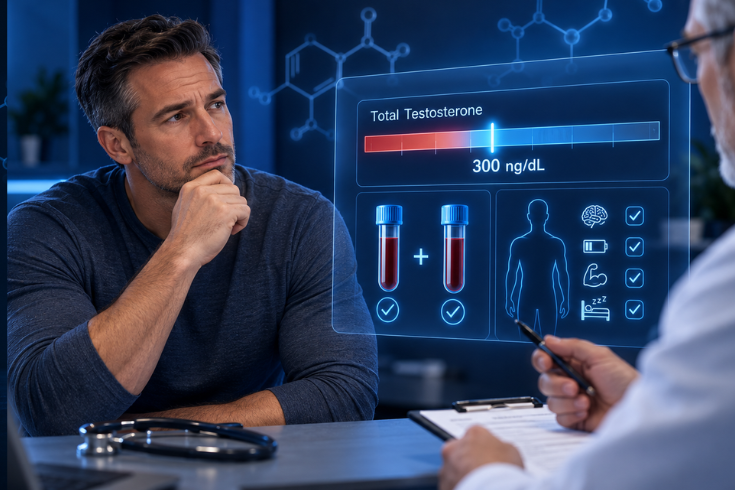
The American Urological Association’s Testosterone Deficiency Guideline sets total testosterone below 300 ng/dL as a reasonable diagnostic cutoff, but a low number alone isn’t sufficient. Diagnosis requires that level plus symptoms like fatigue, low libido, or mood changes. A result of 280 ng/dL with no symptoms is evaluated very differently than the same number paired with clear symptoms. To see how a given result compares across age brackets, reviewing testosterone levels by age is a useful step before your appointment.
How Clinicians Diagnose Low Testosterone
- Repeat morning testing: Levels peak early morning and fluctuate with sleep and stress, so the AUA guideline requires two separate morning draws before confirming a diagnosis.
- Total vs. free testosterone: Total measures everything in your blood, including hormone bound to proteins. Free testosterone measures only the active portion, some men have normal total but low free testosterone due to elevated SHBG.
- LH and FSH: These pituitary hormones indicate where the problem originates. High LH/FSH with low testosterone points to a testicular issue; low or normal LH/FSH points to a pituitary or hypothalamic cause, a distinction that shapes both treatment and fertility-preserving options.
What Causes Low Testosterone?
Low testosterone isn’t always simply age. Documented causes, per NIH’s clinical overview of testosterone and aging, include:
- Testicular injury, undescended testicles, or genetic conditions like Klinefelter syndrome
- Pituitary or hypothalamic disorders, including tumors
- Chronic conditions: obesity, type 2 diabetes, chronic kidney or liver disease, untreated sleep apnea
- Medications, including long-term opioid or anabolic steroid use
Can Low Testosterone Improve Without TRT?
Sometimes, when a reversible cause is driving the low reading:
- Weight loss, since excess body fat both lowers free testosterone and raises estrogen conversion
- Treating obstructive sleep apnea
- Stopping or reducing opioid or anabolic steroid use, where applicable
- Improving sleep quality and reducing chronic alcohol intake
- Resistance training and stress reduction, which have modest but documented effects
These steps don’t replace treatment when levels are significantly low with clear symptoms, but a thorough clinician should discuss them first, particularly for younger men.
Who Should Use Caution Before Starting TRT
Per AUA guidance, particular caution applies to men who:
- Have cardiovascular disease or a recent cardiac event (waiting roughly 3–6 months post-event is generally advised)
- Are actively trying to conceive, since TRT suppresses sperm production
- Have a history of prostate cancer, where risk-benefit evidence remains limited
- Have untreated severe sleep apnea or elevated hematocrit
TRT Benefits vs. Risks
| Potential Benefits | Potential Risks |
|---|---|
| Improved energy and libido in men with confirmed deficiency | Suppressed natural testosterone and sperm production |
| Better muscle mass and bone density | Elevated red blood cell count (polycythemia) |
| Mood improvement reported by many patients | Acne, fluid retention, breast tenderness |
| Some men report better focus or sleep, though evidence here is less consistent than for energy/libido | Requires ongoing lab monitoring for the duration of treatment |
On cardiovascular safety specifically, the FDA’s postmarket review cites its required TRAVERSE trial of over 5,200 men, which found comparable cardiovascular event rates between treatment and placebo groups and no new safety signal. That’s reassuring at a population level, but it doesn’t eliminate the need for individual screening, which is why the monitoring below matters.
What Happens After You Start: Ongoing Monitoring
- Testosterone levels rechecked a few weeks in, then roughly every 6–12 months
- Hematocrit, to catch polycythemia early
- PSA and prostate health, particularly for men over 40
- Symptom tracking, since the goal is relief, not just a higher number on paper
TRT’s Impact on Fertility
Exogenous testosterone reduces LH/FSH signaling, which lowers natural sperm production, sometimes to zero. This is often reversible after stopping, though recovery timelines vary and aren’t guaranteed. Men prioritizing fertility sometimes use hCG or enclomiphene instead of, or alongside, testosterone. This deeper look at TRT and fertility covers those alternatives, a conversation worth having before starting, not after.
TRT by Age

| Age Range | What’s Typical | Clinical Focus |
|---|---|---|
| 20s | Low T uncommon; usually points to a specific cause | Ruling out underlying conditions; fertility preservation |
| 30s | Gradual decline begins | Investigating causes beyond aging alone |
| 40s | Symptomatic, confirmed low T more common | Balancing benefits with cardiovascular/prostate screening |
| 50s | Age-related decline well-documented | Routine monitoring once treatment starts |
| 60+ | Decline continues; other conditions often coexist | Extra caution around cardiovascular history and PSA baseline |
Conclusion
There’s no age that automatically qualifies or disqualifies someone for TRT. What determines candidacy is confirmed lab results across repeat morning testing, real symptoms, an understanding of the underlying cause, and a full risk screening, the same standard at 27 or 57. If you’re unsure where you stand, the useful next step isn’t picking a target age; it’s getting properly evaluated so the decision rests on your actual biology.
Frequently Asked Questions
What is the best age to start TRT?
There isn’t one, the right time is whenever labs confirm low testosterone (typically under 300 ng/dL on two morning tests) alongside real symptoms, regardless of your age.
What testosterone level is considered low enough for TRT?
Most guidelines, including the AUA’s, use total testosterone below 300 ng/dL as a reasonable cutoff, combined with symptoms, the number alone doesn’t confirm a diagnosis.
Is TRT effective at 30?
It can be, if a clinician confirms genuinely low levels tied to an identifiable cause rather than assuming normal age-related decline, which is uncommon this early.
Is TRT worth it at 40?
Many men with confirmed deficiency report meaningful improvement in energy, mood, and libido at this age, whether it’s “worth it” depends on your labs and comfort with ongoing monitoring.
Is it safe to start TRT at 50?
Generally yes, with the same diagnostic and monitoring standards as any age, plus closer attention to cardiovascular and prostate health given the age bracket.
Can low testosterone go away without medication?
Sometimes, if the cause is reversible, such as obesity, untreated sleep apnea, or a medication side effect, addressing that directly can raise levels without TRT.
Once I start TRT, will I need to stay on it long-term?
For many men, yes, since stopping doesn’t guarantee an immediate return to pre-treatment levels, but recovery varies by individual and underlying cause, and natural production often does recover to some degree after stopping. This is worth discussing with your provider before starting.
Written by: Tejanshu Jaluthria, Health Content Writer | Last updated: September 18, 2026
Medical Disclaimer
This article is for informational purposes only and does not constitute medical advice, diagnosis, or treatment. Testosterone replacement therapy should only be started, adjusted, or stopped under the supervision of a licensed healthcare provider based on your individual lab results and medical history. Always consult a qualified physician before beginning any hormone therapy.