Testosterone Shot vs Pellet: The Honest Comparison for Choosing Your TRT
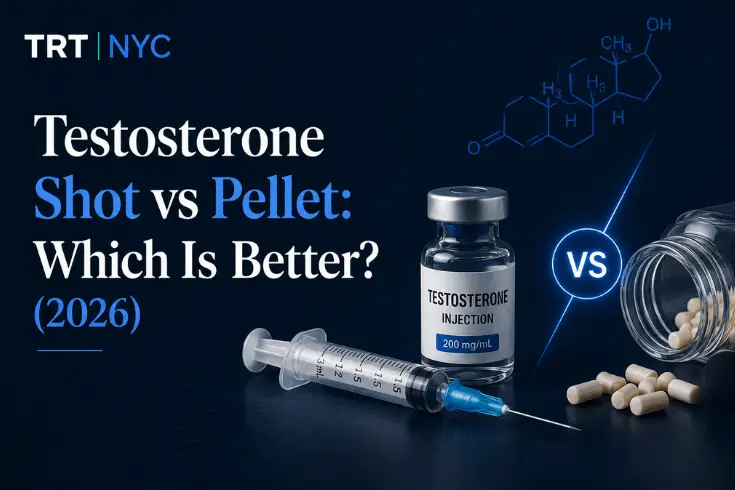
In the testosterone shot vs pellet decision, injections are the better choice for most men — but pellets genuinely win for a specific type of patient, and the right answer depends on one trade-off above all others. Testosterone injections are the better choice for men who want precise dose control, the ability to adjust quickly, and lower cost — which describes most men on TRT. Testosterone pellets are the better choice for men who prioritize convenience above everything and are willing to give up flexibility in exchange for not thinking about treatment for three to four months. The core trade-off is simple: injections give you control; pellets give you convenience.
This is a genuinely balanced comparison — not an argument for whichever method a clinic happens to sell. Here’s the head-to-head on cost, consistency, side effects, and flexibility, plus a clear framework for which method fits which man.
| Dimension | Testosterone Shots (Injections) | Testosterone Pellets |
| How it’s given | Self-injected weekly or twice weekly (IM or subcutaneous) | Inserted under the skin in a minor in-office procedure |
| Frequency | Weekly / twice weekly | Every 3–4 months |
| Hormone pattern | Peak after injection, trough before the next | High early, declining to low before re-insertion |
| Dose flexibility | High — adjustable within weeks | Low — locked in until next insertion |
| Reversibility | Clears in days (~7-day half-life) | Cannot be easily removed; dissolves over 4–6 months |
| Typical cost | ~$100–300/month | ~$600–1,200 per insertion (2–4×/year) |
| Convenience | Lower — frequent self-administration | Higher — set-and-forget for months |
| Main drawback | Needle aversion; peak-trough swings | Locked-in dosing; supraphysiologic early levels |
| Best for | Most men; those wanting control and low cost | Convenience-first patients comfortable with fixed dosing |
How Testosterone Shots Work
Testosterone injections deliver testosterone usually cypionate or enanthate into the muscle (intramuscular) or the fat layer beneath the skin (subcutaneous). Most men self-administer at home on a weekly or twice-weekly schedule after a brief training session.
The advantages:
- Precise dose control. Your provider can fine-tune the dose based on your bloodwork and symptoms, dialing it up or down in small increments.
- Fast adjustability. If your labs show your testosterone or hematocrit is too high, the dose can be reduced and take effect within a week or two.
- Low cost. Injections are the most affordable TRT method, typically $100–300 per month including the medication and supplies.
- Reversibility. Because testosterone cypionate has roughly a seven-day half-life, the drug clears from your system within days if you need to stop or change course.
The drawbacks:
- Frequency. You’re administering treatment every few days, which requires consistency and comfort with self-injection.
- Needle aversion. For men with genuine needle phobia, the routine can be a real barrier.
- Peak-and-trough swings. Each injection produces a peak shortly after and a trough before the next dose. Once-weekly protocols create bigger swings; twice-weekly or daily protocols smooth them out considerably.
How Testosterone Pellets Work
Testosterone pellets are small cylinders of crystallized testosterone, about the size of a grain of rice, inserted under the skin — usually in the hip or upper buttock — during a minor in-office procedure under local anesthesia. Once placed, they slowly dissolve and release testosterone over three to four months.
The advantages:
- Convenience. This is the headline benefit. After insertion, there’s nothing to do for months — no weekly injections, no daily gels, no remembering doses.
- No self-administration. For men who dislike needles or don’t want to manage a regular protocol, the pellet removes the day-to-day burden entirely.
- Steady-ish delivery. Pellets avoid the sharp weekly peak-and-trough cycle of injections (though “steady” comes with an important caveat, covered below).
The drawbacks:
- A minor surgical procedure. Insertion involves a small incision, and there’s a recovery period — typically avoiding heavy activity and swimming for several days to reduce infection and extrusion risk.
- Locked-in dosing. Once the pellets are in, the dose cannot be changed until the next insertion cycle.
- Irreversibility. If the pellets cause side effects, they can’t be easily removed — you either wait months for them to dissolve or undergo a removal procedure.
- Higher cost. Each insertion runs roughly $600–1,200, repeated two to four times a year.
Head-to-Head: Hormone Consistency and the Two Curves
The most common claim in this debate is that pellets provide “steady” testosterone while injections cause “fluctuations.” The reality is more nuanced — both fluctuate, just on different timescales.
Injections
produce a curve that rises to a peak one to two days after the dose and falls to a trough just before the next. With a once-weekly protocol, that swing can be noticeable. With twice-weekly or daily subcutaneous dosing — increasingly the standard — the curve flattens substantially, producing fairly stable levels across the week.
Pellets
do not release testosterone at a perfectly even rate. They release more in the first few weeks after insertion — often pushing testosterone into supraphysiologic territory (above the normal range) — and then taper, frequently dropping to sub-therapeutic levels in the final weeks before the next insertion is due. So the pellet curve trades the injection’s short weekly swing for a long, slow arc: too high early, often too low late.
Neither delivers a perfectly flat line. The honest framing: injections fluctuate over days in a way you can smooth out with more frequent dosing; pellets fluctuate over months in a way you cannot adjust at all once they’re in.
Head-to-Head: Cost, Side Effects, and Hematocrit
Cost
Over a full year, injections are typically the cheaper option — roughly $1,200–3,600 annually versus $1,200–4,800 for pellets, depending on how many insertions you need. Injections also avoid the per-procedure cost structure that makes pellets add up.
Side effects unique to pellets
Because pellets involve a small incision, they carry procedure-specific risks: extrusion (a pellet working its way back out through the skin), which occurs in roughly 1% of insertions with modern Testopel pellets but was substantially higher with older formulations, and infection at the insertion site, which occurs in under 1% of cases. Injections carry their own minor risks — injection-site soreness and, rarely, infection.
The hematocrit question
This is where the data appears to conflict, and it’s worth resolving honestly. Some studies show injections raise hematocrit (red blood cell concentration) more, due to their sharp peaks. Others show pellets raise it more, due to the supraphysiologic levels in the early weeks. The honest synthesis: both methods can raise hematocrit and the associated blood clot risk. The decisive difference isn’t which raises it more on average — it’s that with injections, you can reduce the dose to bring it down, while with pellets, you’re committed to the supraphysiologic early phase every cycle with no ability to dial it back.
Head-to-Head: Control and the Irreversibility Factor
This is the single most underweighted factor in the decision, and it deserves the most attention. With injections, your dose is a dial you can turn. Labs show your testosterone is too high or your hematocrit is climbing? Reduce the dose next week, and because the drug clears in days, the change takes effect quickly. Feeling a side effect? Adjust or pause, and your levels respond within days.
With pellets, your dose is a commitment. Once they’re inserted, the dose is fixed for three to four months. If your testosterone runs too high, your hematocrit climbs, you develop acne or mood changes, or you simply don’t tolerate the dose well — you cannot turn the dial. You either wait four to six months for the pellets to fully dissolve, or undergo a removal procedure that isn’t always straightforward, since the pellets can fragment or migrate.
For men new to TRT whose response to testosterone is still unknown this asymmetry matters enormously. Starting on a method you can’t adjust means discovering a problem and being stuck with it for months. This is the strongest argument for beginning TRT on injections even if you later switch to pellets once your optimal dose is known.
Which Should You Choose? Scenarios That Decide It
The right method depends on which patient profile fits you.
Choose injections if you:
- Are new to TRT and your optimal dose isn’t established yet (you’ll want to adjust)
- Want the tightest control over your levels and your results
- Have risk factors for high hematocrit or are prone to erythrocytosis (you’ll want to be able to reduce the dose)
- Are fertility-minded and may add HCG to preserve sperm production — injection protocols combine more easily
- Want the lowest cost
Choose pellets if you:
- Value convenience above all and want to forget about treatment for months
- Have a stable, well-established TRT dose that’s worked reliably for you
- Strongly dislike frequent self-injection and find the routine a genuine barrier
- Travel constantly or struggle to maintain a consistent dosing schedule
- Don’t have risk factors that would require frequent dose adjustment
The pattern: injections suit men who want to optimize and adjust; pellets suit men who want simplicity and already know what dose works for them.
What Most People Get Wrong When Choosing
Believing pellets are perfectly steady: They front-load running high early and low late. The “steady pellet vs. spiky injection” marketing oversimplifies a more complicated reality.
Underestimating the irreversibility: The inability to adjust or remove a pellet for months is the biggest practical risk, and it’s the factor most often glossed over in the convenience pitch.
Choosing pellets purely to avoid needles: Pellet insertion is a minor surgical procedure with an incision and recovery period — it’s not needle-free, and it happens in a clinic rather than at home.
Assuming convenience equals better results: For most men, the ability to fine-tune the dose based on labs produces better outcomes than the set-and-forget approach. Convenience is a real benefit, but it’s a trade-off against optimization, not a free upgrade.
Frequently Asked Questions
Which is cheaper, testosterone shots or pellets?
Testosterone shots are typically cheaper. Injections run about $100–300 per month including medication and supplies (roughly $1,200–3,600 per year), while pellets cost $600–1,200 per insertion, repeated two to four times annually ($1,200–4,800 per year). Injections avoid the per-procedure cost structure, making them the more economical option for most men over a full year of treatment.
Do testosterone pellets give more stable levels than injections?
Only partly. Pellets avoid the short weekly peak-and-trough cycle of injections, but they don’t release testosterone evenly — levels run high (sometimes supraphysiologic) in the first weeks after insertion and decline to low or sub-therapeutic levels before the next insertion. Twice-weekly or daily injections produce levels that are arguably just as stable across the week, with the added benefit of being adjustable.
Can testosterone pellets be removed if they cause problems?
Not easily. Once inserted, pellets cannot be simply taken back out — they’re designed to dissolve over four to six months. If they cause side effects like high hematocrit or mood changes, your options are to wait for them to dissolve or undergo a removal procedure, which can be complicated because pellets may fragment or migrate. This irreversibility is the main reason injections are often recommended for men new to TRT.
Do pellets or injections cause higher hematocrit?
The data is mixed — some studies show injections raise hematocrit more (due to sharp peaks), others show pellets do (due to supraphysiologic early levels). Both methods can raise hematocrit and the associated clot risk. The more important difference is manageability: with injections you can reduce the dose to lower hematocrit, while with pellets you’re locked into the dose until the next insertion cycle.
How long do testosterone pellets last compared to injections?
Testosterone pellets last three to four months per insertion, while injections are administered weekly or twice weekly. This is the core convenience difference: pellets require a clinic visit a few times a year, whereas injections are a regular at-home routine. The trade-off is that the pellet’s longer duration also means its dose is locked in for that entire period.
Which is better for beginners, shots or pellets?
Injections are generally better for beginners. When you’re new to TRT, your optimal dose and your body’s response are unknown, so the ability to adjust the dose within weeks based on bloodwork is a significant advantage. Starting on pellets means committing to a fixed dose for months before you know how you respond — which is why many providers recommend establishing your dose on injections first, then considering pellets later if convenience becomes a priority.
What are the main side effects of each method?
Injections can cause injection-site soreness, peak-and-trough mood or energy swings (more pronounced with weekly dosing), and elevated hematocrit. Pellets carry procedure-specific risks extrusion (the pellet working its way out, around 1% with modern pellets), insertion-site infection (under 1%), and supraphysiologic testosterone in the early weeks that can’t be dialed back. Both methods can raise hematocrit and require monitoring.
The best TRT delivery method is the one matched to your goals, your labs, and your risk profile — not the one a clinic happens to sell. Book a consultation with TRTNYC to review whether injections or pellets fit your situation, get the bloodwork that informs the choice, and start a protocol you can actually adjust as your body responds.