How to Increase Testosterone Naturally (Science-Backed)
 By TRT NYC Editorial Team
TL;DR — Key Takeaways
- The biggest levers are lifestyle, not pills: sleep, losing body fat, and strength training.
- Sleeping only 5 hours a night can cut testosterone by ~15%.
- A 5% weight loss can raise total testosterone ~58 ng/dL, big losses far more.
- Vitamin D, zinc, and magnesium help, mainly if you’re deficient.
- Ashwagandha has modest real evidence; most “booster” foods do little. If you’re truly low, natural methods may not be enough, test and see a doctor.
You can increase testosterone naturally through proven lifestyle levers, not miracle pills. The biggest, sleep (5 hours a night can cut it ~15%), losing excess body fat (~5% loss → ~58 ng/dL higher), strength training, and fixing vitamin D, zinc, and magnesium deficiencies. Herbs like ashwagandha help modestly; most “booster” foods don’t. If you’re truly low, natural methods may not be enough.
Most “boost your T naturally” advice is noise. This guide ranks what actually works by evidence and links to the deep-dive on each. (If you suspect a real deficiency, also see low testosterone symptoms and our complete TRT guide.)
How to Increase Testosterone Naturally: What Actually Works
Here’s the honest evidence ranking:
| Method | Evidence | Typical effect |
| Fix your sleep | Strong | Poor sleep cuts T ~15% |
| Lose excess body fat | Strong | ~5% loss → +~58 ng/dL |
| Strength training / exercise | Strong | Acute + long-term support |
| Vitamin D (if deficient) | Moderate | Up to ~20% if low |
| Zinc / magnesium (if deficient) | Moderate | Helps if low |
| Ashwagandha | Moderate | Modest rise; lowers cortisol |
| “Booster” foods (celery, etc.) | Weak/none | Little to no effect |
Key fact: The biggest natural testosterone levers are sleep, losing body fat, and strength training, sleeping only 5 hours a night can cut testosterone by about 15%.
1. Fix Your Sleep (the #1 Lever)
Sleep is the single most powerful natural lever. A well-known study found that restricting sleep to ~5 hours a night dropped young men’s testosterone by about 10–15% (Leproult & Van Cauter, JAMA, 2011). Testosterone is largely produced during sleep, so 7-9 hours of quality sleep is foundational. If TRT or stress is disrupting your sleep, see can testosterone cause insomnia.
2. Lose Excess Body Fat
Body fat converts testosterone into estrogen (via aromatase), so carrying extra fat lowers testosterone. The payoff from losing it is real, a 5% weight loss can raise total testosterone by ~58 ng/dL, and large losses (e.g., after bariatric surgery) have raised it by ~250 ng/dL. This is why fat loss is one of the most reliable fixes and why TRT and body composition are so linked.
3. Strength Training and Exercise
Intense, compound resistance training raises testosterone acutely and supports it long-term by building muscle and cutting fat. Bodyweight training counts too, see do calisthenics increase testosterone, and how it compares in does boxing increase testosterone. Recovery matters, overtraining and heat stress (see do saunas increase testosterone) can work against you.
4. Fix Deficiencies: Vitamin D, Zinc, Magnesium
These help mainly if you’re low in them:
- Vitamin D: One year-long study saw ~20% higher testosterone in men taking ~3,300 IU/day (Pilz et al.). See does vitamin D increase testosterone.
- Zinc: Supports testosterone if you’re deficient, does zinc increase testosterone.
- Magnesium: Modest support, especially if low, does magnesium increase testosterone.
Among supplements, vitamin D and zinc have the best support, followed by magnesium.
5. Evidence-Based Herbs (Modest but Real)
A few herbs have genuine, if modest, human evidence:
- Ashwagandha: Lowers cortisol and modestly raises testosterone, does ashwagandha increase testosterone.
- Shilajit: A purified-resin option with RCT support, how much shilajit per day for testosterone.
- Tongkat ali and fenugreek: Promising in some studies, does tongkat ali increase testosterone and does fenugreek increase testosterone.
Others like creatine (does creatine increase testosterone), fasting (does fasting increase testosterone), and cold showers (do cold showers increase testosterone) are popular but weaker.
6. Manage Stress and Cortisol
Chronic stress raises cortisol, which suppresses testosterone. Reducing stress (and getting the sleep from step 1) removes that brake, which is exactly why ashwagandha’s cortisol-lowering effect helps. It’s the same reason stress is tied to low testosterone symptoms.
7. Diet, Alcohol, and Sugar
Eat enough (crash diets lower T), get healthy fats and protein, and limit alcohol, heavy drinking suppresses testosterone (see TRT and alcohol). Cutting excess sugar helps mainly via better body composition and insulin sensitivity.
What Doesn’t Work (Skip These)
Save your money and don’t risk your health on myths:
- “Booster” foods like celery and hibiscus tea, little to no effect.
- Dangerous fads like apricot seeds (cyanide risk), avoid entirely.
When Natural Methods Aren’t Enough
Natural levers can meaningfully help, but they can’t fix genuinely low testosterone (clinical hypogonadism). If you’ve optimized sleep, weight, training, and deficiencies and still have symptoms, test your levels with the right testosterone test (compare to normal ranges) and see whether TRT is right for you, the reliable route to the full benefits.
Conclusion
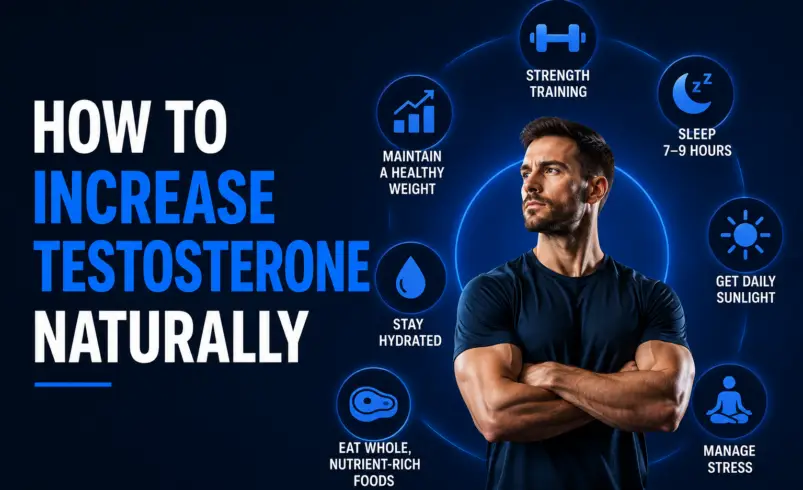
To increase testosterone naturally, prioritize the big levers, sleep 7–9 hours, lose excess body fat, train hard (especially strength work), manage stress, and fix any vitamin D, zinc, or magnesium deficiency. Evidence-based herbs like ashwagandha and shilajit can add modest support; most “booster” foods do nothing. These work best for men with borderline or lifestyle-lowered testosterone, if you’re genuinely low, test your levels and talk to a doctor.
👉 Find your starting point? check your testosterone with an at-home test kit, optimize the levers above for a few months, and see a licensed provider if your levels stay low.
Frequently Asked Questions
How can I increase my testosterone naturally?
Focus on the proven levers: get 7–9 hours of quality sleep, lose excess body fat, do regular strength training, manage stress, and fix any vitamin D, zinc, or magnesium deficiency. Evidence-based herbs like ashwagandha can add modest support. Most “booster” foods have little effect.
What is the fastest way to increase testosterone naturally?
There’s no overnight fix, but improving sleep and reducing stress can help fastest, while fat loss and strength training build bigger gains over weeks to months. Fixing a genuine vitamin D or zinc deficiency can also raise testosterone within months.
Does losing weight increase testosterone?
Yes. Excess body fat lowers testosterone by converting it to estrogen, so losing fat raises it. A roughly 5% weight loss can increase total testosterone by about 58 ng/dL, and large losses have raised it by around 250 ng/dL. It’s one of the most reliable natural levers.
What vitamins increase testosterone?
Vitamin D has the best evidence, especially if you’re deficient, one study saw about 20% higher testosterone with ~3,300 IU/day. Zinc and magnesium also help mainly when you’re low in them. Supplementing beyond correcting a deficiency offers little added benefit.
Can you increase testosterone without TRT?
Yes, to a degree. Sleep, fat loss, exercise, stress management, and correcting deficiencies can meaningfully raise testosterone in men whose levels are lifestyle-lowered or borderline. But natural methods can’t fix genuinely low testosterone (hypogonadism), which usually needs medical treatment.
What foods or supplements actually boost testosterone?
The best-supported supplements are vitamin D and zinc (if deficient), plus modest evidence for magnesium, ashwagandha, and shilajit. Most “testosterone-boosting” foods, like celery or hibiscus, have little to no effect, and some fads, like apricot seeds, are dangerous.
Written by: TRT NYC Editorial Team, Last updated: July 2026 · Reviewed against: peer-reviewed research and Endocrine Society guidance (see References).
Medical disclaimer: This article is for educational purposes only and is not medical advice. trtnyc.com is an independent informational resource, not a medical provider. Consult a licensed healthcare provider about your testosterone.