
At-Home Testosterone Test Kit Reviews: The Best Kits in 2026
 By TRT NYC Editorial Team
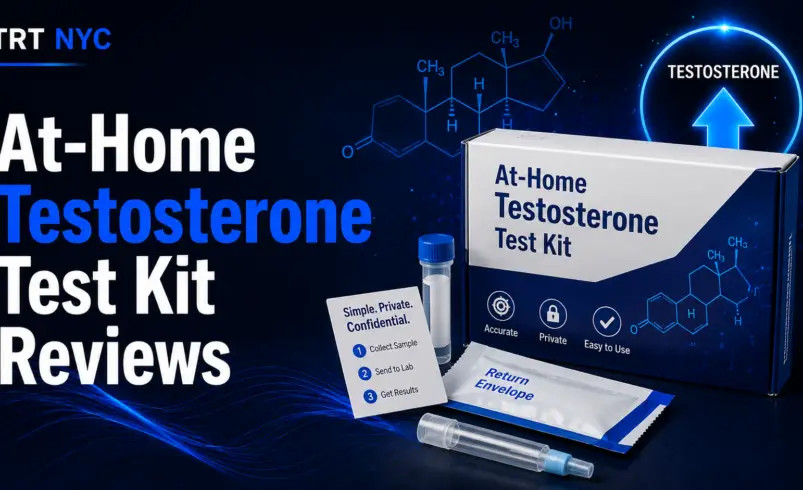
The best at-home testosterone test kits let you check your levels from home using a simple finger-prick or a quick lab visit, with results in a few days. For accuracy, choose a kit that measures total (and ideally free) testosterone from a morning sample analyzed in a CLIA-certified lab. Below we compare the top kits on accuracy, price, and speed and explain how to get a reliable result.
If you suspect low testosterone – fatigue, low libido, brain fog (the classic low testosterone symptoms), an at-home test is the easiest first step before seeing a doctor. But the kits vary a lot in how they collect your sample and what they measure, which changes how reliable your result is. This guide reviews the best at-home testosterone test kits and shows you exactly how to choose and use one.
How We Evaluated the Best At-Home Testosterone Test Kits
Not all kits are equal. We judged each on the factors that actually affect a trustworthy result:
- Sample type: Venous blood (gold standard) > finger-prick blood > saliva (least reliable for testosterone).
- What it measures: Total testosterone at minimum; free testosterone is a big plus (it’s the active form, see free vs total testosterone).
- Lab quality: processed in a CLIA-certified lab.
- Morning collection: Testosterone peaks in the morning; good kits instruct an AM sample.
- Turnaround time: How fast you get results.
- Price & clarity: Fair cost and an easy-to-read report.
Best At-Home Testosterone Test Kits Compared
| Kit | Sample type | Measures | Results | Price (approx) | Best for |
|---|---|---|---|---|---|
| Everlywell | Finger-prick blood | Total T | ~2–5 days | $$ | Best overall |
| LetsGetChecked | Finger-prick blood | Total (panels vary) | ~2–5 days | $$ | Fastest / best app |
| Labcorp OnDemand | Venous (lab visit) | Total T | ~1–3 days | $ | Most accurate |
| Quest Health | Venous (lab visit) | Total T | ~1–3 days | $ | Best value |
| myLAB Box | Finger-prick / saliva | Total T (panels) | ~2–5 days | $$ | Comprehensive panels |
| Hone Health | Finger-prick blood | Total + free + more | ~days | $$$ | Path to treatment |
Prices and exact panel contents change, confirm on each kit’s page before buying.
At-Home Testosterone Test Kit Reviews
Everlywell Testosterone Test: Best Overall
A simple at-home finger-prick kit with results reviewed and delivered through a clean digital report.
Why it matters: easy collection, CLIA-lab processing, and clear results make it the best all-round pick for a first screen.
How to use: collect in the morning, mail it back, view results in the app.
LetsGetChecked Testosterone Test: Fastest / Best App
Finger-prick collection with a polished app and quick turnaround, plus nurse support on some plans.
Why it matters: speed and a smooth experience.
How to use: activate online, morning sample, ship same day.
Labcorp OnDemand: Most Accurate
You order online but give a venous blood sample at a Labcorp location, the same draw a doctor uses.
Why it matters: venous blood is the clinical gold standard, so this is the most reliable option.
How to use: book, visit, get lab-grade results.
Quest Health (questhealth.com) Best Value
Like Labcorp OnDemand: order online, draw at a Quest location, lab-grade results, often at a low price.
Why it matters: gold-standard accuracy without a doctor visit, cheaply.
How to use: order, visit a Quest site, view results online.
myLAB Box: Best for Comprehensive Panels
Offers testosterone alongside broader men’s-health panels.
Why it matters: good if you want more than just testosterone in one order.
How to use: pick a panel, collect at home, mail back.
Hone Health: Best for a Treatment Pathway
An at-home finger-prick assessment that measures total and free testosterone and connects you to a clinician if you qualify.
Why it matters: smooth bridge from testing to care.
How to use: test at home, then a telehealth review.
Do At-Home Testosterone Test Kits Actually Work?
Mostly yes, with caveats. At-home testosterone test kits from CLIA-certified labs are accurate enough for screening, especially venous-blood options (Labcorp, Quest) which match a doctor’s draw. Finger-prick kits (Everly well, Lets Get Checked) are reliable for total testosterone when collected correctly. Saliva tests are the least reliable for testosterone, avoid them if accuracy matters.
Two honesty points:
(1) a single result isn’t a diagnosis, testosterone varies day to day, so abnormal results should be confirmed with a repeat morning test and a doctor; and
(2) collection technique matters a lot (timing, fasting, not squeezing the finger too hard). For the clinical view, see MedlinePlus on the testosterone levels test. If you want to know which markers to order, read what testosterone test do I need.
How to Use an At-Home Testosterone Test Kit (for an Accurate Result)
- Collect in the morning, ideally 7–10 AM, when testosterone peaks (here’s why timing matters).
- Follow fasting/hydration instructions on your kit.
- For finger-prick, warm your hands, let the drops flow (don’t over-squeeze), fill to the line.
- Mail it back same day, so the sample stays fresh.
- Read results against age ranges compare with normal testosterone levels by age.
- Confirm anything abnormal with a clinician before any treatment.
Which At-Home Testosterone Test Should You Choose?
- Want the most accurate result?: Lab corp OnDemand or Quest (venous blood).
- Want easy, no-lab-visit screening?: Everly well (best overall) or Lets Get Checked (fastest).
- Want total and free testosterone + a path to treatment?: Hone Health.
- Want a broader men’s-health panel?: My LAB Box.
- On a budget?: Quest Health.
The Bottom Line
At-home testosterone test kits are a fast, private, affordable first step to check your levels. For pure accuracy, a venous-blood option like Labcorp OnDemand or Quest wins; for convenience, Everlywell is the best all-round pick. Whatever you choose, collect in the morning, use a CLIA-certified lab, and confirm any low or abnormal result with a doctor before starting treatment.
👉 Ready to check your levels? Compare current prices on our top pick Everlywell (best overall) or Labcorp OnDemand (most accurate) then, if your levels are low, read our full testosterone replacement therapy guide to understand your options.
Frequently Asked Questions
Are at-home testosterone test kits accurate?
Yes, for screening, especially venous-blood kits (Labcorp, Quest) that match a clinical draw, and finger-prick kits from CLIA-certified labs when collected correctly. Saliva tests are the least reliable. Confirm any abnormal result with a repeat morning test and a doctor.
What’s the best at-home testosterone test kit?
Everlywell is the best overall for easy finger-prick screening, while Labcorp OnDemand and Quest are the most accurate because they use a venous blood draw. The “best” depends on whether you prioritize convenience, accuracy, price, or a path to treatment.
Do at-home tests measure free testosterone or just total?
It varies. Many basic kits measure total testosterone only; some (like Hone Health) also include free testosterone, the active form. If free testosterone matters to you, check the panel details before buying.
When should I take an at-home testosterone test?
In the morning, ideally between 7 and 10 AM, when testosterone is highest. Follow your kit’s fasting instructions, and avoid testing during acute illness or after poor sleep, which can temporarily lower levels.
What do I do if my at-home test shows low testosterone?
Don’t self-treat. Confirm the result with a repeat morning blood test and see a licensed provider, who can order a full panel and rule out other causes before considering treatment. A single low reading isn’t a diagnosis.
Are at-home testosterone tests worth it?
For a convenient, private first screen, yes. They’re cheaper and faster than a clinic visit. Just treat them as a starting point: any abnormal result should be confirmed by a doctor before making decisions about therapy.
Written by the TRT NYC Editorial Team. Reviewed against current testing guidance (Endocrine Society; MedlinePlus). Last updated: June 2026.
Medical disclaimer: This article is for educational purposes only and is not medical advice, diagnosis, or treatment. At-home tests are screening tools, not a diagnosis. trtnyc.com is an independent informational resource, not a medical provider. Always confirm results with a licensed healthcare provider before starting any treatment.