Does Testosterone Cypionate Expire? Shelf Life and Safety Explained
 By Tejanshu Jaluthria
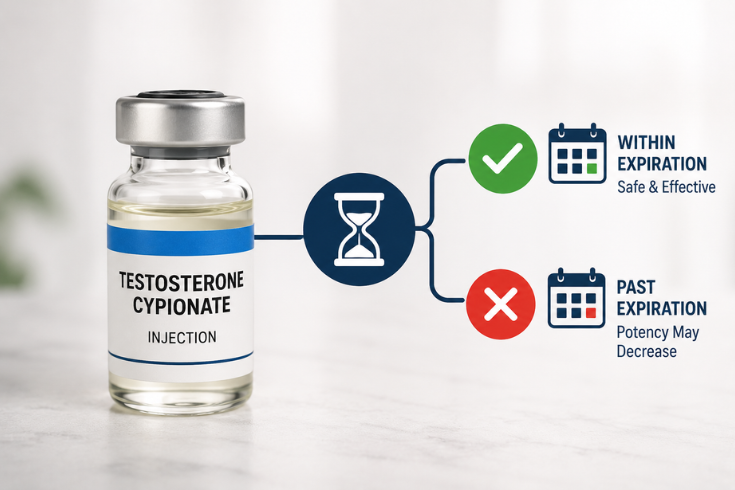
Yes, testosterone cypionate expires — but the date stamped on the vial only tells part of the story, and how long your testosterone actually stays good depends on whether the vial has been opened. Testosterone cypionate is a long-acting, oil-based injectable form of testosterone used in testosterone replacement therapy, with the hormone suspended in a carrier oil inside a sealed glass vial. It’s the most common injectable ester prescribed for TRT in the United States. The key thing to understand is that an unopened vial and an opened one are running on two completely different clocks: an unopened vial has a slow potency clock, while an opened vial has a sterility clock that matters far more for your safety. This guide explains both, clears up the confusing beyond-use dates, and shows you when a vial is fine and when to throw it out.
Does Testosterone Cypionate Expire?
It does — testosterone is a chemical compound, and like any medication it has a manufacturer expiration date based on stability testing. But “expired” isn’t a single event. There are two separate questions hiding inside it: Is the testosterone still strong enough to work? (potency) and Is the vial still clean enough to inject safely? (sterility). These don’t run out at the same time, and confusing them is why so much online advice contradicts itself.
For an unopened, properly stored vial, potency is the relevant clock and it ticks slowly. For a vial you’ve already punctured, sterility becomes the limiting factor — and it’s the one that can actually harm you. Keep those two clocks separate and the rest of this becomes simple. If you’re newer to injectable therapy in general, it helps to understand what TRT is and how the dosing works.
Unopened Vials: The Potency Clock
A sealed, unopened vial of testosterone cypionate is good for about one to two years, with FDA stability data generally supporting roughly 24 months from manufacture when stored correctly. The printed expiration date on the vial reflects that testing — use it before that date.
The reason the window is so long is that testosterone cypionate is chemically stable. It’s an oil-based steroid in a sealed glass container protected from air, so degradation is slow. A vial that’s a month or two past its printed date, if it’s been stored properly and never opened, hasn’t suddenly turned toxic — but its potency may begin to drift, which can mean a slightly weaker dose than the label says. The safe move is to respect the printed date, but understanding the chemistry explains why an unopened vial is the more forgiving of the two scenarios. The slow, steady release of the cypionate ester is also part of how TRT works in the first place.
Opened Vials: The Sterility Clock (and Why the Dates Differ)
Once you puncture the rubber stopper, a second clock starts — and this is the one that matters most. The beyond-use date isn’t about the testosterone breaking down; it’s about how long the vial stays sterile after needles and air have entered it. This is also where all the confusing numbers come from — 28 days, 56 days, even 59 — because they’re set by the manufacturer, not by a single universal rule.
| Source / product | Beyond-use date after first puncture | Notes |
| Pfizer (Depo-Testosterone) | No limit beyond the printed expiration | Per the product label |
| Taro (generic cypionate) | Discard 56 days after first puncture | Manufacturer-specified |
| USP default (conservative) | Discard 28 days | Used when the maker states no specific limit |
| Testosterone enanthate (comparison) | Often 28 days | Different ester, similar handling |
So if your pharmacy told you “28 days” and a forum says “56,” neither is wrong — they’re following different manufacturers’ labels. Check the specific product you were dispensed. Most contamination happens when a vial is punctured repeatedly in a non-sterile way, so clean technique extends real-world safety regardless of which number applies. This sterility limit is one of the practical trade-offs of self-injecting that doesn’t exist with other delivery methods like pellets.
Is Expired Testosterone Dangerous, or Just Weaker?
This is the question most men actually want answered, and the honest version is: it depends on which clock ran out. The important principle is that sterility is usually lost before potency — meaning a vial can still “work” hormonally while no longer being safe to inject.
| Unopened vial | Opened vial | |
| What’s “expiring” | Potency (slow chemical breakdown) | Sterility (contamination risk) |
| How long | 1–2 years (FDA stability ~24 months) | 28–56 days, per manufacturer |
| Main risk if used late | A slightly weaker dose | Infection from contamination |
| What to check | The printed expiration date | The date you first punctured it |
The practical translation: using a vial a little past its potency window mostly risks an inconsistent or weaker dose, which can leave you with fluctuating levels and less symptom relief — annoying, not dangerous. Using a vial past its sterility window risks injecting contaminated solution, which can be dangerous. That’s why a vial that “looks fine” but is months past its post-opening date still shouldn’t go into your body. If your levels feel off and you’re wondering whether weak dosing is the cause, that overlaps with general TRT side effects and dosing issues worth reviewing with your provider.
How to Store Testosterone Cypionate (and the Crystallization Myth)
Proper storage keeps both clocks running as long as they should:
- Keep it at room temperature, ideally 68–77°F (20–25°C).
- Store it in the dark — UV light speeds chemical breakdown.
- Do not refrigerate it. Cold causes crystallization, and sustained heat above 77°F can degrade the testosterone, the ester, and the carrier oil.
Now the myth worth busting: crystals in your vial usually don’t mean it’s expired or ruined. Testosterone cypionate can crystallize simply because it got too cold — which is exactly why refrigeration is a mistake. The fix is gentle warmth. Seal the vial in a zip-top bag so water can’t reach the stopper, submerge it in about 16 ounces of hot water at 100–110°F for at least fifteen minutes, and swirl it. If the solution turns clear again, it’s fine to use — brief warming like this won’t damage the testosterone or the oil. If it stays cloudy or particle-filled after warming, then discard it. Plenty of men throw out perfectly good vials over reversible crystals, which is one of the more common and costly TRT myths worth debunking.
When to Throw a Vial Out
Regardless of the date, discard a vial if you see any of these:
- Cloudiness or particles that remain after gentle warming (clear cold crystals that re-dissolve are fine; persistent cloudiness is not)
- Floating debris or discoloration that wasn’t there before
- It’s past the beyond-use date for your specific product after first puncture
- The seal was broken or compromised before you opened it
- You’re simply unsure of its history — when in doubt about an injectable, throw it out
Don’t pour leftover or expired testosterone down the drain or toss it in the trash where others could find it. Use a pharmacy take-back program or a sharps/medication disposal site. And weigh it against the cost of TRT: a vial is worth protecting with good storage, but never worth an infection — when the two are in tension, safety wins.
The Bottom Line
If you’re staring at a vial and not sure whether it’s still safe to use, don’t gamble with a home injection — ask the people who prescribed it. If you’re not yet a patient, book a TRT consultation with TRT NYC: we’ll prescribe pharmacy-fresh testosterone cypionate, label it with clear beyond-use dates, and show you exactly how to store it so you never have to guess whether a vial has gone bad.
Frequently Asked Questions
How long is a testosterone vial good for after opening?
It depends on the manufacturer. Pfizer’s Depo-Testosterone sets no limit beyond the printed expiration, Taro’s generic specifies 56 days after first puncture, and the conservative USP default is 28 days when no specific limit is stated. Check your product’s label.
Does testosterone expire after 28 days?
Not always — 28 days is the conservative default used when a manufacturer doesn’t specify. Many cypionate products allow 56 days after opening, and some set no post-opening limit beyond the printed date. The 28-day rule is about sterility, not the testosterone going bad.
Can you use expired testosterone cypionate?
It’s not recommended. An unopened vial slightly past its date is mostly a potency concern (a weaker dose), but a vial past its post-opening sterility window risks contamination. When sterility is in question, don’t inject it.
Does testosterone cypionate need to be refrigerated?
No. Store it at room temperature (68–77°F) and out of light. Refrigeration causes crystallization and can make the solution cloudy.
Why did my testosterone cypionate crystallize, and can I still use it?
Crystals usually form because the vial got too cold, not because it expired. Seal it in a bag, submerge it in 100–110°F water for about fifteen minutes, and swirl. If it turns clear again, it’s safe to use; if it stays cloudy, discard it.
How can you tell if testosterone cypionate has gone bad?
Look for cloudiness or particles that don’t clear after gentle warming, discoloration, or floating debris. Any of these — or being past the beyond-use date or unsure of the vial’s history — means throw it out.
Does unopened testosterone last longer than the printed expiration date?
Chemically, testosterone is stable and degrades slowly, so an unopened, properly stored vial doesn’t instantly fail on its expiration date. But potency can drift afterward, so the printed date is the right line to respect.