
How Does Testosterone Move Across the Cell Membrane?
 By TRT NYC Editorial Team
TL;DR — Key Takeaways
- Testosterone crosses the cell membrane mainly by passive (simple) diffusion.
- It can do this because it’s a lipid-soluble steroid hormone it dissolves through the fatty phospholipid bilayer, no transporter or energy needed.
- Only free (unbound) testosterone diffuses in, the part bound to SHBG and albumin can’t.
- Inside, it binds the androgen receptor → travels to the nucleus → switches genes on/off (or converts to DHT).
- This is why free testosterone, not just total, is what acts on your cells.
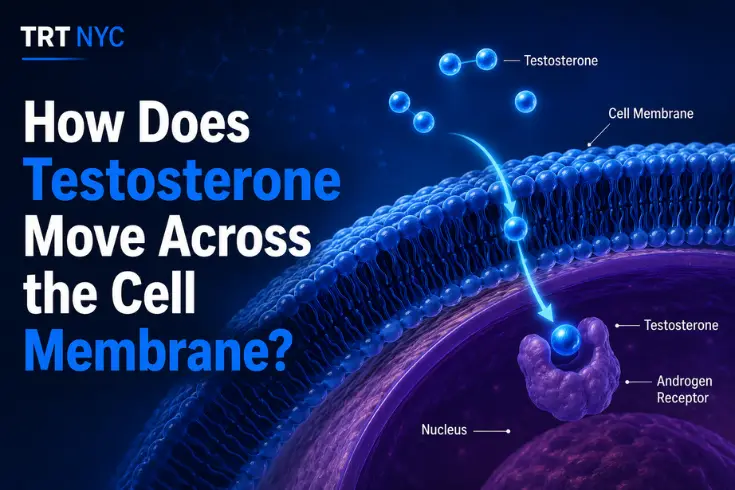
Testosterone crosses the cell membrane mainly by passive (simple) diffusion. As a lipid-soluble steroid hormone, it dissolves straight through the fatty phospholipid bilayer no transporter needed. Only free, unbound testosterone diffuses in; the part bound to SHBG and albumin cannot. Inside, it binds the androgen receptor and moves to the nucleus to switch genes on or off.
If you’ve wondered how testosterone actually gets into your cells to do its job, the answer is elegantly simple physics. Here’s the mechanism, explained clearly. (For the broader picture, see our complete TRT guide.
How Does Testosterone Move Across the Cell Membrane?
Testosterone enters cells primarily by passive diffusion it simply dissolves through the cell membrane down its concentration gradient, without a pump, channel, or energy input.
Key fact: Because testosterone is a lipid-soluble steroid hormone, it diffuses directly through the cell membrane’s lipid bilayer no transporter or energy required. This is fundamentally different from water-soluble hormones (like insulin), which can’t cross the membrane and must signal from the outside via surface receptors.
Why Testosterone Can Diffuse Through the Membrane
It comes down to chemistry. The cell membrane is a phospholipid bilayer a fatty, water-repelling barrier. Testosterone is a steroid hormone derived from cholesterol, making it lipophilic (“fat-loving”). Like dissolves like: because testosterone is fat-soluble, it slips through the fatty membrane easily. Water-soluble molecules get blocked by that same fatty layer.
Only Free Testosterone Crosses the “Free Hormone Hypothesis”
Here’s the part with real clinical relevance. In your blood, most testosterone is bound to carrier proteins mainly SHBG (sex hormone-binding globulin) and albumin. According to the free hormone hypothesis:
- Only the free (unbound) testosterone can diffuse across the cell membrane and act.
- Testosterone bound to SHBG/albumin is essentially held in reserve and can’t directly enter cells.
This is exactly why doctors often measure free testosterone, not just total, the free fraction is the biologically active part. It’s a key reason the right testosterone test matters, and why two men with the same total testosterone vs normal ranges) can feel completely different if their free levels differ.
What Happens After Testosterone Enters the Cell
Once inside, testosterone acts through the genomic pathway:
- It binds the androgen receptor (AR) in the cytoplasm.
- The hormone–receptor complex moves into the nucleus.
- There it acts as a transcription factor, switching target genes on or off driving muscle growth, libido, and the other benefits of testosterone.
Alternatively, testosterone can be converted (bioactivated) into DHT (dihydrotestosterone) a more potent androgen tied to effects like hair loss — or aromatized into estrogen (relevant to estrogen on TRT). It’s the same precursor-and-conversion biology behind questions like does pregnenolone increase testosterone.
Is It Only Passive Diffusion? (The Honest Nuance)
Mostly but not the whole story. The classic, well-accepted model is passive diffusion of free hormone. However, researchers note that passive diffusion alone doesn’t fully explain all the kinetics of how cells take up and clear steroid hormones — some evidence points to additional transport mechanisms (and there are also rapid, “non-genomic” effects via membrane-associated receptors). So the simple answer is passive diffusion, with the honest caveat that the full picture is still being refined.
Why This Matters for You
This isn’t just textbook trivia:
- It explains why free testosterone is the active form — and why testing it (not just total) gives a truer picture if you have low testosterone symptoms.
- It explains why SHBG levels strongly influence how you feel.
- It’s the foundation for understanding how TRT works at the cellular level, useful context when deciding whether TRT is right for you.
The Bottom Line
How does testosterone move across the cell membrane? By passive diffusion, as a lipid-soluble steroid hormone, it dissolves directly through the fatty phospholipid bilayer, no transporter or energy needed. Only free, unbound testosterone (not the SHBG/albumin-bound portion) can diffuse in, which is why free testosterone is the biologically active fraction. Inside, it binds the androgen receptor and regulates genes, or converts to DHT/estrogen. The model is mostly passive diffusion, with some still-debated nuance.
👉 Since only free testosterone acts on your cells, measure what matters: check your testosterone (total and free) with an at-home test kit and review the results with a licensed provider.
Frequently Asked Questions
How does testosterone move across the cell membrane?
Testosterone moves across the cell membrane mainly by passive (simple) diffusion. As a lipid-soluble steroid hormone, it dissolves directly through the fatty phospholipid bilayer without needing a transporter or energy. Only free, unbound testosterone diffuses in to reach the androgen receptor.
Does testosterone need a transporter to enter cells?
In the classic model, no — free testosterone diffuses passively through the membrane because it’s lipid-soluble. That said, research suggests passive diffusion alone may not fully explain steroid-hormone uptake, so some additional transport mechanisms may also contribute.
Why can testosterone pass through the cell membrane?
Because it’s a steroid hormone made from cholesterol, testosterone is lipophilic (fat-soluble), and the cell membrane is a fatty phospholipid bilayer. Like dissolves like, so the fat-soluble hormone passes easily through the fatty membrane, while water-soluble molecules are blocked.
What happens to testosterone after it enters the cell?
Inside the cell, testosterone binds the androgen receptor, and the complex moves to the nucleus to act as a transcription factor, switching target genes on or off. Testosterone can also be converted into DHT, a more potent androgen, or aromatized into estrogen.
Why does only free testosterone enter cells?
According to the free hormone hypothesis, only unbound (free) testosterone can diffuse across the cell membrane and act. Testosterone bound to SHBG or albumin is held in the bloodstream and can’t directly enter cells, which is why free testosterone is the biologically active fraction.
Is testosterone uptake only by passive diffusion?
Passive diffusion of free hormone is the classic, widely accepted model. However, researchers note it doesn’t fully account for all steroid-hormone uptake and clearance kinetics, and testosterone also has rapid non-genomic effects via membrane-associated receptors, so the complete picture is still being refined.
Written by: TRT NYC Editorial Team, Last updated: June 2026. Reviewed against: peer-reviewed endocrinology literature (see References).
Medical disclaimer: This article is for educational purposes only and is not medical advice. trtnyc.com is an independent informational resource, not a medical provider. Always consult a licensed healthcare provider about your testosterone.