



TRT Before and After Results: What Changes Week by Week
 By Trevor Jaxon
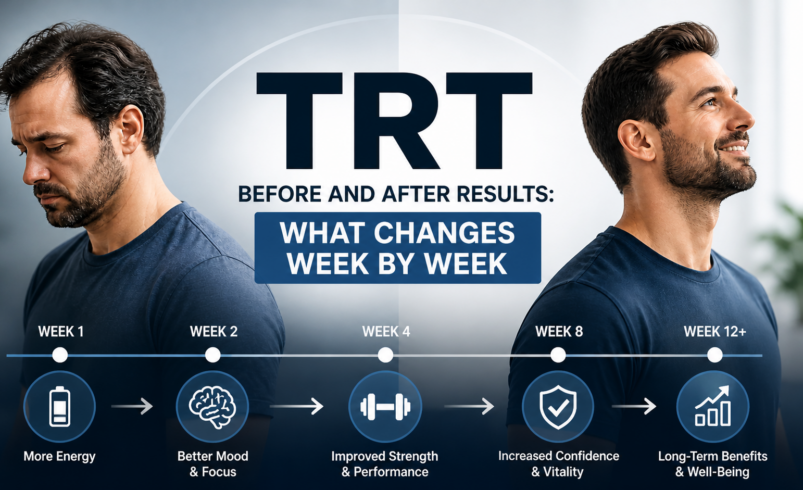
TRT before and after results are nothing like the transformation photos online suggest. Those images show two endpoints. However, they skip everything in between. That gap is precisely where most men either succeed or quit too early.
According to a 2011 review in the European Journal of Endocrinology, testosterone therapy affects each body system on a different schedule. Specifically, energy shifts first. Libido follows weeks later. After that, body composition takes months to change. Bone improvements take even longer.
At TRT NYC, we treat men at every stage of this process. Some arrive with classic signs of low testosterone and no clear answers. Others tried online clinics without proper support. Many simply want to understand how TRT works and what to expect. This guide gives you the honest, week-by-week picture. No hype. Just what the research and our clinical experience show.
Why Most TRT Before and After Content Get It Wrong
Most TRT before and after content has a framing problem. It shows two photos months apart. However, nothing explains the biology in between. That gap creates unrealistic expectations every time.
Here is what typically happens when men misread the timeline:
- They expect fast visible results from week one
- When week three looks the same, doubt sets in
- When week five brings water retention, they quit
- They stop treatment at exactly the wrong moment
There are also a lot of TRT myths that shape how men approach treatment. Many men arrive expecting steroid-like speed. That is not how testosterone therapy works. Its effects follow a fixed biological order. No amount of motivation can speed that up.
TRT before and after results also depend on where you start:
- A man at 150 ng/dL feels early changes fast and clearly
- A man at 310 ng/dL notices more gradual early shifts
- Both can reach strong long-term outcomes with proper care
At TRT NYC, men who understand this timeline before starting consistently report better results and stay on treatment longer.
TRT Before and After Results: The Evidence-Based Week-by-Week Timeline
Before the detailed breakdown, this table gives you a quick reference for what to expect and when.
| Timeframe | What Typically Changes | What Has Not Changed Yet |
|---|---|---|
| Weeks 1-2 | Sleep quality, daytime energy, mood stability | Libido, body composition, strength |
| Weeks 3-6 | Libido, morning erections, mental clarity | Measurable muscle or fat change |
| Weeks 7-12 | Muscle fullness, strength, workout recovery | Full body recomposition |
| Months 3-6 | Visible lean mass gain, fat loss, mood peak | Bone density, metabolic markers |
| Months 6-12+ | Bone density, triglycerides, metabolic health |
Weeks 1-2: The First Signals
The first changes appear within days to two weeks. However, they are rarely the ones men expect.
What changes first:
- Sleep quality improves, often right away
- Afternoon energy becomes more stable
- Mental sharpness returns in small but real ways
- Emotional steadiness improves slightly
Why this happens:
Testosterone receptors in the brain respond before muscles and fat do. Your body’s hormone feedback system starts adjusting to the new input. This is a brain-level shift, not a physical one. Body composition shows zero change yet. Libido has not shifted either. Both are normal and expected.
Weeks 3-6: When the Shift Becomes Undeniable
Between weeks three and six, most men know TRT is working. This is the window where daily life starts to feel different.
What changes during this window:
- Libido returns as a steady, consistent presence
- Morning erections become more regular and reliable
- Mental fog lifts and stays lifted
- Mood becomes more even and predictable
- Gym drive improves, even without significant muscle gain yet
Research published in the European Journal of Endocrinology confirms this timing. Mood improvements become detectable at weeks three to six. They continue building through months four and five. This is especially meaningful for men dealing with low testosterone and depression, where the mood shift is often the most life-changing benefit.
At TRT NYC, men at this stage often say the same thing. They did not realize how flat their baseline had been. The slow decline of testosterone makes its symptoms invisible over time. So the reversal, when it comes, feels significant even when it is gradual.
Weeks 7-12: Body Composition Begins to Respond
Weeks seven to twelve are when TRT before and after results begin showing physically. This is especially true for men who train consistently.
What drives the change:
- Testosterone raises nitrogen retention in muscle tissue
- Growth factor production increases
- Fat-storing processes slow down
What you can expect by week twelve:
- Noticeably stronger in the gym
- Faster recovery between sessions
- Less soreness after hard workouts
- Early visual changes in muscle definition
The T-Trials, published in the New England Journal of Medicine, confirmed measurable lean mass gains at the three-month mark. Moreover, effects continued developing through month six. The transformation is in motion by week twelve. However, full body recomposition still takes more time.
TRT Before and After at 3-6 Months: The Transformation Window
Three to six months is when most visible TRT before and after transformation occurs. This is the window the photos actually capture. The benefits of TRT are in full effect here.
During this period:
- Lean body mass keeps increasing steadily
- Deep belly fat keeps declining, especially around the abdomen
- Mood reaches its peak around months four and five
- Sexual function fully stabilizes by month six
- Emotional control and daily motivation are at their best
The T-Trials data shows average lean mass gains of 1 to 3 kilograms in the first six months. This applies to men combining TRT with regular training. Fat reduction also happens alongside these gains. Men in our practice often say the mood shift affects daily life more than any physical change.
What Are Realistic Six-Month Benchmarks?
| Body Metric | Expected Change at 6 Months | Key Requirement |
|---|---|---|
| Lean muscle mass | +1.5 to 3 kg above training alone | Resistance training 3-4x per week |
| Body fat | -1.5 to 3 kg, focused on abdominal area | Caloric management alongside training |
| Compound lift strength | +10 to 20% above pre-TRT baseline | Consistent progressive overload |
| Waist circumference | -2 to 4 cm for men with high belly fat | Sustained treatment plus exercise |
| Mood and energy | At maximum effect by months 4-5 | Protocol adherence and monitoring |
| Sexual function | Fully stabilized by month 6 | Therapeutic testosterone levels |
TRT Before and After at 6-12 Months: Long-Term Results
By six months, the main benefits most men want are fully in place. However, the body keeps changing beyond that point.
What develops from months six to twelve:
- Bone density increases, especially in the spine and hips
- Fasting insulin levels drop
- Triglycerides decrease
- Markers of metabolic syndrome improve
- Heart and metabolic health shift in a positive direction
The Endocrine Society’s 2018 Clinical Practice Guideline documents clear bone density gains in men on TRT. Improvement continues through two to three years of consistent treatment. This matters most for men over 45, where low testosterone raises long-term fracture risk.
One critical note: hematocrit rises on TRT because testosterone boosts red blood cell production. A level above 54 percent needs a dose adjustment or a short treatment pause. Regular bloodwork throughout treatment is essential.
Recommended Monitoring Schedule on TRT
| Test | First Check | Ongoing Frequency | Why It Matters |
|---|---|---|---|
| Total testosterone | 6-8 weeks | Every 3-6 months | Confirms therapeutic range |
| Free testosterone | 6-8 weeks | Every 3-6 months | Checks active hormone levels |
| Estradiol (E2) | 6-8 weeks | Every 3-6 months | Monitors estrogen conversion |
| Hematocrit and CBC | 6-8 weeks | Every 3-6 months | Tracks red blood cell levels |
| PSA | Baseline | 3-6 months, then annually | Prostate safety check |
| Lipid panel | Baseline | Every 6-12 months | Tracks heart health markers |
| Liver function | Baseline | Annually | General health marker |
What No Other TRT Guide Covers: The Week 3-5 Adjustment Period
Between weeks three and five, some men hit a rough patch. It arrives right after the early gains of weeks one and two. Without knowing it exists, most men quit during this window.
What causes it:
- Rising testosterone triggers the enzyme aromatase
- Aromatase converts some testosterone into estrogen
- Before estrogen stabilizes, some men feel temporary side effects
Common symptoms:
- Mild water retention or light bloating
- Brief mood swings instead of steady improvement
- An energy plateau after the initial lift
- Slight changes in sleep quality
This clears by weeks six to eight for most men. The fix is a bloodwork check at six to eight weeks covering testosterone and estrogen levels. If estrogen is running high, anastrozole is a commonly used option to bring it back in range. This is why physician-supervised testosterone therapy consistently produces better outcomes than self-managed plans.
Not every man hits this window. In our experience, men starting from very low levels on injectable testosterone are most likely to feel it. If you do, call the clinic. Do not stop treatment.
What Shapes Your Personal TRT Before and After Results
TRT before and after results are not the same for every man. Here are the key factors that determine how fast and how much you change.
Starting testosterone level:
- Below 200 ng/dL: dramatic early improvements are likely
- 250 to 350 ng/dL: more gradual early shifts, but comparable long-term results
- Check the testosterone levels by age chart to understand where you fall
Age and body type:
- Younger men with less belly fat respond faster to body composition changes
- Men over 55 still get excellent results, though early physical changes may be more gradual
Exercise and nutrition:
- TRT multiplies the gains from training, it does not replace them
- Men who train three to four times per week see far better body results
- Without exercise, fat loss and muscle gain stay minimal
- Adequate protein intake is just as important as the workouts
Monitoring and dose management:
- A dose that is too low will not produce results
- Regular bloodwork lets your physician fine-tune the plan
- Skipping follow-up labs is one of the most common reasons results stall
Delivery method: The type of TRT you use affects how quickly results come. The table below breaks down the key differences.
TRT Delivery Method Comparison
| Delivery Method | Onset Time | Peak Levels | Best For |
|---|---|---|---|
| Testosterone injections (cypionate/enanthate) | 2-3 weeks | High, cyclical peaks | Men wanting faster early results |
| Topical gels or creams | 4-6 weeks | Moderate, stable daily levels | Men preferring daily topical use |
| Testosterone pellets | 1-2 months | Steady, long-acting release | Men wanting minimal clinic visits |
| Testosterone nasal spray | 1-2 weeks | Lower, frequent dosing | Men sensitive to injection peaks |
Who Should Not Start TRT: Important Considerations
TRT delivers real benefit for men with confirmed low testosterone. However, it is not right for everyone. Before diving into TRT side effects and risks, understanding who should avoid it altogether is important.
TRT is not appropriate for:
- Men with active or suspected prostate cancer
- Men with a history of treated prostate cancer (discuss with a urologist first)
- Men with untreated severe sleep apnea (treat this condition first)
- Men actively trying to conceive (an HCG or clomiphene plan works better)
- Men with a baseline hematocrit above 50 percent
- Men with severe untreated heart failure or a recent heart attack
- Men concerned about hair loss should also read our guide on TRT and hair loss before starting
- Healthy men whose testosterone is already in the normal range
The Endocrine Society’s 2018 guideline lists active prostate cancer as an absolute contraindication. Sleep apnea is a concern because testosterone can make it worse, particularly in men with obesity.
Before starting, every man needs:
- Two separate morning blood draws confirming low testosterone
- A full blood count including hematocrit
- Lipid panel and PSA test
- A full clinical evaluation by a men’s health specialist
- See our guide on how to test testosterone for what to ask for at your lab appointment
A qualified physician should evaluate your specific situation. This content is for educational purposes only and does not constitute medical advice.
FAQ About TRT Before and After Results
What Are the First Signs That TRT Is Working?
The earliest signs are improved sleep and better daytime energy. These typically appear within the first one to two weeks. After that, libido returns and morning erections become more consistent between weeks three and six. These early shifts happen before any visible body composition change occurs.
How Long Does It Take to See Results From TRT?
Most men notice energy and sleep improvements within one to two weeks. Libido shifts emerge at weeks three to six. Visible body changes then start appearing at weeks eight to twelve. The most significant transformation occurs between months three and six. Full stabilization develops over six to twelve months depending on delivery method, training, and individual factors.
How Much Muscle Can You Realistically Gain on TRT?
Research shows average lean mass gains of 1 to 3 kilograms in the first six months when TRT combines with regular training. Results vary based on how often you train, what you eat, and your starting body composition. TRT increases your body’s response to exercise. However, it does not build muscle without consistent training alongside it.
Does TRT Help With Weight Loss?
TRT produces measurable fat reduction in men with low testosterone, particularly in the deep belly region. Men in clinical trials typically see 1.5 to 3 kg of fat reduction in the first six months. Additionally, combining TRT with training and caloric management produces more significant fat loss over twelve months.
Can TRT Improve Mood and Mental Clarity?
Yes. Research confirms that mood effects become detectable at three to six weeks and reach their peak around months four to five. Men consistently report that improved mental clarity and mood stability affect their work and personal life more than any physical change. For men also dealing with erectile dysfunction on TRT, sexual confidence typically improves alongside mood as hormones stabilize.
What Happens if You Stop TRT?
Testosterone levels return to the pre-treatment baseline over weeks to months after stopping. Muscle gains maintained through training are partially preserved. However, energy, libido, and mood benefits typically reverse as testosterone drops. Men with confirmed low testosterone generally need ongoing treatment to sustain their results. For a full overview of what to expect, see what happens when you stop TRT. Always consult your doctor before making any changes to your plan.
Conclusion:
TRT before and after results follow a clear biological order. Energy and mood come first. Libido follows. Body changes emerge at two to three months. The most visible transformation peaks between months three and six. Furthermore, bone and metabolic improvements continue through year one.
The men who get the best results share a few things:
- They understand the timeline before they start
- They train consistently throughout treatment
- They get regular bloodwork with a qualified physician
- They stay the course through the adjustment weeks
TRT is not a shortcut. It is medical correction for a documented hormone deficiency. When managed well, the results are real and build at every phase of treatment.
If you are experiencing symptoms of low testosterone and want to know whether TRT is right for you, the team at TRT NYC offers comprehensive hormone evaluations, complete lab work, and personalized treatment plans. Speak with one of our specialists to learn more.
Medical Disclaimer: The information on this page is for educational purposes only and does not constitute medical advice, diagnosis, or treatment recommendations. Always consult a qualified and licensed healthcare provider before beginning any hormone therapy or changing your current treatment plan. TRT NYC is a medical practice licensed in New York State. Individual outcomes vary based on individual health factors.